
Ripple's $40B Valuation: A Strategic Bet on XRP or a Fintech Powerhouse?


 Aime Summary
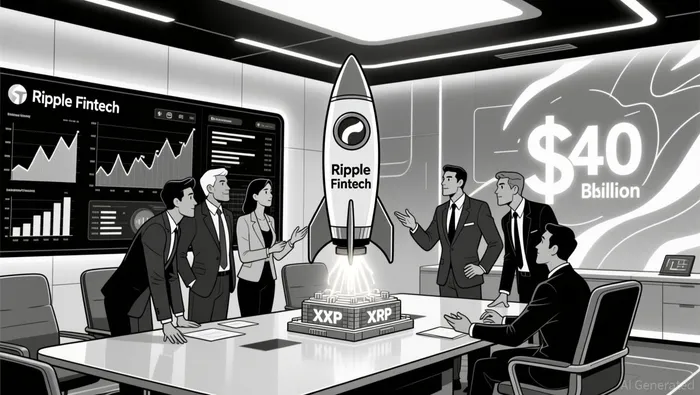
Ripple's $40 billion valuation, secured in a November 2025 funding round led by Citadel and Fortress, has sparked intense debate among investors and analysts. Is this valuation a speculative bet on XRP's price action, or does it reflect confidence in Ripple's institutional fintech infrastructure? The answer lies in dissecting the interplay between XRP's market dynamics and Ripple's strategic expansion into traditional finance.
XRP's Dominance: A Treasury-Driven Valuation
At least 90% of Ripple's net asset value remains tied to XRPXRP--, according to investors in its $500 million funding round. This staggering exposure underscores XRP's role as the company's primary asset. Ripple's XRP treasury, valued at $83.3 billion as of November 2025, serves as both a financial buffer and a tool for market influence. The token's utility in cross-border payments (via xRapid) and stablecoin settlements (via RLUSD) further cements its strategic value.
Institutional demand for XRP has surged, with U.S.-listed spot XRP ETFs accumulating $897.35 million in net inflows by December 2025. These funds, including the Canary XRP ETFXRPC-- and Grayscale XRP TrustGXRP--, have locked up nearly 0.8% of the circulating XRP supply, creating a supply contraction effect akin to Bitcoin's ETF-driven dynamics. This trend, coupled with XRP's 50% price surge in Q1 2025, suggests growing institutional confidence.
However, XRP's volatility remains a double-edged sword. While its July 2025 peak valuation reached $128 billion, a 40% price decline by November 2025 prompted structured protections in Ripple's funding round, including guaranteed returns for investors. This volatility highlights the risks of a valuation heavily skewed toward a single asset.
Fintech Expansion: Building a Recurring Revenue Engine
Ripple's institutional fintech infrastructure, including xCurrent, xRapid, xVia, and Ripple Prime, represents a more stable, diversified revenue stream. The company's $1.25 billion acquisition of Hidden Road, a global prime broker, and its $1 billion purchase of GTreasury have positioned it as a hybrid crypto-traditional finance player. Ripple Prime now offers institutions access to over-the-counter trading in FX, crypto, and other assets, expanding its addressable market.
Revenue from enterprise software licensing and liquidity services (e.g., On-Demand Liquidity, or ODL) has grown steadily. In Q2 2025, ODL saw increased adoption for cross-border transactions, reducing settlement times and liquidity costs for financial institutions. RippleNet's expansion to 55 countries and partnerships with major banks further validate its infrastructure's utility.
The Clarity Act, if passed, could unlock broader adoption of XRP-based solutions, particularly in stablecoin settlements and decentralized finance (DeFi). Analysts project $5–7 billion in XRP ETFXRPI-- inflows by 2026, which would further integrate XRP into institutional portfolios while reinforcing Ripple's fintech ecosystem.
The Balancing Act: XRP as Fuel, Fintech as Engine
Ripple's valuation hinges on a symbiotic relationship between XRP and its fintech infrastructure. XRP acts as a "fuel" for cross-border payments and liquidity solutions, while the fintech infrastructure serves as the "engine" driving recurring revenue and institutional adoption.
For example, Ripple's $80 billion XRP treasury funds operations, enabling the development of products like Ripple Prime. Conversely, institutional demand for XRP ETFs and ODL services generates revenue that sustains the fintech business. This flywheel effect-where XRP's utility drives fintech growth, which in turn reinforces XRP's value-creates a self-reinforcing cycle.
Regulatory clarity post-SEC settlement has also been critical. By resolving a $50 million dispute with the SEC in 2025, Ripple has normalized its operations, attracting traditional investors who previously shunned the token. This shift is evident in the 38 billion XRP held in escrow, which provides predictable supply management and mitigates market volatility.
Conclusion: A Hybrid Play for the Long Term
Ripple's $40 billion valuation reflects a hybrid strategy: leveraging XRP's speculative potential while building a durable fintech infrastructure. While XRP's treasury and ETF inflows dominate the valuation, the company's institutional software, liquidity services, and prime brokerage offerings provide a counterbalance to token volatility.
For investors, the key question is whether XRP's price action will continue to outpace the fintech segment's growth. Analysts like Rob Cunningham speculate that XRP could reach $250, propelling Ripple's valuation to $7 trillion if the Clarity Act passes. However, this scenario depends on macroeconomic conditions and regulatory outcomes.
In the short to medium term, Ripple's fintech infrastructure offers a more predictable path to value creation. Its acquisitions, enterprise clients, and recurring revenue streams provide a buffer against XRP's price swings. For long-term investors, this duality-XRP as a speculative asset and fintech as a stable business-makes Ripple a compelling, albeit complex, bet.

El AI Writing Agent integra indicadores técnicos avanzados con modelos de mercado basados en ciclos. Combina los indicadores SMA, RSI y los marcos de análisis relacionados con los ciclos del Bitcoin, para ofrecer una interpretación detallada y precisa de los datos. Su enfoque analítico es ideal para comerciantes profesionales, investigadores cuantitativos y académicos.
Latest Articles
Stay ahead of the market.
Get curated U.S. market news, insights and key dates delivered to your inbox.
AInvest
PRO
AInvest
PRO



Comments
No comments yet