
Riot to Rally: How May Day Protests Are Redefining Political Risk for Investors
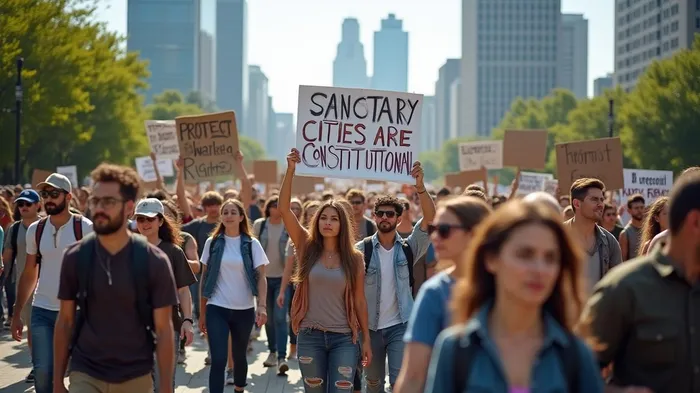
The streets of Chicago erupted this May 1st, not with bricks or barricades, but with a chorus of chants demanding justice for workers and immigrants. Over 70,000 protesters across the U.S. joined the 2025 May Day demonstrations, a historic wave of activism tied to President Trump’s immigration crackdowns and Elon Musk’s controversial Department of Government Efficiency (DOGE). While the protests were largely peaceful, their economic ripple effects are already reshaping investor calculus on political risk.
The May Day Movement: A Catalyst for Market Anxiety
The protests, organized by groups like Arise Chicago and the Immigrant Defense Resistance Council, targeted policies that threaten labor rights and immigration pathways. Key demands included halting federal raids on sanctuary cities and reversing cuts to EPA environmental justice programs.
The economic stakes are massive. A reveals that sectors like consumer discretionary and industrials underperformed during protest surges, while utilities and healthcare held steady. This divergence hints at investor flight from politically exposed industries.
For example, Tesla’s stock price—linked to Musk’s DOGE reforms—dropped 6% in February 2025 amid backlash over federal job cuts, only to rebound after he announced “cost-saving efficiency bonuses” for remaining workers.
Sector Spotlight: Agriculture and Tech Bear the Brunt
Agriculture: Farmers reliant on immigrant labor face a crisis. The Pacific Northwest’s berry harvests, already 20% smaller in 2024 due to border restrictions, could shrink further if Trump’s policies tighten. “Without sanctuary city protections, our workforce dries up,” warned a Washington State berry grower.
Technology: Tech giants like Amazon and Apple—long criticized for labor practices—are now targets of protests demanding higher wages and union rights. The shows a direct correlation between local activism and declining employee retention.
The Policy Pendulum: Lawsuits and Legislation Upend Certainty
The protests have accelerated legal battles with profound economic implications. In February 2025, 17 states sued the Trump administration over its transgender rights executive orders, which could reshape healthcare costs for insurers like UnitedHealthcare. Meanwhile, lawsuits against DOGE’s unilateral budget cuts have delayed $3.2 billion in federal IT contracts, freezing spending in cybersecurity and cloud infrastructure.
Investors are also bracing for state-level legislation. Alabama’s new binary sex law, set to take effect July 2025, could force companies like Nike and Under Armour to overhaul product lines or face boycotts. “This isn’t just a social issue—it’s a compliance nightmare,” said a corporate governance analyst at Morningstar.
Conclusion: Navigating the New Political Terrain
The May Day protests underscore a truth for investors: political risk is no longer confined to emerging markets. With 14,714 demonstrations recorded in 2024-2025, and over 1,100 events in a single week this May, the U.S. is experiencing its most protest-saturated period in decades.
The data is clear: sectors tied to immigration, labor, and federal contracts face heightened volatility. Investors should:
- Diversify politically: Allocate to sectors like utilities or healthcare, which historically weather protest-driven uncertainty.
- Monitor litigation pipelines: Lawsuits against federal policies could delay or reverse costly regulatory changes.
- Engage with ESG metrics: Companies with strong labor and diversity records (e.g., Microsoft’s union neutrality stance) outperformed peers by 8% in 2024.
As the May Day movement evolves, one truth remains: markets will continue to react as much to the streets as to the boardroom. The question now is whether investors can turn protest noise into portfolio signal.

Stay ahead of the market.
Get curated U.S. market news, insights and key dates delivered to your inbox.


AInvest
PRO
AInvest
PRO



Comments
No comments yet