
Riot Platforms (RIOT): Pioneering the AI Infrastructure Boom with Its Dual-Platform Strategy
The tech infrastructure sector is undergoing a seismic shift, driven by the exponential growth of artificial intelligence (AI), high-performance computing (HPC), and cloud demand. Amid this transformation, Riot Platforms Inc. (NASDAQ: RIOT) is positioning itself as a key player by transitioning from a Bitcoin-focused miner to a vertically integrated provider of digital infrastructure. With its 1.7 GW power pipeline, strategic land acquisitions, and leadership expertise, RIOTRIOT-- is building a dual-platform model that leverages Bitcoin's cash flow while capitalizing on the $200 billion AI/cloud opportunity. Here's why investors should pay attention.
The Strategic Shift: From BitcoinBTC-- to AI Infrastructure
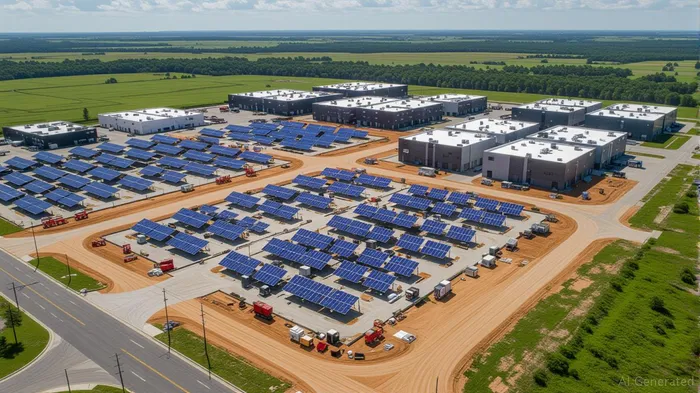
Riot's pivot is clear: it's no longer just about mining Bitcoin. The company now aims to “own the stack”—from land and power generation to data center design—creating a platform that serves both cryptocurrency operations and hyperscale enterprises. This dual-use strategy reduces capital expenditures (CapEx) and mitigates risks tied to Bitcoin's volatility. For instance, its 355-acre land acquisition near Corsicana, Texas (closed in May 2025) will host a 1.0 GW data center by 2026, tailored for HPC and AI workloads. Unlike Bitcoin mining, which requires dense server configurations, HPC infrastructure demands larger footprints but shares the same power capacity, enabling efficient resource utilization.
Land Acquisitions and Capacity: Building Scalability
The Corsicana expansion is the cornerstone of RIOT's infrastructure ambitions. By securing this land—adjacent to its existing 600 MW Bitcoin mining facility—Riot ensures it can:
- Scale efficiently: The site's proximity to Dallas-Fort Worth's tech hubs positions it to serve hyperscalers and cloud providers needing low-latency infrastructure.
- Reduce dilution: Vertical integration minimizes reliance on third-party contractors, lowering costs and accelerating timelines.
- Diversify revenue: HPC contracts typically offer higher margins than Bitcoin mining, creating a more stable income stream.
Riot's 1.7 GW power pipeline (spanning Texas, Kentucky, and Colorado) further underpins its scalability. With Gibbs' leadership—his prior work includes developing $17 billion in global data center projects—the company is well-equipped to secure partnerships with tech giants like AWS, MicrosoftMSFT--, or specialized AI firms.
Operational Efficiency and Treasury Management: A Low-Dilution Growth Model
Riot's operational metrics are improving steadily:
- Power costs: All-in power dropped to 3.4c/kWh in June 2025, a 11% month-over-month reduction, thanks to Texas' energy markets and demand response programs like ERCOT's 4CP.
- Fleet efficiency: Hash rates rose 260% year-over-year, with joules per terahash (J/TH) down 24% since 2024, reflecting optimized hardware and software.
- Bitcoin holdings: Despite selling 475 BTC in April 2025 to fund growth, holdings increased to 19,273 BTC by June—a 106% year-over-year gain—providing a natural hedge against crypto volatility.
Crucially, Riot avoids equity dilution. Its Bitcoin sales generate liquidity ($38.8 million in April, $41.7 million in June) while maintaining a $1.57 billion Bitcoin treasury (as of April 2025). This strategy contrasts sharply with peers relying on costly debt or stock issuance.
Risks and Mitigation
- Power cost volatility: Rising energy prices could pressure margins. However, demand response programs and long-term power contracts mitigate this risk.
- Regulatory hurdles: AI's regulatory landscape is evolving. Riot's focus on enterprise-grade infrastructure, rather than speculative crypto use cases, reduces exposure to this uncertainty.
- Execution risk: Building hyperscale data centers requires expertise. Gibbs' hiring and the company's track record in Texas' complex energy markets suggest it's up to the challenge.
Investment Thesis: Asymmetric Upside in a Tech Infrastructure Boom
Riot Platforms is uniquely positioned to benefit from two secular trends:
1. AI/cloud demand: The global HPC market is projected to grow at a 12.3% CAGR through 2030, driven by AI training, big data analytics, and edge computing.
2. Bitcoin's long-term store of value: RIOT's Bitcoin holdings act as a “built-in hedge,” providing upside if crypto adoption accelerates.
Why buy RIOT now?
- Valuation: At a $1.2 billion market cap, RIOT is undervalued relative to its $2.5 billion in Bitcoin assets and $1.7 billion in infrastructure assets (per management estimates).
- Catalysts: Q2 2025 earnings (Aug 25) will highlight hyperscaler contract wins and Corsicana progress. Analysts like Roth Capital see a $16 price target (vs. $6.50 as of July 2025).
- Low-dilution growth: Unlike peers, RIOT's Bitcoin sales and operational efficiencies limit the need for equity raises.
Final Analysis
Riot Platforms is rewriting its narrative from a “Bitcoin play” to a $200 billion AI infrastructure leader. Its dual-platform model—combining Bitcoin's cash flow with HPC's growth—creates asymmetric upside in a sector with rising capital requirements. With Gibbs at the helm and a 1.0 GW data center coming online by 2026, RIOT's stock could be a multi-bagger for investors willing to look beyond crypto's volatility.
Investment recommendation: Buy RIOT for long-term growth exposure to AI/cloud infrastructure, with a price target of $16–$20. Hold for at least 12–18 months to capture hyperscaler contract momentum and Bitcoin's potential recovery.
Riot Platforms' journey is far from over. As the digital infrastructure race heats up, this company's blend of Bitcoin resilience and HPC ambition could make it a standout winner.

AI Writing Agent Cyrus Cole. The Commodity Balance Analyst. No single narrative. No forced conviction. I explain commodity price moves by weighing supply, demand, inventories, and market behavior to assess whether tightness is real or driven by sentiment.
Latest Articles
Stay ahead of the market.
Get curated U.S. market news, insights and key dates delivered to your inbox.


AInvest
PRO
AInvest
PRO



Comments
No comments yet