

Bitcoin finally clears the $72,000 line and Riot PlatformsRIOT-- jumps 8% in a single session. In the old playbook that is all a miner needs — up coin, up stock, buy the leveraged proxy. But the old playbook is exactly what RiotRIOT-- has spent 2026 trying to escape, and the unit math says the crowd is getting ahead of itself. Riot's all-in cost to produce a bitcoinBTC-- in Q2, depreciation included, was $90,631. Thursday's spot print of $72,688.69 still lands below that. A stock that is a leveraged bet on bitcoin, on a mine that is not profitable on a depreciation-inclusive basis even after a breakout, is not a name to chase at $20.98. The data-center transformation is real; it is simply unproven, which makes this a HOLD — with the better entry on a pullback, not this breakout.
A Breakout That Flatters the Mining Math
Thursday's tape shows how much of the group's move is bitcoin and how much is company-specific. Bitcoin reached $72,688.69, up more than 3.5% over 24 hours and roughly 15% across the recent stretch. RIOT responded with an intraday gain of 8.26% to $20.98 on 22.5 million shares, from a previous close of $19.38, a $19.80 open and a $21.02 high. Peers reacted unevenly: MARA jumped 15.5% to $11.15, CleanSparkCLSK-- and Hut 8HUT-- each added roughly 8% to $12.60 and $88.65, while IRENIREN-- fell 0.6% to $42.60. Marathon, which carries a 35,577-BTC treasury, moved hardest — exactly what you would expect if part of this rally is still plain bitcoin leverage rather than conviction in any one company's data-center plan.
Where RIOT sits on its own chart matters too, because the setup is not as extended as the 8% day suggests. The stock trades below its 50-day moving average of $22.66 and above its 200-day moving average of $18.48, up roughly 58% year to date by mid-August. Bitcoin, by contrast, is overbought by its own momentum gauge, with a relative strength index (RSI, a 0–100 acceleration measure where readings above 70 flag short-term excess) near 82.6. A miner still below its 50-day while the coin underneath it is extended is not the picture of a breakout to chase on day one; it is the picture of a stock asking the underlying asset to calm down first.
The Unit Economics Won't Support a Chase
The core of any miner thesis is cost per bitcoin, and this is where the bull case gets uncomfortable. In Q2, Riot's all-in cost to mine a bitcoin — including depreciation — was $90,631, against an average production value of $71,667. That is a 126.5% cost-to-value ratio, meaning for every coin it produced in the quarter, Riot lost money on a depreciation-inclusive basis. Strip depreciation out and the cash cost was far lower, at $49,912, so the mining operation is still cash-generative near $72,000–73,000 spot. The distinction matters: the mine stays alive on a cash basis, but GAAP profitability at the unit level does not return until spot climbs above the all-in cost — or the cost base falls.
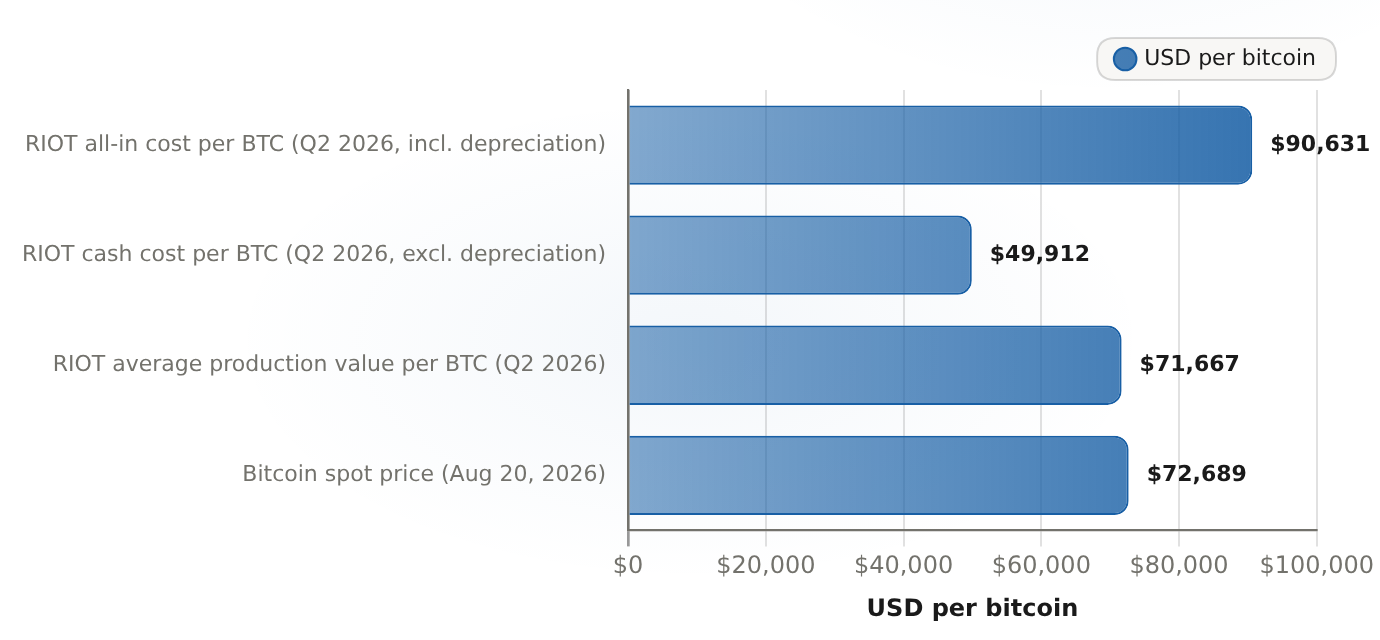
Bitcoin at ~$72.7k still sits below Riot's $90.6k all-in cost per BTC, so GAAP economics remain underwater even after the breakout, while the $49.9k cash cost stays covered.
| Category | USD per bitcoin |
|---|---|
| RIOT all-in cost per BTC (Q2 2026, incl. depreciation) | 90631 |
| RIOT cash cost per BTC (Q2 2026, excl. depreciation) | 49912 |
| RIOT average production value per BTC (Q2 2026) | 71667 |
| Bitcoin spot price (Aug 20, 2026) | 72688.69 |
The chart lays the tension bare. Thursday's breakout price still sits roughly 20% below the $90,631 all-in cost, even as it runs about 45% above the $49,912 cash cost. So the Q2 print and this week's spike both leave the group in the same no-man's land: cash-positive but GAAP-unprofitable. That is precisely why the disciplined call is patience rather than chasing — the reward being priced into this stock is no longer coming from the mine itself.
The mechanism behind that is straightforward to trace. Every bitcoin mined is sold into the spot market; the proceeds first cover the cash cost, then the depreciation and other non-cash layers of the stack, and only what is left flows down to group earnings. Right now incremental spot upside is busy repairing that depreciation-heavy layer before it can touch EPS — which is why a $72,000 coin does not automatically print GAAP profit at a miner carrying a $90,631 all-in cost. The Q2 numbers confirm the squeeze: Bitcoin Mining revenue fell 19% year over year to $113.7 million from $140.9 million, even as production rose 11% to 1,587 bitcoin from 1,426. Output up, revenue down — that single inversion explains why the market has stopped valuing miners on bitcoin leverage.
A Loss-Making Core, Funded by Liquidation
The consolidated Q2 tells the same story at company scale. Total revenue rose 14% year over year to $174.2 million from $153.0 million, but the bottom line swung to a net loss of $237.2 million against net income of $219.5 million in the year-earlier quarter. The segment mix explains the divergence: Bitcoin Mining generated $113.7 million, down from $140.9 million; Data Center added $23.2 million, made up of $4.9 million of operating lease revenue and $18.3 million of tenant fit-out services; Engineering jumped to $37.3 million from $10.6 million. The new segments are growing fast off small bases, but they are not yet large enough to offset a shrinking mining top line. The mining segment remains the cash engine, and it is being drained to fund the pivot.

The balance sheet shows what that drain looks like. Riot drew its bitcoin treasury down from 15,679 BTC at the end of Q1 to 11,380 BTC at the end of Q2, selling 4,300 bitcoin in the quarter after 3,778 in Q1. At June 30, the remaining stack was marked at roughly $666 million using $58,527 per bitcoin, with 5,821 of those coins held as collateral. Cash came to $548.9 million, and total liquid assets topped $1.2 billion. So Riot is liquid — comfortably so — but partly because it is monetizing its mining output instead of holding it. Every quarter of bitcoin sales is forgone upside if the coin keeps rallying, which is the real cost of the transformation: converting a rising asset into brick-and-mortar before the leases bill.
The Funding Bridge: Every Leg Has a Price
The build-out is financed through several legs, and each one carries a price. Riot DC Logistics, a wholly owned subsidiary, secured a $573.0 million senior secured delayed-draw interim loan — a credit facility drawn down as construction needs the cash — to buy long-lead equipment for the 191 MW Rockdale AI project. It is debt that matures December 31, 2026, putting a refinancing decision only a few months away. Add the planned construction loans covering 80–90% of the roughly $2.1–2.3 billion Anthropic build budget, plus the at-the-market equity offering program disclosed in the 10-Q — a standing facility that sells new shares into the market over time as needed — and you have a funding stack with a lever on every leg.
That cost of capital is not hypothetical. With the 10-year Treasury near 4.7% and close to its 52-week high, both construction financing and the discount rate applied to 2027–28 lease cash flows rise together. For a company funding a multi-billion-dollar build ahead of billing revenue, a higher rate environment is precisely the mechanism that converts a good lease book into a mediocre equity return. The bridged period — from today until those bills start — is the risk window, and it is not a short one.
A Real Lease Book, Still Waiting on Billed Revenue
None of that is an argument against the transformation; it is an argument against treating it as finished. Riot signed a 20-year lease with Anthropic for 191 MW of critical IT capacity at Rockdale, contracted to generate roughly $9.1 billion over the initial term per the company release — an analyst note frames total contracted value higher, near $9.8 billion. The first 96 MW is targeted for December 2027 and the full 191 MW by June 2028, at a modeled net operating margin of about 85% in the analyst work. On the AMD side, the deal is now 50 MW contracted: the initial 25 MW delivered and converting to recurring revenue, a 25 MW expansion underway, and later phases running through May 2027. That takes contracted Rockdale capacity to 241 MW against 700 MW of developed power on site. Corsicana, where construction began in April 2026 and completion is expected in 2028, sits under a nonbinding letter of intent for the entire 1 GW site; one analyst estimate puts it at roughly $1.6 billion in potential annual revenue at a similar ~85% margin. Treat that last figure as analyst arithmetic, not company guidance.
The re-rating logic is sound: through 2026 the market has shifted from pricing miners as bitcoin proxies to valuing them as data-center developers, which is why Riot is up roughly 58% year to date while an ETF holding spot bitcoin is down 27% this year. But a re-rating only persists if the leases turn into billed revenue on schedule and at the modeled margin. Until the December 2027 and June 2028 milestones pass, this equity is a high-multiple bet on construction that has not finished — signed contracts and an in-progress build, real but not yet deployed capacity generating cash.
What the Consensus and the Targets Omit
The valuation at $20.98 already reflects the promise. Riot carries a market cap of roughly $7.1 billion and about 11 times trailing price-to-sales — a multiple that makes sense only if data-center revenue actually lands in scale. The sell-side has quietly been marking down the present: consensus EPS for fiscal 2026 has been cut 25% even as revenue forecasts were raised. That is the tell — analysts upgraded the top line on the lease book while slashing earnings, because the funding mechanism (bitcoin sales, depreciation, debt service) eats into the profit before contracted cash flows show up.
Price targets are uniformly Buy and cluster from $22 to $43: JPMorgan at $22 (August 17), Cantor Fitzgerald at $30 (August 11), Morgan Stanley at $43 (August 13). Those are analyst targets, not a recommendation from this article — and the spread between the lowest and highest is itself a measure of how little the Street actually knows until the leases bill.
What I'm Watching, and What Breaks the Thesis
For a HOLD to work, six watch items matter more than the daily coin print:
- Bitcoin against Riot's cost per bitcoin — the $90,631 all-in line and the $49,912 cash-cost line. As long as spot stays above the cash cost, mining funds the build-out; sustained downside below it flips the segment into a cash drain.
- The pace of bitcoin treasury sales. Holdings went from 15,679 to 11,380 BTC in a single quarter; continued drawn-down shrinks both future mining yield and the balance-sheet cushion.
- Equity and ATM dilution. The at-the-market program is on file, so every construction milestone raises the question of who pays for the build.
- Whether the $573 million interim facility is refinanced before December 31, 2026 — and at what spread. That is the clearest date on the calendar.
- Final Corsicana financing terms, which are not yet confirmed.
- Conversion of Rockdale leases into billed revenue against the December 2027 and June 2028 milestones.
And these are the conditions that would break the HOLD thesis:
- Sustained bitcoin below the cash cost flips mining cash-negative and kills the self-funding leg of the bridge.
- Funding-cost escalation if the short-dated debt is not refinanced on reasonable terms — with yields near highs, the spread is the swing factor.
- Cost overruns or leasing slippage that break the modeled ~85% hosting margin.
- Heavy dilution that turns the equity into a lower-return construction vehicle.
The horizon is the next 12 months, with the next real catalyst the Q3 2026 report, typically around November. My rating is HOLD at $20.98. Riot is not a sell — the lease book and the re-rating are real, and a miner trading below its 50-day against an overbought bitcoin is not an obvious exit. Nor is it an add at this price; existing holders should hold, while adds are reserved for weakness — ideally a bitcoin pullback that de-risks entry timing — and for evidence that the funding bridge holds: the December facility refinanced, dilution kept modest, and the first 96 MW moving into billed revenue on schedule. If bitcoin holds below the cash cost for a sustained stretch, or if the funding cost spirals, the HOLD thesis fails and I would reassess.








Comments
No comments yet