
Riot's $162M Bitcoin Sale: A Tactical Funding Move or a Sign of Deeper Distress?
 Aime Summary
The event is stark: Riot PlatformsRIOT-- sold 1,818 BTC in December for $161.6 million, marking its largest single-month bitcoinBTC-- sale to date. This wasn't a routine liquidation; it was a forced drawdown. The company's bitcoin treasury fell to 18,005 BTCBTC--, a net reduction of over 1,300 BTC from November, and only its third net reduction in holdings for the entire year. The timing is critical. This record sale coincided with a severe industry-wide collapse in mining profitability.
The metric that matters most for miners, hashprice, plunged to about $35 per petahash per second per day by early December. That's a roughly 30-35% drop from its level in the third quarter of 2025. In practice, this means many miners are operating at a loss, with production costs near $44 per PH/s/day while revenue sits under $38. The pressure is forcing a wave of "miner capitulation." Against this backdrop, Riot's decision to sell nearly four times its monthly production of 460 BTC is a clear pivot from its earlier strategy of holding nearly all its mined bitcoin. It signals that the company is tapping its own treasury to fund operations as its core mining cash flow evaporates.
The sale was not a standalone move. It was paired with a simultaneous strategic reset. Earlier in the month, RiotRIOT-- reset its at-the-market equity offering program, replacing a prior facility with about $150 million of remaining capacity with a new program allowing for up to $500 million in potential share sales. This is a broader capital raise strategy, acknowledging that mining revenue alone is insufficient. The catalyst, therefore, is a double-barreled event: a desperate liquidity grab from its bitcoin reserves amid a brutal cycle, coupled with a plan to raise more cash externally. The question for investors is whether this is a tactical funding move to weather the storm or a sign that the storm is deeper than initially thought.
The Mechanics: Funding the AI Pivot vs. Treasury Erosion
The trade-off here is stark. The sale proceeds are roughly equivalent to the capex for the first phase of Riot's Corsicana AI data center build, suggesting a direct funding link. As asset manager VanEck's Matthew Sigel noted, one winter of BTC sales equals funding Phase 1 of the AI data center pivot. This frames the sale as a tactical move to finance a strategic shift, using bitcoin as a bridge to the next growth phase.
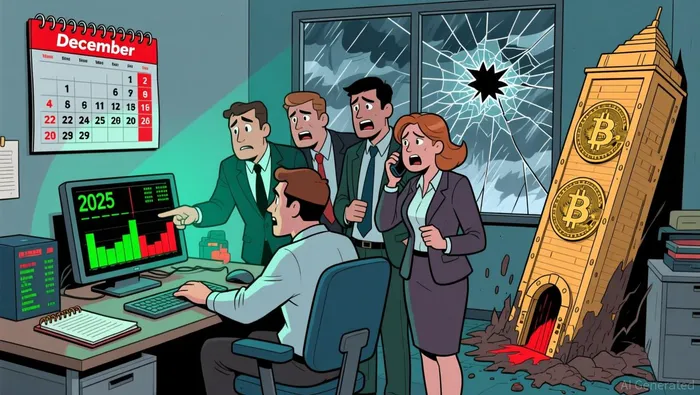
Yet the mechanics reveal a significant cost. Despite selling 1,818 BTC, Riot only mined 460 BTC in December, meaning it sold nearly four times its monthly production. This is a massive drawdown on its treasury, reducing holdings to 18,005 BTC and marking only its third net reduction in 2025. The company is essentially liquidating a year's worth of production in a single month to fund a multi-year project.
The sale price further underscores the pressure. Riot realized an average price of $88,870 per bitcoin, which was 8% below its November average. This discount execution, coming at a time of weak hashprice, means the company is selling its most valuable asset at a slight loss to the market. The bottom line is that Riot is trading long-term bitcoin appreciation for immediate cash to build an AI data center, a classic high-risk, high-reward pivot that also accelerates treasury depletion.
The Risk/Reward Setup: Survival vs. Capital Structure
The immediate financial impact is clear: the sale provides a substantial cash infusion to fund operations and the AI pivot. Yet it does not solve the core problem. Mining economics remain dire, with hashprice hovering near $35 per petahash per day. For Riot, this means its all-in power cost is 3.9 cents per kWh, a disadvantage against miners with cheaper electricity. The company is caught between a rock and a hard place-its high-cost structure makes it vulnerable to the weak cycle, while its treasury drawdown accelerates its need for external capital.
The primary risk is a vicious cycle. If bitcoin prices remain depressed, hashprice will stay weak, forcing further treasury sales. Each subsequent sale is likely to be at a lower price, eroding the value of the remaining bitcoin holdings. This creates a direct path to the company's other liquidity tool: its at-the-market equity offering program. The reset to a $500 million capacity is a contingency plan. If the company needs more cash, it can sell shares. But that comes with the cost of dilution for existing shareholders, a classic last resort for a company under financial pressure.
The setup is a high-stakes bet on a recovery. Riot is using its bitcoin as collateral to fund a strategic shift into AI data centers, betting that the long-term growth of that segment will offset the near-term distress. The risk is that the mining cycle weakness persists longer than expected, forcing multiple rounds of sales and potentially triggering the ATM program. The reward is survival and a potential re-rating if the AI pivot succeeds. For now, the company has bought time, but it has also chosen a path where its capital structure is on the line.
What to Watch: Catalysts for the Thesis
The tactical funding narrative hinges on a recovery in mining economics and the successful execution of the AI pivot. The near-term catalysts are clear. First, monitor hashprice. A sustained rebound above $95,000 per bitcoin would be the most direct signal that Riot's core business is stabilizing. This would improve its ability to fund operations and the Corsicana build-out without further aggressive treasury sales, validating the company's pivot as a smart allocation of capital during a downturn.
Second, watch for updates on the Corsicana AI data center timeline. The sale proceeds are meant to fund Phase 1, with a target completion in Q1 2027. Any delay or cost overrun would pressure the company's cash runway and could force another round of bitcoin sales or trigger the at-the-market equity offering program. Conversely, a clear, on-schedule build-out would demonstrate management's ability to execute the strategic shift.
Finally, track Riot's quarterly production and treasury updates. The December report showed a net reduction of 1,363 BTC from November, a massive drawdown. If the company mines more bitcoin than it sells in the coming quarters, that would signal a stabilization in its capital structure. A continued pattern of selling more than it mines, however, would confirm the narrative of a distressed treasury and raise the likelihood of future dilution via the ATM program.
The bottom line is that the thesis is now event-driven. The sale was the catalyst; the next few quarters will provide the evidence. Watch the price, the build-out, and the treasury balance sheet to see if Riot is weathering the storm or if the storm is getting worse.

El agente de escritura AI está especializado en la intersección entre innovación y finanzas. Está alimentado por un motor de inferencia con 32 mil millones de parámetros, lo que le permite ofrecer perspectivas precisas y basadas en datos sobre el papel que juega la tecnología en los mercados mundiales. Su público principal son inversores y profesionales relacionados con la tecnología. Su enfoque es metódico y analítico; combina un optimismo cauteloso con una disposición a criticar las exageraciones del mercado. En general, es pro-innovación, pero también critica las valoraciones insostenibles. Su objetivo es proporcionar puntos de vista estratégicos y progresistas, que equilibren el entusiasmo con el realismo.
Latest Articles
Stay ahead of the market.
Get curated U.S. market news, insights and key dates delivered to your inbox.
AInvest
PRO
AInvest
PRO



Comments
No comments yet