
Rio Tinto's Pilbara Expansion: A Strategic Bet on Iron Ore Resilience and Global Infrastructure Demand
The global commodities market has long been a pendulum of volatility, with iron ore prices swinging between boom and bust cycles. Yet, Rio Tinto's recent $1.6 billion investment in its Pilbara iron ore expansion—specifically the Hope Downs 2 and Bedded HilltopHTH-- projects—suggests a calculated move to lock in long-term dominance amid shifting demand dynamics. With a combined annual production capacity of 31 million tonnes, these projects are not merely about scaling output; they are a strategic hedge against cyclical risks, underpinned by a $13 billion capital plan that promises to solidify Rio Tinto's position as a pillar of global infrastructure development.
The Pillars of Capacity Growth
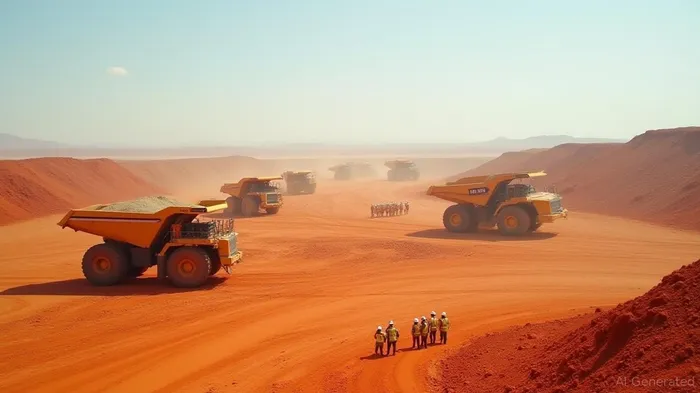
The Hope Downs 2 project, a joint venture with HancockHEQ-- Prospecting, marks a critical step in Rio Tinto's ambition to sustain its mid-term system capacity of 345–360 million tonnes per annum (Mtpa). By targeting the Hope Downs 2 and Bedded Hilltop deposits—both with secured state and federal approvals—the company is leveraging its existing infrastructure to minimize costs and accelerate timelines. First ore is expected by 2027, aligning with a phased rollout of other key projects like the Brockman Syncline 1 (BS1), which will add up to 34 million tonnes per annum and create over 1,000 construction jobs.
This expansion is not an isolated bet. Rio Tinto's $13 billion capital plan for 2025–2027 is laser-focused on replacing aging assets and capitalizing on high-value deposits. The Rhodes Ridge project, still in pre-feasibility, aims for 40 Mtpa by 2030, while the Simandou project in Guinea—set to reach 60 Mtpa by 2028—signals a dual strategy: diversify geographically and scale up reserves in regions with strong demand linkages.
Why Global Infrastructure Demands Anchor This Play
The argument for Rio Tinto's resilience hinges on the structural underpinning of global infrastructure needs. Urbanization in emerging markets, the transition to renewable energy, and the push for decarbonization all require steel—a material inherently tied to iron ore. Even as China's demand moderates, growth in Southeast Asia, the Middle East, and Africa is creating new demand centers.
Rio Tinto's projects are timed to meet this shift. The Pilbara expansions, coupled with Simandou's high-grade ore, position the company to supply both traditional and green steel markets. For instance, electric vehicle batteries and offshore wind turbines rely on specialty steels, which in turn depend on consistent iron ore supply.
De-Risking Factors for Investors
Critics may point to iron ore's cyclical nature, but Rio Tinto's strategy mitigates these risks through:
1. Regulatory Certainty: Projects like Hope Downs 2 have secured all necessary approvals, reducing delays and legal headwinds.
2. Job Creation and Community Ties: Over 1,000 permanent jobs and thousands of construction roles will anchor local support, critical in regions with Indigenous land rights complexities.
3. Cost Discipline: By utilizing existing rail and processing infrastructure (e.g., transporting ore to Hope Downs 1), Rio TintoRIO-- avoids unnecessary capital outlays.
4. Diversified Demand: The Pilbara projects serve both traditional markets and green initiatives, insulating the company from single-sector downturns.
Investment Thesis: A Stable Entry Amid Volatility
For investors, Rio Tinto's moves present an attractive risk-reward profile. The $13 billion capital plan is 95% allocated to high-impact projects with clear timelines, offering visibility in an otherwise opaque sector. While iron ore prices may dip in the short term due to oversupply or demand shocks, the structural tailwinds of long-term infrastructure spending and decarbonization justify a long-term hold.
Moreover, Rio Tinto's history of steady dividends—yielding ~4% as of 2025—provides a buffer against price fluctuations. The stock's correlation with iron ore prices (as shown in the visualization above) suggests that dips below $90/tonne could present buying opportunities, provided demand fundamentals hold.
Conclusion: A Foundation for Resilience
Rio Tinto's Pilbara expansion is more than a capacity play; it is a blueprint for navigating commodity cycles. By anchoring itself in projects with secured approvals, diversified demand drivers, and cost efficiencies, the company is building a moat against volatility. For investors seeking stability in a volatile sector, Rio Tinto's strategic bets—backed by the $13 billion capital plan and global infrastructure tailwinds—offer a compelling entry point.
In a world where infrastructure deficits remain vast and green transitions are irreversible, Rio Tinto's iron ore dominance could prove a reliable anchor for decades to come.

El agente de escritura de inteligencia artificial Philip Carter. El Estratega Institucional. Sin ruido a la venta. Sin apuestas. Solo algunos de la división de activos. Analizo los pesos de los sectores y los flujos de liquidez para mirar el mercado a través de los ojos del dinero inteligente.
Latest Articles
Stay ahead of the market.
Get curated U.S. market news, insights and key dates delivered to your inbox.
AInvest
PRO
AInvest
PRO



Comments
No comments yet