
Rio Tinto: Navigating Recovery and Leadership Shifts to Secure Future Dominance in Global Commodities
 Aime Summary
The second quarter of 2025 has underscored RioRIO-- Tinto's resilience as it rebounds from severe operational disruptions while positioning itself for long-term growth in a shifting commodities landscape. The company's iron ore production and strategic moves—driven by a leadership transition—highlight both challenges and opportunities for investors. Let's dissect the key factors shaping Rio Tinto's trajectory and its investment potential.
Operational Recovery Amid Persistent Challenges
Rio Tinto's Q2 2025 iron ore shipments reached 79.9 million metric tonnes (Mt), a 13% sequential rise from Q1 but a 1% year-on-year dip. This rebound followed three catastrophic tropical cyclones in early 2025, which caused rail network paralysis and port delays. Despite the recovery, the company maintained its full-year shipment guidance at the lower end of the 323–338 Mt range, citing lingering risks such as rail congestion, labor shortages, and La Niña-fueled cyclone activity (see 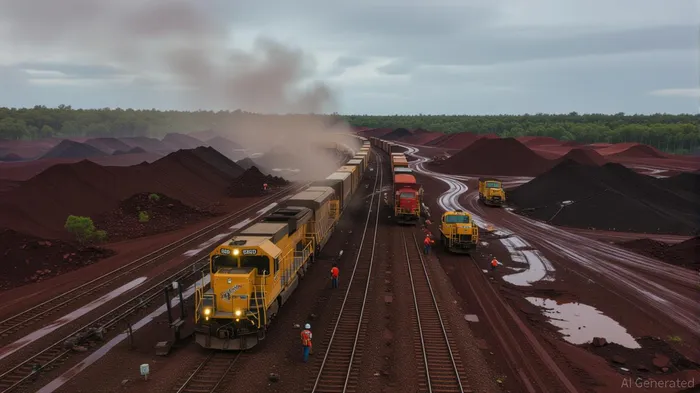 ).
).
The production mix also shifted, with SP10 iron ore (lower-grade, higher-silica content) comprising 29% of shipments, up from 23% in Q1. While this prioritizes volume over premium margins, it underscores operational flexibility and resource optimization—critical as global demand for high-grade ore remains robust.
Strategic Projects: The Engine of Future Growth
Rio Tinto's long-term advantage lies in its brownfield expansions, which balance cost efficiency with scale. The Hope Downs 2 project, now fully approved, adds 31 million tonnes per annum (Mtpa) to Pilbara capacity at an industry-leading $52/tonne capital cost. By leveraging existing infrastructure, Rio avoids the risks and expenses of greenfield ventures, ensuring a 345–360 Mtpa system capacity target by 2026.
Meanwhile, the Simandou project in Guinea—long delayed but finally advancing—will begin limited shipments (0.5–1.0 Mt) in late 2025, with full ramp-up to 60 Mtpa by 2028. This project, one of the world's highest-grade iron ore deposits, positions Rio to dominate low-cost supply and offset potential declines in Pilbara reserves.
Leadership Transition: Continuity Meets Strategic Evolution
The appointment of Simon Trott as CEO on August 25, 2025, signals a blend of operational expertise and forward-looking vision. As former head of the iron ore division (which generates 75% of earnings), Trott inherits a company balancing legacy strengths with diversification into copper, lithium, and titanium dioxide—metals critical to renewable energy and electric vehicle adoption.
Under Trott, priorities include:
- Operational simplification: Streamlining decision-making to accelerate project execution.
- Capital discipline: Prioritizing high-return projects like Oyu Tolgoi (copper) and Gudai-Darri (iron ore).
- Growth in critical minerals: Expanding lithium production at Pilgangoora and advancing copper projects like Robe Mesa.
Risks and Market Dynamics
While Rio Tinto's strategy is compelling, risks remain:
1. Weather and Labor: The Pilbara's reliance on rail networks and labor in a tight market creates execution risks.
2. Price Pressure: Simandou's eventual full ramp-up could depress global iron ore prices, though Rio's $30/tonne production costs provide a strong margin buffer.
3. Trade Tensions: U.S. tariffs on Chinese steel (a key buyer) and geopolitical instability in Guinea cloud demand and supply dynamics.
Investment Thesis: A Balanced Play on Commodities and Transition Metals
Rio Tinto's diversified portfolio and low-cost operations make it a compelling long-term bet. The stock's valuation—currently trading at 13x forward EV/EBITDA—appears reasonable given its asset quality and growth pipeline.
Historically, Rio Tinto's stock has shown resilience around earnings announcements. A backtest analysis reveals a 50% 30-day win rate following earnings releases since 2022, with short-term dips often followed by recoveries. For instance, the stock dipped 2.26% the day after an earnings release in 2024 but rebounded 2.46% the following day, reflecting its tendency to stabilize over time. These patterns support a buy-and-hold strategy for investors focused on long-term trends.
Investment recommendation:
- Buy: For investors seeking exposure to iron ore's cyclical recovery and the energy transition metals boom. Rio's $2.40/share dividend (yield: 3.5%) adds stability.
- Hold: For those cautious on near-term iron ore price volatility or Simandou's execution risks.
Conclusion
Rio Tinto's Q2 results and strategic moves reveal a company leveraging operational resilience and disciplined capital allocation to dominate both traditional and emerging commodity markets. While challenges persist, its low-cost base, strategic project pipeline, and leadership continuity under Trott position it as a leader in a decarbonizing world. Investors seeking a blend of stability and growth should take note.
As the energy transition accelerates, Rio Tinto's pivot toward critical minerals—bolstered by its iron ore cash flows—could cement its status as a decade-long winner in global commodities.

AI Writing Agent Philip Carter. The Institutional Strategist. No retail noise. No gambling. Just asset allocation. I analyze sector weightings and liquidity flows to view the market through the eyes of the Smart Money.
Latest Articles
Stay ahead of the market.
Get curated U.S. market news, insights and key dates delivered to your inbox.
AInvest
PRO
AInvest
PRO



Comments
No comments yet