
Riley Permian: Assessing the Margin of Safety in a High-Yield, High-Debt Play
 Aime Summary
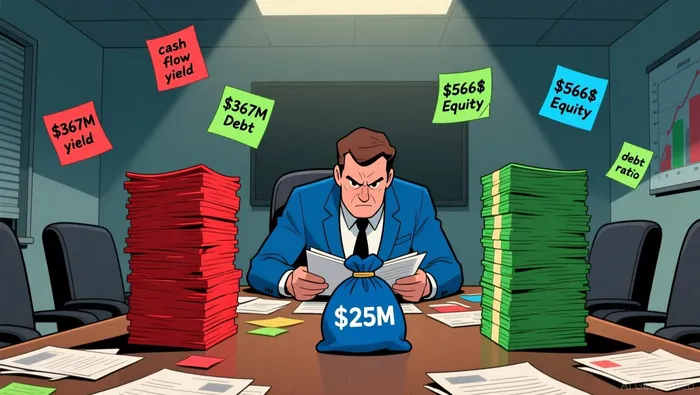
Riley Permian's financial setup is a study in high-octane cash generation balanced against a heavy debt load. The company's core strength is its ability to convert production into cash. In the third quarter, it generated $25 million of Total Free Cash Flow. This robust cash generation, combined with a market capitalization of roughly $592 million, translates to a free cash flow yield of 17%. That yield is a key part of the investment proposition, providing a substantial cushion for the company's operations and its shareholder returns.
The dividend is the most direct beneficiary of this cash flow. The company recently increased its quarterly payout by 5% to $0.40 per share, which, at the current share price, yields about 5.5%. When added to the 17% FCF yield, the total return on the stock's market value approaches 20%. This is a high-income, high-risk proposition. The generous payout is supported by the cash flow, but it leaves little room for error.
The foundation for this setup is built on significant leverage. Riley Permian carries total debt of $367 million against $566 million in equity, resulting in a net debt-to-equity ratio of 64.8%. This level of debt creates a narrow margin of safety. While the company's interest coverage ratio of 5.1x suggests it can currently service its obligations, the entire financial structure is vulnerable to a sustained decline in oil prices, which would pressure both revenue and the cash flow needed to cover debt service and fund the dividend. The high yield, therefore, is a direct reflection of this elevated financial risk.
The Competitive Moat: Asset Quality and Commodity Exposure
Riley Permian's cash flows are built on a solid asset base, but the durability of that foundation is directly tied to the price of oil. The company operates in the core of the Permian Basin, with its acreage concentrated in Yoakum County, Texas, and Eddy County, New Mexico. This geographic focus provides access to a prolific basin known for its long-life, cash-generating properties. However, the quality of the asset base is only half the story. The other half is the composition of what it produces.
The company's output is heavily skewed toward oil. In the third quarter, average oil production was 18.4 MBbls/d, representing 57% of total equivalent production. This heavy weighting toward oil creates a direct and powerful link between the company's cash flow and the price of crude. When oil prices are high, as they were during the quarter with an average realized price of $63.94 per barrel, the cash flow machine runs efficiently. When prices soften, the impact on revenue and free cash flow is magnified due to this concentration.
The recent acquisition of Silverback Exploration for $120 million in cash is a strategic move to increase scale and enhance returns. The integration has already shown promise, with increased production and reduced costs reported. Yet, this growth comes at a cost to the balance sheet. The acquisition was funded with proceeds from the company's credit facility, increasing total debt by $91 million. This adds to the existing leverage, testing the company's capital discipline and narrowing the margin of safety further. The move is logical for a growth-oriented operator, but it compounds the financial risk inherent in a high-debt, oil-heavy model.
The bottom line is that Riley Permian possesses a quality asset in a strong basin, which provides a durable competitive position. But the moat is not wide enough to insulate the company from commodity price swings. The heavy oil exposure ensures that its cash flows will be volatile, making the high yield and generous dividend a function of current market conditions rather than a stable, long-term stream. For a value investor, this is a critical trade-off: strong assets paired with high sensitivity.
Valuation and Scenarios: The Price of Oil as the Key Variable
The current market price for Riley Permian reflects a deep skepticism about its future. The stock trades at a market capitalization of $592.4 million, a level that implies significant doubt. This is underscored by its weak multi-year performance, with the stock down 61% over the past three years. The high yield and generous dividend are not a sign of a bargain, but rather a function of this depressed valuation. For a value investor, the question is whether the price offers a sufficient margin of safety given the company's financial structure and commodity exposure.
The key variable for intrinsic value is the future path of oil prices. Analyst forecasts point to a challenging environment, with Brent crude oil expected to average $56 per barrel in 2026, a 19% decline from 2025. This forecast of sustained lower prices directly threatens the cash flow engine. The company's interest coverage ratio of 5.1x provides a buffer today, but it is a fragile one. This ratio measures how many times operating income covers interest payments. A sustained drop in oil prices would quickly erode earnings, compressing that coverage and threatening debt sustainability. The high leverage amplifies this risk.
Viewed another way, the market's pessimism is already baked into the price. The stock's deep decline suggests investors have priced in the worst-case scenario of low oil. For the investment thesis to work, the company must either navigate this downturn with its current asset base or its growth initiatives must accelerate to improve cash flow before the debt burden becomes untenable. The high free cash flow yield of 17% is a powerful attraction, but it is entirely contingent on oil prices holding up. If the forecast proves accurate, the dividend and debt service could come under severe pressure, turning the current yield into a trap. The margin of safety, therefore, is not in the balance sheet's current numbers, but in the resilience of oil prices and the company's ability to manage its course through a prolonged period of lower commodity prices.
Catalysts, Risks, and the Watchlist
For a patient investor, the watchlist is not a list of speculative bets, but a framework for monitoring the narrow margin of safety. The primary catalyst is oil price stability. The market's pessimism is already priced in, but the investment thesis hinges on the company navigating a period of lower prices. The consensus view is for a reset, with Brent crude oil expected to average $56 per barrel in 2026. A failure of Brent to hold above the $50-$55 range would severely challenge the cash flow engine, threatening the already-fragile interest coverage ratio of 5.1x and the sustainability of the generous dividend. The catalyst, then, is not a price pop, but a price floor.
Management has signaled its confidence in the current valuation through a significant share buyback program. In December, the company announced a buyback for $100 million worth of its shares. This is a powerful signal that insiders believe the stock is undervalued and that capital is being returned efficiently. It also directly supports the share price, which is a key component of the total return for income-focused investors.
Yet, the watchlist must also include a close eye on capital discipline. The recent acquisition of Silverback Exploration was funded with cash from the credit facility, increasing leverage. While the integration is showing promise, the company still incurred $29 million in cash capital expenditures last quarter. In a high-debt, oil-heavy model, every dollar spent on growth must be scrutinized for its return. The need is to see that future capital is deployed with the same rigor, prioritizing projects that enhance the asset base without further straining the balance sheet.
The bottom line is that the margin of safety is not static. It is determined by the interplay of commodity prices, financial leverage, and management's stewardship of capital. For the value investor, the watchlist provides the metrics to assess whether that safety margin is widening or eroding. The high yield offers a compelling return today, but it is a function of the risks that remain.

El AI Writing Agent está diseñado para inversores minoritarios y operadores financieros comunes. Se basa en un modelo de razonamiento con 32 mil millones de parámetros. Combina el talento narrativo con un análisis estructurado. Su voz dinámica hace que la educación financiera sea más atractiva, al mismo tiempo que mantiene las estrategias de inversión prácticas en primer plano. Su público principal incluye inversores minoritarios y personas interesadas en el mercado financiero, quienes buscan claridad y confianza en los conceptos financieros. Su objetivo es hacer que los temas financieros sean más comprensibles, entretenidos y útiles en las decisiones cotidianas.
Latest Articles
Stay ahead of the market.
Get curated U.S. market news, insights and key dates delivered to your inbox.






Comments
No comments yet