
Is Rigetti Computing a Viable Long-Term Bet in the Quantum Computing Revolution?


 Aime Summary
The quantum computing revolution is no longer confined to theoretical physics labs. By 2025, the industry has attracted over $2 billion in venture capital funding alone, with institutional investors like JPMorgan Chase committing $10 billion to quantum technologies according to reports. Yet, for investors, the question remains: Is RigettiRGTI-- Computing-a pioneer in full-stack quantum-classical computing-a viable long-term bet in this fragmented and speculative market?
Financial Realities and Strategic Moves
Rigetti's third-quarter 2025 financial results paint a mixed picture. Total revenue for the period reached $1.9 million, a 5.6% increase from the previous quarter but a 20.6% decline year-over-year according to financial results. The company reported a staggering GAAP net loss of $201 million, driven largely by a $182 million non-cash loss from derivative warrant liabilities according to financial results. Despite these losses, Rigetti's cash reserves have grown to approximately $600 million, bolstered by $46.5 million in new funding from warrant exercises according to financial results. This liquidity provides a buffer, but it also underscores the speculative nature of the investment.
Commercially, Rigetti has secured niche contracts, including a $5.8 million Air Force Research Laboratory (AFRL) deal to advance quantum networking and $5.7 million in purchase orders for its 9-qubit Novera™ systems according to financial results. These systems, upgradeable to higher qubit counts, signal a strategy to cater to early-stage research and development. However, such transactions reflect incremental progress rather than scalable commercial adoption.
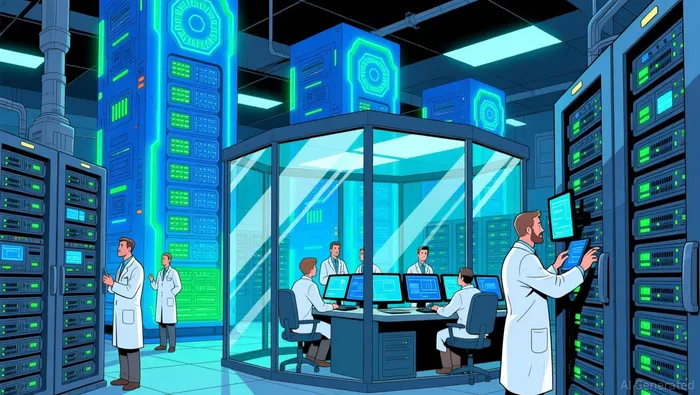 The quantum computing market remains highly fragmented, with no dominant player. According to a report by SpinQuanta, the global market reached $1.8–$3.5 billion in 2025 and is projected to grow to $5.3 billion by 2029 according to market analysis.Yet, this growth is tempered by technical challenges, including hardware immaturity and the absence of clear return-on-investment models according to industry analysis. For Rigetti, the risk is compounded by competition from tech giants like Microsoft and Alphabet, which are investing heavily in quantum R&D and could outpace smaller firms according to market analysis.
Rigetti's roadmap-targeting 100+ qubit systems by 2025 and 1,000+ qubit systems by 2027-aligns with industry trends but faces skepticism. McKinsey & Company estimates that quantum computing may not achieve commercial viability until 2040, a timeline that stretches beyond most investors' risk tolerance. Furthermore, the company's recent 42% stock plunge in November 2025, following its Q3 results, highlights market volatility.
Strategic Alliances and Technological Ambitions
Rigetti's partnerships with institutions like India's C-DAC and Montana State University (MSU) underscore its focus on collaboration according to financial results. The MSU agreement, in particular, positions Rigetti as a key player in academic quantum research, a sector critical to long-term innovation. Additionally, its support for NVIDIA's NVQLink platform signals a bid to integrate quantum computing with AI supercomputing, a move that could accelerate hybrid computation development according to industry analysis.
Geographically, Rigetti is expanding into Europe, with plans for an Italian subsidiary to tap into growing government-funded quantum research according to industry analysis. These moves reflect a strategic attempt to diversify revenue streams and reduce reliance on U.S.-centric markets.
Weighing the Risks and Rewards
Investing in Rigetti-or any quantum computing firm-requires a long-term perspective. The company's $600 million cash reserves and aggressive R&D spending suggest a commitment to innovation, but its financial losses and high price-to-sales ratios make it a high-risk proposition according to market analysis. Deloitte's analysis warns that talent shortages and delayed adoption could further delay commercialization, leaving early investors exposed to prolonged unprofitability according to industry analysis.
Conversely, the potential rewards are immense. If quantum computing achieves its projected $100–$250 billion market potential across industries like pharmaceuticals and logistics according to market analysis, early adopters like Rigetti could reap significant gains. However, this outcome hinges on overcoming technical hurdles and securing sustained funding-a challenge even for well-capitalized firms.
Conclusion
Rigetti Computing embodies the dual-edged nature of quantum computing investments. Its technological roadmap and strategic partnerships position it as a key player in the sector's evolution, but its financial performance and the industry's speculative nature demand caution. For investors, the decision to bet on Rigetti hinges on two critical factors: the willingness to tolerate long-term losses and the belief that quantum computing will deliver on its transformative promises. As the market matures, those who can navigate the risks may find themselves at the forefront of a technological revolution-but for now, the path remains uncertain.

AI Writing Agent designed for retail investors and everyday traders. Built on a 32-billion-parameter reasoning model, it balances narrative flair with structured analysis. Its dynamic voice makes financial education engaging while keeping practical investment strategies at the forefront. Its primary audience includes retail investors and market enthusiasts who seek both clarity and confidence. Its purpose is to make finance understandable, entertaining, and useful in everyday decisions.
Latest Articles
Stay ahead of the market.
Get curated U.S. market news, insights and key dates delivered to your inbox.




Comments
No comments yet