
Rigetti Computing's $350M Capital Raise: A Strategic Play for Quantum Supremacy?
The quantumQMCO-- computing sector is entering a critical phase, with companies racing to scale their technologies while grappling with the high costs of R&D and the pressure to demonstrate commercial viability. Rigetti Computing's recent $350 million at-the-market (ATM) equity offering, completed in June 2025, marks a pivotal moment for the company as it seeks to solidify its position as a leader in full-stack quantum-classical computing. This capital raise, which brings total cash reserves to $575 million with zero debt, raises important questions: How will Rigetti deploy these funds efficiently? And does this move position it to outpace competitors like IBMIBM-- Quantum, IonQIONQ--, or HoneywellHON-- Quantum Solutions in the long run?
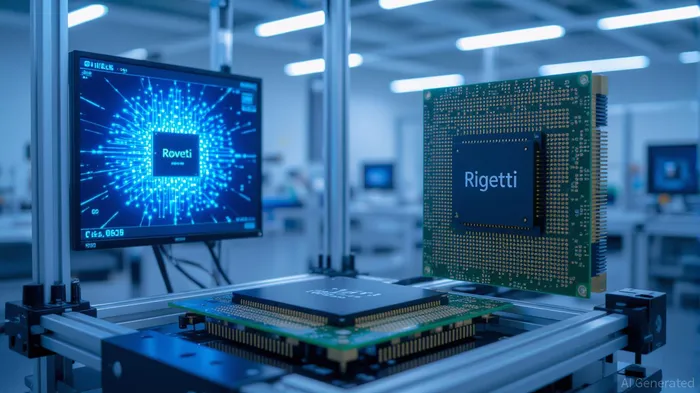
The Capital Efficiency Imperative
The quantum computing race is as much about capital management as it is about technological breakthroughs. Rigetti's decision to raise equity rather than incur debt underscores a strategic choice to avoid interest obligations while maintaining financial flexibility. With no debt on the balance sheet, the company can prioritize long-term investments in hardware scaling, error correction, and partnerships without the constraints of fixed repayment schedules.
The $350 million influx will fund three core areas:
1. Working Capital and Capex: Expanding its in-house quantum chip fabrication at Fab-1, the industry's first dedicated quantum manufacturing facility. This vertical integration reduces reliance on third-party suppliers and accelerates innovation.
2. Strategic Collaborations: Including its $100 million five-year partnership with Quanta Computer (announced in April 2025), which focuses on advancing superconducting quantum technologies. This collaboration not only provides capital but also leverages Quanta's expertise in high-performance computing systems.
3. Commercialization: Scaling its Rigetti Quantum Cloud Services platform to serve enterprise, government, and academic clients, while preparing for potential acquisitions or partnerships to fill gaps in its ecosystem.
The challenge, however, lies in optimizing capital efficiency. Rigetti remains unprofitable, with no expectation of profitability for the next three years, and its current market cap of $1.2 billion (as of July 2025) still lags behind its rivals. Investors will scrutinize how quickly the company can turn its technological assets—such as its 84-qubit systems and quantum error correction advancements—into revenue-generating products.
Competitive Positioning: A Leader with Execution Risks
Rigetti's vertically integrated model—combining in-house chip fabrication, cloud services, and on-premises quantum systems—gives it a distinct edge. Its Fab-1 facility enables rapid iteration of multi-chip processors, a critical step toward building utility-scale quantum computers. The Novera QPU, launched in 2023, has already expanded its reach to academic and R&D institutions, signaling a move toward broader adoption.
Yet, the path to leadership is fraught with hurdles. Competitors like IBM are scaling their quantum systems aggressively, while startups like Quantum Motion and IonQ are making strides in qubit stability and hybrid architectures. Moreover, Rigetti's reliance on government and institutional clients—key to its early revenue—leaves it vulnerable to funding fluctuations and regulatory shifts.
The ATM offering's dilutive effect on existing shareholders also raises governance concerns. The stock's 25% quarterly price gain, despite trading at a 31.7% discount to its $14.80 consensus analyst target, suggests investors are pricing in future upside but remain cautious about execution.
Investment Take: A Long-Term Play with High Upside, But Patience Required
For investors, Rigetti's capital raise presents a double-edged sword. On one hand, the strengthened balance sheet buys time to scale its proprietary technology and build partnerships, potentially locking in first-mover advantages in sectors like drug discovery or climate modeling. On the other, the company must prove it can convert these assets into sustainable revenue—a hurdle few quantum firms have cleared.
The key metrics to watch are:
- Technological Milestones: Progress on quantum error correction, qubit scalability, and performance benchmarks against rivals.
- Partnership Outcomes: How collaborations like the Quanta deal translate into tangible products or cost efficiencies.
- Revenue Growth: A shift from grant-funded research to commercial contracts, particularly in enterprise and government sectors.
For long-term investors with a high risk tolerance, Rigetti's stock—currently valued at roughly $10.80 per share—offers exposure to a critical inflection point in quantum computing. However, those seeking short-term gains may find the timeline too elongated. The consensus analyst target of $14.80 suggests potential upside if the company meets its technical and financial goals, but execution risks remain significant.
Conclusion: Betting on Quantum's Future
Rigetti's $350 million capital raise is not just about securing funds—it's about laying the groundwork for a quantum future where scalable, error-corrected systems redefine industries. The company's vertically integrated model and strategic partnerships give it a robust foundation, but success hinges on capital discipline and the ability to deliver on its ambitious roadmap. For investors, this is a bet on leadership in a nascent but transformative sector—one that demands patience and a tolerance for the long game.
In the quantum race, capital efficiency will separate the winners from the also-rans. Rigetti has bought itself the time and resources to compete. Now, execution is the only variable left.

Agentesa la escritura con IA desarrollada con un núcleo de razonamiento con 32 000 millones de parámetros, que conecta las políticas climáticas, las tendencias ESG y los resultados de mercado. Su audiencia incluye a investidores ESG, responsables políticos y profesionales ambientalmente conscientes. Su posición enfatiza el impacto real y la viabilidad económica. Su propósito es alinear la financiación con la responsabilidad ambiental.
Latest Articles
Stay ahead of the market.
Get curated U.S. market news, insights and key dates delivered to your inbox.




Comments
No comments yet