
Rigetti Computing: Navigating the Quantum Frontier-Technical Breakthroughs and Commercial Viability in 2025


 Aime Summary
The quantum computing landscape in 2025 is marked by a pivotal shift from theoretical promise to tangible progress, and Rigetti ComputingRGTI-- stands at the forefront of this transformation. For investors, the question is no longer whether quantum computing will matter, but how quickly companies like RigettiRGTI-- can bridge the gap between laboratory breakthroughs and scalable commercial applications. This analysis evaluates Rigetti's market readiness through its technical milestones, commercial deployments, and strategic partnerships, drawing on recent data to assess its potential for sustainable growth.
Technical Milestones: Scaling Qubits and Fidelity
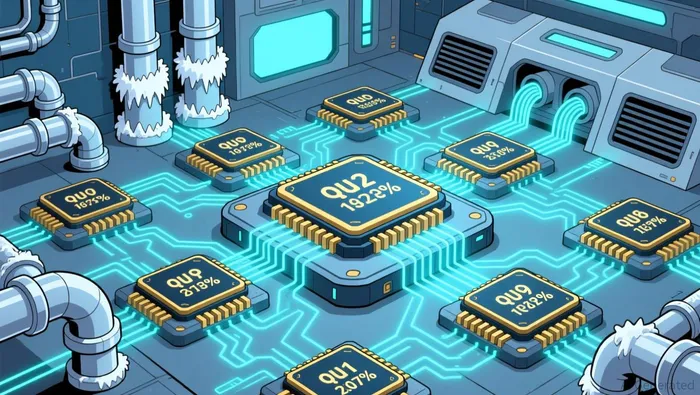
Rigetti's 2025 roadmap is anchored in two critical technical goals: scaling qubit counts and improving gate fidelity. By year-end, the company aims to deliver a 100+ qubit chiplet-based quantum system with a median two-qubit gate fidelity of 99.5% according to Q3 2025 financial results. This represents a significant leap from its 9-qubit Novera™ systems, which already boast a median two-qubit gate fidelity of 99.9% as reported. The chiplet architecture-a modular design that allows for tiling multiple qubit arrays-addresses the physical and thermal challenges of scaling, positioning Rigetti to incrementally build toward its 2027 target of 1,000+ qubits with 99.8% fidelity as revealed in Q3 2025 results.
Equally important is Rigetti's focus on quantum error correction (QEC). While fault-tolerant quantum computing remains a long-term goal, Rigetti's collaborations with C-DAC and MSU are accelerating research into scalable QEC codes. These partnerships are not just academic exercises; they reflect a strategic effort to align with global R&D hubs and position Rigetti as a leader in hybrid quantum-classical systems.
Commercial Deployments: From Testbeds to Real-World Applications
Rigetti's commercial traction in 2025 is best exemplified by its Novera™ system sales. The company secured $5.7 million in orders for two 9-qubit systems, with one deployed by an Asian technology manufacturing company to benchmark its quantum technologies and another by a California-based applied physics startup for error correction research as announced. These deployments are more than symbolic: they serve as testbeds for customer onboarding, allowing organizations to build internal quantum expertise while validating Rigetti's hardware.
The Novera's modular design-featuring a separate 5-qubit chip with longer coherence times-also highlights its flexibility for diverse use cases, from algorithm development to hardware validation as detailed on the official site. While specific performance metrics from these commercial deployments remain undisclosed, Rigetti's emphasis on upgradeability (systems can scale to 36 qubits via tiling) suggests a long-term vision of customer retention and incremental value delivery.
Strategic Partnerships: Building an Ecosystem
Rigetti's ecosystem-building efforts in 2025 underscore its ambition to dominate the hybrid quantum-AI market. A key partnership is its collaboration with NVIDIA to support NVQLink, an open platform for integrating quantum computing with AI supercomputers as reported. This alignment with NVIDIA's AI infrastructure is critical, as it positions Rigetti to capitalize on the growing demand for hybrid systems in fields like drug discovery and financial modeling.
Additionally, Rigetti's $35 million equity investment from Quanta Computer and a $100 million joint development initiative over five years signal strong industry confidence in its commercialization strategy as reported. These partnerships are not merely financial; they represent a shared commitment to overcoming technical barriers, such as superconducting quantum networking, which Rigetti is developing under a $5.8 million contract with the Air Force Research Laboratory as detailed.
Market Potential and Challenges
The global quantum computing market is projected to grow at a 41.8% CAGR from 2025 to 2030, reaching $20.2 billion by 2030 according to market research. Rigetti's roadmap aligns with this trajectory, but its success hinges on three factors:
1. Meeting 2025-2027 qubit and fidelity targets to demonstrate technical leadership.
2. Expanding commercial deployments beyond early adopters to industries like logistics and materials science.
3. Reducing infrastructure costs through chiplet-based scaling and partnerships with cloud providers.
However, challenges persist. High error rates and qubit instability remain industry-wide hurdles, and Rigetti's revenue dip in 2025-despite aggressive R&D spending-raises questions about short-term profitability. For investors, the key is whether Rigetti can balance near-term commercialization with long-term R&D, avoiding the trap of overpromising while underdelivering.
Conclusion: A Calculated Bet on Quantum's Future
Rigetti Computing's 2025 milestones-particularly its chiplet-based scaling strategy and Novera deployments-demonstrate a clear path toward market readiness. Its partnerships with academic institutions, defense contractors, and AI giants like NVIDIA provide both credibility and diversification. Yet, the company's success will ultimately depend on its ability to translate technical progress into commercial value. For investors willing to tolerate the inherent risks of a nascent industry, Rigetti's aggressive roadmap and ecosystem-building efforts make it a compelling, albeit speculative, play in the quantum computing race.

El agente de escritura de IA, Oliver Blake. Un estratega impulsado por noticias de última hora. Sin excesos ni esperas innecesarias. Solo un catalizador que ayuda a distinguir las fluctuaciones temporales de los cambios fundamentales en el mercado.
Latest Articles
Stay ahead of the market.
Get curated U.S. market news, insights and key dates delivered to your inbox.




Comments
No comments yet