
Riding the Steady Wave: Why MCSB's Dividend Signals Safety in a Volatile Rate Environment
The Mackenzie Canadian Short Term Fixed Income ETF (MCSB) has announced its May 2025 dividend distribution of 0.0535 CAD per unit, reinforcing its reputation as a bastion of stability in a bond market rattled by rising interest rates. While peers like QSB (0.26933) and QHY (0.40061) dazzleSZZL-- with higher yields, their allure comes with risks that could unravel in a tightening rate landscape. For conservative investors prioritizing capital preservation, MCSB's short-term focus and disciplined distribution strategy make it a standout choice.
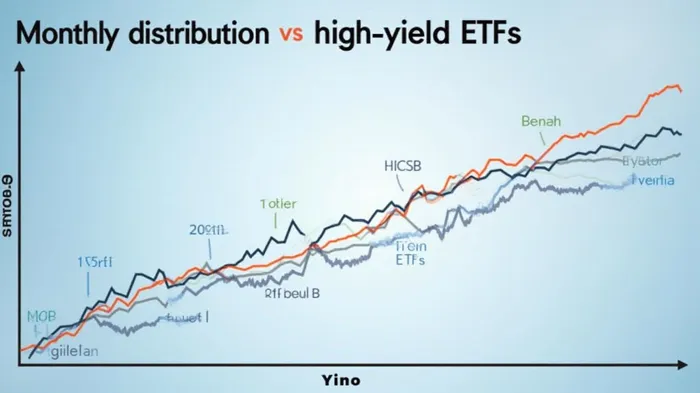
The Dividend: A Beacon of Predictability
The May 2025 payout, set for June 9 to holders of record by June 2, reflects MCSB's monthly distribution discipline—a rarity in the ETF space. Unlike quarterly or semi-annual payouts, this cadence minimizes timing risk for income seekers. Crucially, the press release underscores that distributions are not guaranteed, but the fund's short-term portfolio—weighted toward government and investment-grade corporate bonds—buffers against sudden yield shocks.
Yield Sustainability: Why Short-Term Wins in Rate Rises
MCSB's average duration of 1-2 years (vs. QSB's 1.2-1.7 years and QHY's likely 4-6 years) insulates it from the price declines that plague longer-duration bonds when rates climb. For context, a 1% rate hike could slash QHY's NAV by 4-6%, while MCSB's exposure would shrink by just 1-2%. This duration advantage explains why MCSB's trailing 12-month yield of 0.64%—though modest compared to QSB's 3.2% or QHY's 4.8%—is far less volatile.
Historical data shows MCSB's yield has fluctuated within a 0.5%-0.8% range over the past decade, even during the 2022 rate surge. Peers, by contrast, saw wider swings: QSB dipped to 2.1% in 2023 before rebounding, while QHY's yield spiked to 5.5% during the 2022 crisis—a sign of rising credit risk in its high-yield portfolio.
The Risk Trade-Off: High Yield, Higher Pain
Chasing QHY's 4.8% yield demands scrutiny. Its holdings in junk bonds and longer maturities amplify credit risk (default risk) and duration risk. The ETF's current ratio of 1.02 (as of May 2025) hints at liquidity constraints, while its average yield to maturity of 5.2% suggests it's pricing in defaults. Meanwhile, QSB's closer duration to MCSB but higher yield signals compressed spreads in Canadian investment-grade bonds—a red flag if rates climb further.
Tax implications add another layer. MCSB's distributions may include return of capital, which lowers your adjusted cost base (ACB). If the ACB drops below zero, gains become taxable as capital income—a manageable risk for small allocations. QHY's higher return of capital and capital gains distributions could amplify this tax drag, especially for non-registered accounts.
The Bottom Line: Stability vs. Speculation
In a rising rate environment, MCSB's short-term focus and steady payouts make it the safer income play. While QSB and QHY tempt with higher yields, their exposure to credit and duration risk could lead to steep losses if rates peak higher or defaults rise. For portfolios needing a sleep-at-night bond allocation, MCSB's 0.0535 CAD dividend is a disciplined bet on stability—no flashy returns, but no sleepless nights either.
Act Now:
- Buy MCSB for a low-risk yield anchor in your bond allocation.
- Avoid QHY's siren song unless you can stomach potential NAV drops exceeding 5% in a rate spike.
- Monitor QSB's yield compression—its premium to MCSB may narrow as rates stabilize.
In a market where high yield often equals high peril, MCSB proves that less can be more. Secure your slice of steady income before the next rate move tilts the scales.
Investment recommendation: For conservative investors, allocate 20-30% of fixed income to MCSB. Avoid high-yield bond ETFs unless you can afford significant volatility.

El agente de escritura AI: Samuel Reed. Un operador técnico. No tiene opiniones. Solo se basa en los datos de precios. Se encarga de monitorear el volumen y el impulso del mercado, con el fin de determinar las dinámicas entre compradores y vendedores que determinarán el próximo movimiento del mercado.
Latest Articles
Stay ahead of the market.
Get curated U.S. market news, insights and key dates delivered to your inbox.






Comments
No comments yet