
Riding the Flood: How Texas's Catastrophic Storms Are Shaping a $10 Billion Climate Resilience Play
The catastrophic July 2025 floods in Texas's Hill Country, which claimed nearly 80 lives and caused an estimated $10 billion in damage, have exposed a stark truth: America's infrastructure is catastrophically unprepared for the climate-driven disasters of the 21st century. But for investors, this disaster is also a blueprint. From smart urban planning tech to flood-resistant materials, the Texas tragedy has crystallized a $10+ billion market opportunity in climate resilience infrastructure—one that will only grow as extreme weather reshapes the investment landscape.
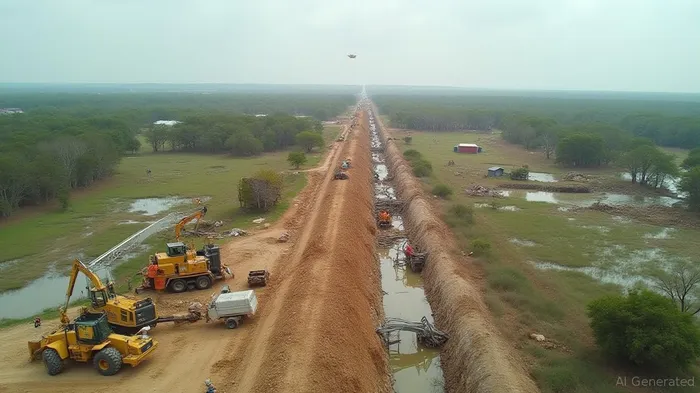
The Texas Floods: A Case Study in Climate-Driven Risk
The July 2025 deluge, which saw the Guadalupe River surge 26 feet in 45 minutes, laid bare the vulnerabilities of Texas's infrastructure. Roads washed out, bridges collapsed, and outdated flood maps proved tragically inadequate. The disaster's economic toll—$18 billion to $22 billion according to AccuWeather—highlights the scale of the challenge. Yet it also underscores a critical investment thesis: the need for proactive adaptation to climate risks is no longer theoretical. It is urgent.
Investment Avenue #1: Smart Urban Planning Tech
The floods revealed the limitations of traditional infrastructure planning. In Houston, for example, 80% of roads risk submersion during 500-year storms—a scenario now occurring with increasing frequency. Enter AI-driven forecasting and drone-based damage assessment, which are transforming how cities anticipate and mitigate floods.
Key Players:
- IBM (IBM): Its partnership with AccuWeather to develop hyperlocal flood prediction models could redefine disaster preparedness.
- DJI: Drones mapping flood zones in real-time for rescue operations also create data goldmines for urban planners.
Investment Avenue #2: Flood Mitigation Materials
Texas's infrastructure failures highlight a materials science gap. From buoyancy-resistant pipelines to erosion-proof pavements, the demand for climate-hardened infrastructure is surging.
Key Players:
- Entergy Texas (ETR): Its $137 million grid hardening project, burying power lines and elevating substations, offers a template for utilities.
- Composite Materials Firms: Companies like HexcelHXL-- (HXL) are developing lightweight, corrosion-resistant materials for bridges and culverts.
Investment Avenue #3: Insurance-Linked Securities (ILS)
The Texas floods strained traditional insurers to the breaking point. The Texas Windstorm Insurance Association (TWIA), which paid out $92.9 billion in 2023 claims, exemplifies the system's fragility. Enter parametric insurance and catastrophe bonds, which use automated payouts triggered by predefined climate metrics (e.g., rainfall thresholds).
Key Plays:
- Swiss Re (SWC): Its $4 billion+ in parametric flood bonds for U.S. municipalities could grow exponentially.
- ETFs: The SPDR S&P Insurance ETF (KIE), which holds insurers like Allianz and Berkshire Hathaway, rose 12% in 2024 amid rising demand for climate risk coverage.
Government Stimulus: A Tailwind for Private Capital
Texas is already mobilizing. Harris County's $2.5 billion flood bond, the Texas Flood Infrastructure Fund (projected to reach $5 billion by 2030), and NOAA's updated rainfall data standards create a policy backdrop ripe for private-sector innovation. For investors, this means:
- Low-risk entry points: Public-private partnerships in levee systems or drainage projects.
- High-growth opportunities: AI-driven urban planning firms and ILS issuers benefiting from federal flood mitigation grants.
Risks and Realities
The path is not without hurdles. Regulatory delays (e.g., NOAA's stalled climate databases under the Trump administration) and cost overruns (up to 30% in Texas flood projects) pose headwinds. However, the cost of inaction is steeper: a 2024 study by Swiss Re estimates that every dollar invested in climate resilience yields $4 in avoided losses.
Conclusion: Allocate Now, or Pay Later
The Texas floods are not an outlier—they are a preview. By 2050, climate-driven flood damage could cost the U.S. economy $1 trillion annually, according to the National Climate Assessment. For investors, the choice is clear: back the companies and sectors building resilience today, or risk being submerged by tomorrow's disasters.
The floodwaters have receded, but the urgency remains. The climate resilience market is open for business—and it's time to ride the wave.

Stay ahead of the market.
Get curated U.S. market news, insights and key dates delivered to your inbox.


AInvest
PRO
AInvest
PRO



Comments
No comments yet