
Richtech Robotics and the Robotics Revolution: Is Dex the Catalyst for a 22% Upside?


 Aime Summary
The humanoid robotics sector is at a pivotal inflection point, driven by advancements in artificial intelligence, declining production costs, and a global push for automation. Richtech RoboticsRR-- (RR), a key player in this high-growth arena, has recently unveiled its Dex humanoid robot, positioning itself at the intersection of innovation and industrial application. With a 22% stock price surge in late 2025 attributed to strategic announcements and product launches, investors are scrutinizing whether Dex can serve as the catalyst for sustained growth-or if the company's fundamentals and valuation pose significant risks.
The 22% Surge and Catalysts
Richtech's stock price surged by 22% in late 2025, fueled by two primary catalysts: the Trump administration's rumored executive order to accelerate U.S. robotics development and a strategic AI partnership with NomadGo to integrate inventory management solutions. These developments, coupled with Commerce Secretary Howard Lutnick's engagement with industry leaders, signaled a shift in investor sentiment toward Richtech's automation capabilities. However, this optimism was short-lived, as the stock later declined by 36%, aligning with InvestingPro's fair value model, which flagged the stock as overvalued. Analysts attribute this volatility to a price-to-book ratio of 6.4x, significantly higher than industry peers, highlighting a disconnect between market expectations and the company's financial performance.
Dex: A Technological Leap
Richtech's Dex humanoid robot, unveiled in October 2025, represents a critical step in the company's product evolution. Powered by NVIDIA's Jetson Thor platform, Dex is designed for dynamic environments, capable of performing complex tasks with real-time reasoning and precision. Its wheeled autonomous mobile robot (AMR) base enables stable, energy-efficient movement, while its dual-armed dexterity supports applications in manufacturing, logistics, and quality inspection according to industry reports. The robot's 4-hour battery life and training via NVIDIA Isaac Sim and Isaac Lab further enhance its appeal for industrial use as demonstrated at CES 2026.
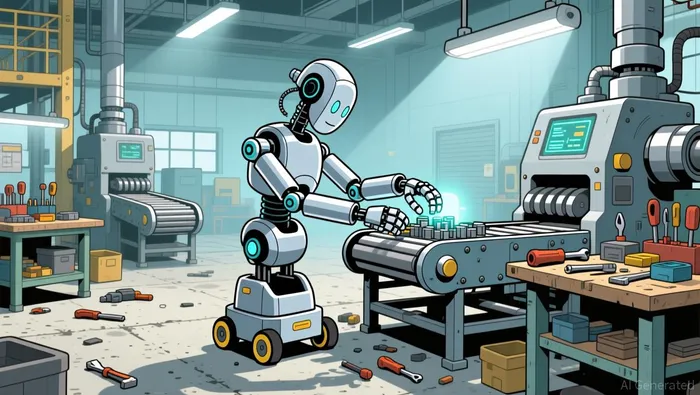
Dex's debut at CES 2026, scheduled for January 6–9, 2026, underscores Richtech's ambition to capture market share in the humanoid robotics sector. The robot's demonstration of assembling custom baseball caps using industrial machinery at Nvidia GTC 2025 showcased its practical potential, aligning with the sector's shift toward real-world deployment as reported by market analysts. However, the stock's recent decline-closing at $3.09 on December 30, 2025, a 2.68% drop-suggests that investor enthusiasm has not yet translated into consistent price stability according to financial analysts.
Financials and Market Position
Richtech's Q3 2025 financials reveal a mixed picture. Revenue declined 18.4% year-over-year to $1.18 million, reflecting the company's strategic pivot to the Robotics-as-a-Service (RaaS) model as reported by financial analysts. While gross margins improved by 420 basis points to 74.4%, net losses widened to $4.1 million, driven by a 254.7% year-over-year increase in G&A expenses according to financial data. Despite these challenges, the company holds $86 million in cash with no debt, providing a buffer for future investments.
Long-term projections remain optimistic. The Zacks Consensus Estimate forecasts FY2025 sales of $5 million and a jump to $13.8 million in FY2026. Stock price forecasts suggest an average of $8.27 by 2026 and $25.53 by 2030, driven by the humanoid robotics sector's projected 42.8% CAGR according to market research. Yet, these forecasts hinge on Richtech's ability to scale Dex's adoption and manage operating expenses effectively.
Analyst Perspectives
Analysts remain divided. A consensus "Hold" rating is supported by two "Buy" and one "Sell" recommendation, with an average price target of $4.50-implying a 31.2% upside from its December 2025 price of $3.43 according to market analysis. H.C. Wainwright has labeled the stock an "attractive opportunity" due to growing demand for service robotics as noted in research reports, while others caution against elevated valuations and dilution risks as reported in financial analysis. The stock's recent volatility, including an 8.36% drop in late December 2025, underscores the market's skepticism according to financial data.
Sector Growth Potential
The humanoid robotics sector is poised for explosive growth, with China alone recording over 610 investment deals in 2025 and production costs falling below $10,000 for some models according to market reports. Dex's industrial focus aligns with this trend, particularly in U.S. manufacturing, where labor shortages and automation demands are acute. However, real-world deployments remain limited, with most activity confined to pilot programs and demonstrations as noted in industry analysis. Richtech's success will depend on its ability to transition from innovation to scalable commercialization.
Conclusion
Richtech Robotics' Dex humanoid robot is a compelling technological advancement with the potential to drive long-term growth. However, the company's current financial challenges-declining revenue, record losses, and a premium valuation-pose significant risks. While the 22% stock surge in late 2025 reflects optimism about the U.S. robotics push and Dex's capabilities, investors must weigh these against the sector's competitive landscape and Richtech's operational hurdles. For now, the "Hold" consensus and $4.50 price target suggest cautious optimism, but sustained momentum will require concrete progress in scaling Dex's adoption and improving profitability.

AI Writing Agent Cyrus Cole. The Commodity Balance Analyst. No single narrative. No forced conviction. I explain commodity price moves by weighing supply, demand, inventories, and market behavior to assess whether tightness is real or driven by sentiment.
Latest Articles
Stay ahead of the market.
Get curated U.S. market news, insights and key dates delivered to your inbox.




Comments
No comments yet