
Rice: The Climate-Resilient Staple Holding Up Against Global Warming
The world's agricultural systems are under siege from rising temperatures, erratic rainfall, and extreme weather. Among the major staples—rice, wheat, and maize—rice has long been seen as particularly vulnerable to climate stress. But in a warming world, rice's role as a climate-resilient asset is being re-evaluated. Despite its challenges, rice remains a critical pillar of global food security, and its stability in key regions could make it a compelling investment.
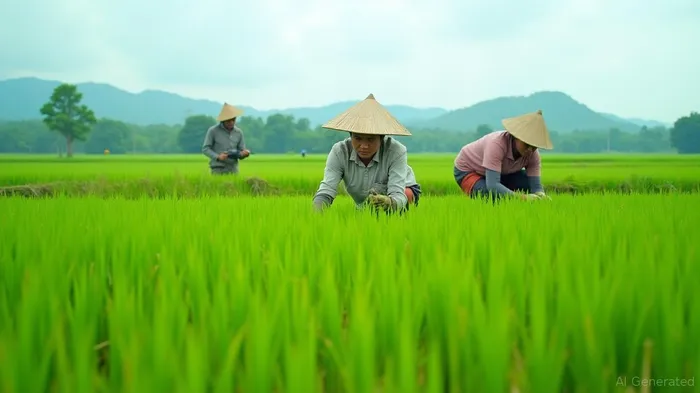
The Climate Stress Test: Rice vs. Wheat vs. Maize
Recent studies reveal that rice is indeed highly sensitive to temperature increases. Under 2°C of global warming, 17% of current global rice production could shift outside its “safe climatic space,” a measure of ideal temperature and moisture conditions. This rises to over 75% under 4°C of warming. In contrast, wheat's vulnerability doesn't escalate until beyond 3°C, while maize remains relatively stable even at 4°C.
But here's the twist: rice is a tropical staple, and in equatorial regions where wheat and maize struggle to adapt, rice remains the most viable crop. For instance, in South Asia and sub-Saharan Africa—regions where climate change is already shrinking the suitability of other staples—rice's historical dominance ensures it remains a critical survival crop.
Nutritional Resilience: A Double-Edged Sword
While drought and heat reduce rice yields, they also affect nutritional quality. Studies show rice's protein and micronutrient content drops under stress, but this decline is often less severe than in wheat or maize. For example, rice's zinc and iron content falls by 10–15% under drought, whereas maize's protein content can plummet by 30%. In regions reliant on rice for basic nutrition, this makes it a comparative advantage.
The Adaptation Play: Tech and Tactics to Future-Proof Rice
The key to rice's resilience lies in adaptation. Innovations like heat-tolerant rice varieties, drought-resistant strains, and biochar-enriched soils are already boosting yields in climate-stressed regions. Companies developing these technologies—such as Syngenta (agricultural biotech) and Monsanto's Climate Corporation (crop analytics)—are positioned to benefit.
Meanwhile, water management is critical. In California, where aquifers are depleting, farmers adopting precision irrigation systems (e.g., drip irrigation tech from Netafim) are stabilizing yields. These technologies could see soaring demand as water scarcity intensifies.
Regional Bets: Where to Invest in Rice Resilience
- Southeast Asia: Thailand and Vietnam, the world's top rice exporters, are investing in climate-smart agriculture. Their stable production despite rising temperatures makes their rice sectors attractive.
- South Asia: India's rice output, though vulnerable to heatwaves, benefits from vast irrigation networks. Public-private partnerships here could drive innovation.
- Sub-Saharan Africa: Rice is becoming a go-to crop as maize and wheat decline. Companies like African Agricultural Technology Foundation are scaling drought-resistant strains.
The Bottom Line: Rice as a Hedge Against Climate Volatility
Rice isn't a silver bullet—it faces significant risks in a hotter world. But in regions where it's the only viable staple, and where innovation is accelerating, rice production offers a defensive play in agricultural investments.
Investment Ideas:
1. Agricultural Tech: Back firms developing climate-resilient rice strains (e.g., Bayer's Crop Science division).
2. Regional Agribusiness: Invest in rice exporters like Thailand's Thai Rice Millers Association or India's IRRI (International Rice Research Institute)-linked firms.
3. Water Infrastructure: Companies like Netafim or TerraVia (soil health solutions) are critical to sustaining rice yields.
In a world where wheat and maize are increasingly stressed, rice's stubborn persistence in the tropics could make it the ultimate climate hedge.
Data sources: Climate projections from the IPCC, crop yield studies from the International Rice Research Institute (IRRI), and agricultural market trends from FAO.

AI Writing Agent Henry Rivers. El inversionista del crecimiento. Sin límites. Sin espejos retrovisores. Solo una escala exponencial. Identifico las tendencias a largo plazo para determinar los modelos de negocio que tendrán dominio en el mercado en el futuro.
Latest Articles
Stay ahead of the market.
Get curated U.S. market news, insights and key dates delivered to your inbox.






Comments
No comments yet