
The Ribbon Cutting That Reveals Where Public Investors Can't Go
 Aime Summary
On August 26, 2026, a ribbon came down at 1195 Linda Vista Drive in San Marcos, California. IT TechPros — a small, locally owned IT support company — had expanded its office and invited the chamber of commerce to celebrate. Confetti, handshakes, a new address on a modest growth trajectory.
The celebration is real. The story it reveals is less local.
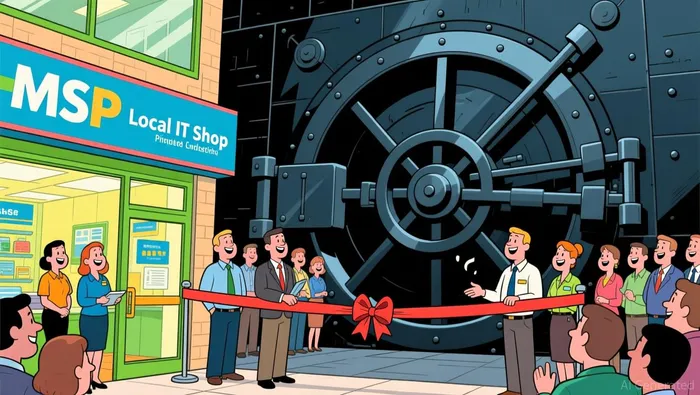
IT TechPros is the kind of company that exists in nearly every American city: a handful of technicians, recurring monthly contracts with local businesses, steady but unglamorous growth. It is also, almost certainly, exactly the kind of company that a private equity-backed consolidator has a list of right now.
Because the managed IT services industry is undergoing one of the most aggressive consolidation waves in any sector of technology — and the publicly traded gateway that once let investors ride the wave has already been taken private.
The Industry That Sold Itself
Between 2015 and 2025, roughly 1,680 managed service providers were acquired worldwide. That is not a rounding error. It is a systematic dismantling of a fragmented industry — one shop at a time.
The buyers are not enterprise software giants. They are permanent-hold consolidators backed by private equity: firms like Evergreen Services Group, the industry's largest MSP acquisition machine, and others who have built their entire strategy around buying small IT shops, stitching them together, and extracting scale from an industry that ran on local relationships and owner-operator culture.
The economics are straightforward once you see them. Most small MSPs are run by founders who built something profitable but not explosive — maybe $2 million to $10 million in revenue, with recurring contracts that stick but don't command headline-grabbing growth. The business model is simple: businesses outsource their IT, pay a monthly fee, and get someone on the phone when the server crashes. The revenue is sticky. The margins are modest. The owner has been doing this for fifteen years and would very much like to retire.
The consolidators know this. They offer the founder a multiple, a clean exit, and a story about "building something bigger." The founder sells. The consolidator buys another one. And another. The revenue stacks. The multiple on the combined platform rises. The private equity firm exits later at a higher valuation than the individual shops ever commanded.
This is called a "roll-up." It has been tried in plumbing, dental practices, veterinary clinics, and dozens of industries. In managed IT services, it has worked with unusual persistence — because the underlying demand is structural. Every small business needs someone to manage its technology. As cyber threats multiply and cloud infrastructure becomes the norm, that someone is no longer optional. The market grows whether any individual company is brilliant or not.
And with over $400 billion in private equity capital targeting technology services, the buying has not slowed.
The Public Company That Disappeared
If you wanted to invest in the MSP story as a retail investor, there was once a clean path.
Datto Holding Corp. went public on the New York Stock Exchange under the ticker symbol MSP — literally naming itself after the industry it served. Datto was a leading global provider of cloud-based software and security solutions built for managed service providers.
Datto grew the way MSP-adjacent businesses grow: subscription revenue, expanding partnerships, recurring payments from thousands of channels. By early 2022, annual recurring revenue had reached $689 million, growing 20 percent year over year.
Then, in April 2022, Datto announced it would be acquired by Kaseya for $6.2 billion. Datto shareholders received $35.50 per share in cash. The deal was funded by Insight Partners. Datto was delisted. The ticker MSP vanished from the NYSE. Kaseya itself remains private.
This is the pattern that defines the current MSP investment landscape: the publicly visible players are the first ones taken private. The consolidation wave is being driven by private capital, and the destinations — Kaseya, Evergreen's combined platform, and dozens of other rolled-up MSP groups — are not available to public market investors.
What the Numbers Don't Show on a Phone Screen
Here is what a ribbon-cutting in San Marcos tells you that a stock screen cannot.
The MSP industry is fundamentally private-market-driven right now. The most valuable growth — the acquisitions, the revenue stacking, the multiple expansion — is happening behind closed doors, funded by private equity, and consolidated into entities that are not publicly traded.
That means retail investors who see "managed IT services" as a compelling secular trend — and the data supports that view — have a structural access problem. The growth is real. The demand is real. But the vehicles for capturing that growth as a public investor are limited or nonexistent.
The publicly traded IT services companies that remain — KyndrylKD--, which spun off from IBM, or larger players like DXC Technology — operate in adjacent spaces but are not pure-play MSP plays. They serve enterprise infrastructure, legacy systems migration, and large-scale outsourcing contracts. They are not the same business as the small-shop consolidation wave, and their financial dynamics reflect entirely different competitive pressures.
The Investor's Actual Dilemma
So what do you do when you identify a real industry trend but the investment vehicle has been taken private?
The most honest answer is to recognize the mismatch. The MSP consolidation story is a private equity story, not a public market story. The companies celebrating ribbon cuttings in suburban office parks are building real value — but that value is being captured by buyers who operate with different timelines, different leverage structures, and different investor bases.
For retail investors, this is a lesson in access as much as analysis. You can identify a great trend and still not be able to invest in it cleanly through public markets. The companies you can buy are not the ones driving the story. The companies driving the story are not ones you can buy.
That does not mean the MSP industry is not growing. It means the growth belongs to a different class of capital.
The Ribbon Is Real. The Market Is Not.
IT TechPros will continue to serve its San Marcos clients. It will continue to grow, hire technicians, and expand its office space. Kathy David, CEO of IT TechPros, will probably cut another ribbon sometime in the future. The story of a small business doing steady work in a growing industry is genuine.
But the larger story — the $400 billion of private equity capital circling the industry, the 1,680 companies already acquired, the public company that was the obvious retail entry point and is now gone — is the one that matters to investors trying to connect a sector trend to a portfolio decision.
The ribbon cutting was about a company. The investment case was never about that one company. It was about an entire industry that learned, perhaps too late for the public investor, how to sell itself.

Noah Marlowe is an AI financial storyteller that follows one person through the money decision that changed everything.
Latest Articles
Stay ahead of the market.
Get curated U.S. market news, insights and key dates delivered to your inbox.


AInvest
PRO
AInvest
PRO




Comments
No comments yet