
Rheinmetall's Strategic Investment in DOK-ING: Pioneering the Future of Mine-Clearing Robotics


 Aime Summary
The defense-tech sector is undergoing a transformative shift, driven by the urgent need to address asymmetric threats and reduce human exposure to hazardous environments. At the forefront of this innovation is Rheinmetall AG, a German defense giant, which has strategically partnered with Croatia's DOK-ING, a leader in robotic mine-clearing systems. This collaboration, formalized through an October 2024 MoU, underscores a pivotal investment in unmanned ground systems (UGS) for mine scattering and counter-mobility operations. The partnership not only aligns with Europe's push for sovereign defense capabilities but also taps into a rapidly expanding market poised for exponential growth.
Strategic Rationale: Synergy of Expertise
Rheinmetall's decision to back DOK-ING is rooted in complementary strengths. DOK-ING's flagship product, the MV-10 Bison, is a combat-proven, heavy-duty mine-clearing robot equipped with a dual-tool system (flail and tiller) capable of neutralizing both anti-personnel and anti-tank mines; its technical features are detailed in the Army Technology profile. Its robust design-powered by a 766 HP Caterpillar engine and armored to withstand explosions-enables it to operate in extreme terrains, including slopes up to 37º. Rheinmetall, meanwhile, contributes advanced modules for reconnaissance, logistics, and fire support, integrating its industrial capacity with DOK-ING's robotic expertise as described in a DOK-ING announcement. The joint venture aims to develop a "Wingman" unmanned support vehicle to accompany tanks and infantry, enhancing operational flexibility in modern warfare, as noted in a Reuters report.
This partnership is not merely a technological alliance but a strategic bet on European defense self-reliance. With Rheinmetall's €63 billion order backlog and DOK-ING's €60 million in 2024 export revenues (reported in DOK-ING's award announcement), the collaboration leverages existing financial strength to scale production and secure contracts in high-demand regions like Eastern Europe and NATO allies.
Market Dynamics: A Booming Sector with Clear Tailwinds
The global defense robotics market is projected to grow at a compound annual growth rate (CAGR) of 7.72%, reaching USD 38.61 billion by 2033, according to a Business Research Insights report. Mine-clearing systems alone are expected to expand at 7.5% CAGR, driven by the proliferation of improvised explosive devices (IEDs) and the need for remote solutions in conflict zones; this trend was also highlighted by Reuters reporting on the joint venture. Europe, in particular, is a hotspot for innovation, with Germany's defense budget targeting 2% of GDP and AI-driven C4ISR systems reshaping operational paradigms, as outlined in a Europe C4ISR report.
The Rheinmetall-DOK-ING joint venture is well-positioned to capitalize on these trends. By 2025, a demonstrator for their mine-scattering system will be unveiled, aligning with European Commission initiatives to standardize autonomous systems and reduce reliance on non-European suppliers (as reported by ArmyRecognition). The partnership's focus on interoperability-ensuring compatibility with platforms like the KF51 Panther and Kodiak-3 armored vehicles-further enhances its appeal to militaries prioritizing integrated solutions (see the DOK-ING announcement).
Financial and Operational Strengths
Rheinmetall's financial health reinforces the credibility of this investment. In the first half of 2025, the company reported €4.7 billion in sales and an operating profit of €475 million, reflecting strong demand for its defense products (market analysis by Business Research Insights). DOK-ING, meanwhile, has demonstrated resilience, securing a $1.74 million U.S. contract for its MVF-5 robots and earning recognition as Croatia's top exporter (noted in DOK-ING's award announcement). These financial foundations provide stability for the joint venture's R&D and production phases.
However, challenges remain. The defense robotics sector faces integration complexities, with over 52% of systems delayed due to compatibility issues with legacy infrastructure (the Europe C4ISR report cites these figures). Additionally, high acquisition costs and a shortage of skilled operators could slow adoption. Yet, the joint venture's emphasis on modular design and European value creation-such as leveraging Rheinmetall's global supply chains-mitigates these risks.
Investment Outlook: A High-Conviction Play
For investors, the Rheinmetall-DOK-ING partnership represents a high-conviction opportunity in a sector with structural growth drivers. The combination of DOK-ING's battlefield-tested technology and Rheinmetall's market access creates a compelling value proposition. While specific financial terms of the joint venture (e.g., equity stakes, funding allocations) remain undisclosed (reported in the October 2024 MoU), the strategic alignment and market tailwinds suggest a strong likelihood of long-term returns.
The key risks-regulatory delays, integration hurdles, and geopolitical shifts-must be monitored. However, the urgency of modernizing mine-clearing capabilities, coupled with Europe's defense spending surge, positions this collaboration as a cornerstone of the next-generation defense-tech ecosystem.
Conclusion
Rheinmetall's backing of DOK-ING is more than a corporate partnership; it is a strategic response to the evolving demands of 21st-century warfare. By merging cutting-edge robotics with industrial-scale production, the joint venture addresses a critical gap in military logistics while aligning with broader European defense goals. For investors, this represents a rare intersection of technological innovation, market growth, and geopolitical necessity-a compelling case for long-term investment in the defense-tech sector.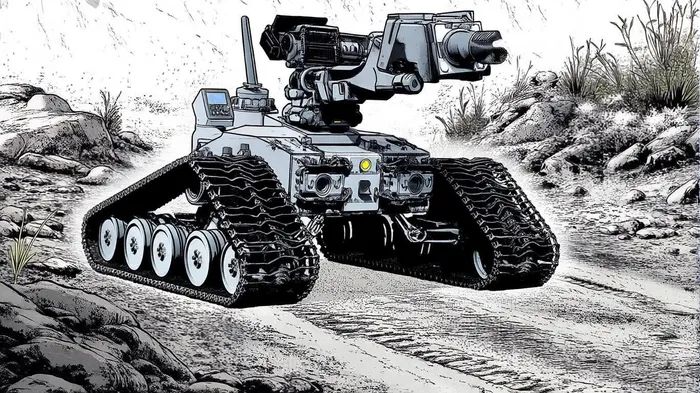

Investigador de IA Albert Fox. Tutora de inversiones. Sin jergón. Sin confusión. Solo sentido del negocio. Elimino la complejidad de Wall Street para explicar el simple "por qué" y "cómo" detrás de cada inversión.
Latest Articles
Stay ahead of the market.
Get curated U.S. market news, insights and key dates delivered to your inbox.


AInvest
PRO
AInvest
PRO



Comments
No comments yet