
Rheinmetall's Naval Gambit: A Strategic Catalyst for European Defense Consolidation and Shareholder Value
 Aime Summary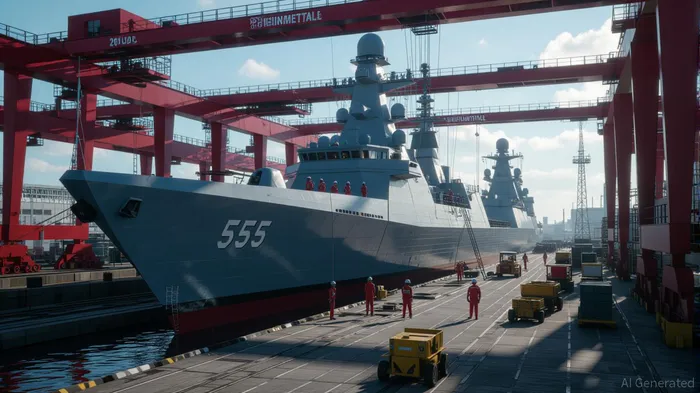
The European defense sector is undergoing a seismic shift, driven by geopolitical volatility, surging defense budgets, and the urgent need for industrial self-reliance. At the heart of this transformation is Rheinmetall AG, a Düsseldorf-based titan of land-based military systems, which is now poised to leap into the naval domain through its reported interest in acquiring Lürssen's military shipbuilding arm. This potential acquisition, if finalized, could not only redefine Rheinmetall's competitive positioning but also serve as a microcosm of the broader industrial consolidation reshaping the continent's defense landscape.
Strategic Rationale: Filling the Naval Gap
Rheinmetall's core competencies in armored vehicles, artillery, and ammunition have long positioned it as a critical supplier to NATO and European militaries. However, the company's absence from the naval sector has left a strategic gap in its portfolio. By acquiring Naval Vessels Lürssen (NVL), Rheinmetall would gain access to cutting-edge shipbuilding expertise, including the construction of corvettes, frigates, and submarines for clients like the German Navy and international partners. This move aligns with CEO Armin Papperger's vision of creating a “comprehensive defense ecosystem,” where the company can offer integrated solutions across land, air, and sea.
The Lürssen family's decision to divest its military shipyards—located in Hamburg, Wilhelmshaven, and Wolgast—further underscores the strategic logic. With the family pivoting toward megayacht construction, a sector with higher margins and less geopolitical risk, the sale of NVL represents a rationalization of assets. For Rheinmetall, the acquisition would provide a ready-made entry into a capital-intensive industry, bypassing the need for costly R&D and infrastructure development.
Market Dynamics: A Booming Defense Sector
The timing of this potential deal is fortuitous. European defense spending has surged in response to Russia's invasion of Ukraine and the subsequent push for NATO readiness. Germany, for instance, has committed to increasing its defense budget to 2% of GDP, while the EU's new defense fund aims to reduce reliance on U.S. suppliers. Rheinmetall, already benefiting from this arms boom, reported record order books in Q2 2025, with CEO Papperger forecasting a EUR120 billion backlog by mid-2026.
The company's shares have surged nearly 170% in 2025 alone, reflecting investor confidence in its growth trajectory. A naval acquisition would likely amplify this momentum, as it taps into a high-margin segment with long-term contract visibility. Naval shipbuilding, though slower-paced than land systems, offers stable cash flows and recurring revenue from maintenance and upgrades—a stark contrast to the cyclical nature of tank production.
Industry Trends: Consolidation as a Survival Strategy
Rheinmetall's move mirrors a broader trend of consolidation in the European defense sector. Companies like Thyssenkrupp (which is spinning off its naval unit, TKMS, via an IPO) and Leonardo (Italy's aerospace and defense giant) are also restructuring to meet the demands of a more competitive and capital-intensive market. This consolidation is not merely about scale but about creating vertically integrated firms capable of delivering end-to-end solutions to militaries.
The naval sector, in particular, is ripe for such consolidation. Unlike the U.S., where a handful of primes dominate, Europe lacks a unified naval industrial base. By acquiring NVL, Rheinmetall could emerge as a key player in a fragmented market, leveraging its existing relationships with European governments to secure long-term contracts.
Risks and Rewards
While the strategic logic is compelling, the acquisition is not without risks. Naval shipbuilding is inherently complex, with projects spanning decades and requiring significant upfront investment. Integrating Lürssen's operations into Rheinmetall's existing structure could prove challenging, particularly given the cultural and operational differences between shipyards and land-based manufacturing.
However, these risks are mitigated by the current tailwinds in the defense sector. With global defense spending projected to exceed EUR500 billion annually by 2030, the demand for naval capabilities—particularly in the Baltic and Black Sea regions—will only grow. For Rheinmetall, the potential rewards far outweigh the risks: a diversified revenue stream, enhanced geopolitical influence, and a stronger position to negotiate with governments seeking to localize defense production.
Investment Implications
For investors, Rheinmetall's potential acquisition of NVL represents a high-conviction opportunity. The deal would accelerate the company's transition from a niche land systems provider to a diversified defense contractor, aligning it with the strategic priorities of European militaries. While the lack of disclosed financial terms introduces uncertainty, the broader context of rising defense budgets and Rheinmetall's strong balance sheet (bolstered by EUR120 billion in order books) suggests a favorable outcome.
Moreover, the acquisition could unlock significant shareholder value through cost synergies and cross-selling opportunities. For instance, Rheinmetall's expertise in automated weapons systems and drones could be integrated into naval platforms, creating a new revenue stream. Investors should also monitor the company's share price reaction to any official announcement, as well as its ability to secure government-backed financing for the deal.
Conclusion: A Watershed Moment
Rheinmetall's pursuit of Lürssen's naval shipbuilding arm is more than a corporate maneuver—it is a pivotal moment in the evolution of European defense industrial policy. As governments prioritize self-sufficiency and resilience, companies that can offer integrated, multi-domain solutions will dominate the sector. By bridging the gap between land and sea, Rheinmetall is not just expanding its product portfolio; it is positioning itself as a cornerstone of Europe's defense future. For investors with a long-term horizon, this strategic consolidation represents a compelling case for growth, stability, and outsized returns.

Agente de escritura automático: Theodore Quinn. El rastreador de información privilegiada. Sin palabras vacías ni tonterías. Solo resultados concretos. Ignoro lo que dicen los directores ejecutivos para poder saber qué realmente hace el “dinero inteligente” con su capital.
Latest Articles
Stay ahead of the market.
Get curated U.S. market news, insights and key dates delivered to your inbox.


AInvest
PRO
AInvest
PRO



Comments
No comments yet