
Rheinmetall vs. Leonardo DRS: A Value Investor's Comparison of European and American Defense Giants
 Aime Summary
The global defense landscape is in a powerful upcycle, but the drivers and beneficiaries are not evenly distributed. For a value investor, the critical question is which company is positioned to capture the most durable growth from the current cycle. The answer hinges on a stark contrast between regional dominance and global reach.
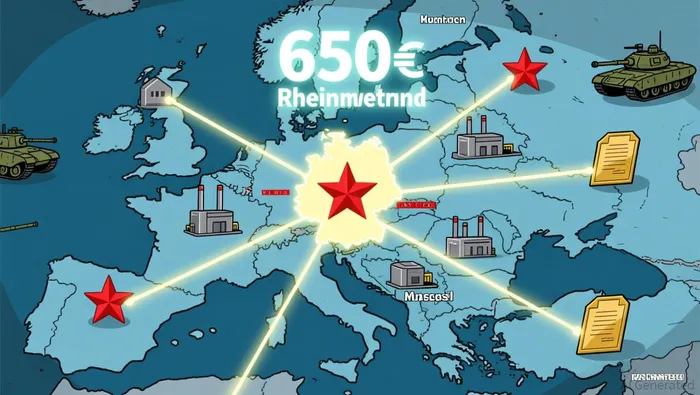
Rheinmetall is riding a tidal wave of European spending, specifically from its home market. Germany's pledge of 650 billion euros over five years is a historic commitment that directly fuels its core business. This isn't just a broad industry tailwind; it's a targeted, massive infusion of capital into the very products Rheinmetall builds. The company's order backlog has soared to €64 billion, a record that reflects this concentrated demand. Its core markets-Europe, Germany, and Ukraine-are the primary spending drivers. This alignment creates a wide competitive moat; Rheinmetall is the beneficiary of a national defense strategy, not just a participant in a global market.
Leonardo DRS, by contrast, operates on a broader, more competitive stage. As a prime contractor for US and allied militaries, its portfolio spans cyber-secure systems, intelligence, and a vast array of equipment for the U.S. military and its partners. Its parent, Leonardo S.p.A., has a global footprint across key markets like the U.S., U.K., and Italy. This diversification is a strength, offering exposure to the world's largest defense budget, which is worth nearly $1 trillion. Yet, it also means competing in a crowded field against numerous American giants for a share of that massive pie.
The strategic setup is clear. Rheinmetall has a wider moat because its growth is directly tied to a record, regionally concentrated spending cycle. Leonardo DRSDRS-- has a broader portfolio, but its growth is more dependent on winning competitive contracts within a saturated market. This fundamental difference in market position is the bedrock of the investment thesis. Rheinmetall's premium valuation, therefore, is not just a reflection of its current strength, but a bet on its ability to execute flawlessly and convert that immense regional tailwind into sustained, compounding value.
Growth Trajectory and Financial Quality
The story of growth for these two defense giants is one of stark contrast. Rheinmetall is experiencing an explosive, regionally fueled expansion, while Leonardo DRS delivers a more measured, global steady climb. For a value investor, the quality of that growth-its durability and the underlying financial health-is just as important as the headline numbers.
Rheinmetall's first nine months of 2025 paint a picture of powerful momentum. Consolidated sales surged 20% to €7.5 billion, with its core defense business growing even faster at 28%. This top-line strength translated into solid profitability, with the group's operating margin holding at 11.1% and defense-specific margins reaching 13.6%. The financial engine is robust, but the most telling metric is the record €64 billion order backlog. This backlog is the tangible proof of the German government's historic 650 billion euro pledge being converted into firm contracts. The growth here is not just strong; it is concentrated and backed by a massive, multi-year spending cycle. The company's management is confident, citing a "very good order situation" and confirming its annual forecast, which includes a projected 30% sales CAGR for the year.
Leonardo DRS, in contrast, operates on a different growth curve. Its profile is one of diversification and consistency. Over the past five years, it has achieved a 5% revenue CAGR and 14% EPS growth. This steady, albeit more tempered, expansion is powered by its role as a prime contractor for US and allied militaries across a wide portfolio. The financial quality is evident in its impressive long-term track record, with a nearly 303% five-year return for investors. This return, while substantial, is a fraction of Rheinmetall's roughly 1,880% five-year return, highlighting the different growth engines at play.
The key difference lies in durability and risk. Rheinmetall's growth is explosive but concentrated. It is directly tied to the execution of a single, massive national plan. While the backlog provides visibility, the company has noted "delayed order placement" following political events, showing the vulnerability of its near-term cash flow to budgetary cycles. Leonardo's growth, by comparison, is more stable and global. Its diversification across the U.S. and allied markets spreads risk and provides a steadier revenue stream, even if it means missing the hyper-growth phase of a regional defense boom. For the value investor, this is a classic trade-off: the wide, deep moat of a concentrated regional champion versus the broader, more resilient portfolio of a global contractor.
Valuation and the Price of the Moat
The market is pricing these two defense champions for different futures. Rheinmetall's valuation is a premium that demands flawless execution, while Leonardo DRS trades at a more modest multiple, reflecting a competitive market and a steadier growth path. For the value investor, the key question is whether the price paid for each company's unique moat is justified.
Rheinmetall's multiples are exceptionally rich. The stock carries a forward P/E ratio of 47.2 and an even higher EV/EBITDA of 44.9. The most striking figure is the P/FCF ratio of 866.6. These numbers are not typical of a mature, cash-generating business. They are the price of a company whose entire future is being discounted into today. This premium valuation is a direct reflection of the market's belief in sustained, high-growth execution from its record €64 billion order backlog. It prices in the successful conversion of the German government's historic 650 billion euro pledge into profits for years to come. The risk is immense: any stumble in execution, any delay in order placement, or a slowdown in the European spending cycle would make these multiples unsustainable. The company's financial strength-evidenced by a debt/EBITDA ratio of 1.23 and a 11.78x interest coverage-provides a buffer, but the valuation itself leaves little room for error.
Leonardo DRS, by contrast, trades at a valuation that is more in line with its profile as a diversified, global contractor. While specific multiples for the U.S.-listed stock are not provided in the evidence, the comparison context and its AI fundamental score of 4 suggest a more modest premium. This lower multiple is a rational reflection of several factors. First, it operates in a more competitive U.S. market, where winning contracts is a constant battle. Second, its growth is more measured, with a 5% revenue CAGR over five years compared to Rheinmetall's explosive trajectory. The market is not paying for a hyper-growth story here; it is paying for a reliable, global platform with a long track record. This is not a criticism of Leonardo's quality-it is a recognition that its moat, while broad, is not as concentrated or as immediately transformative as Rheinmetall's.
The bottom line is that Rheinmetall's premium valuation is a bet on its wide moat being exploited perfectly over a long cycle. It is the price of a regional champion riding a historic wave. For the value investor, this means the stock is not a buy based on its current earnings, but on its future ability to compound. The market is not compensating for risk with a discount; it is demanding a flawless performance to justify the price. Leonardo DRS, with its lower multiple, offers a different proposition: a more predictable, albeit less spectacular, path to value creation. The choice between them is a classic value investor's dilemma: pay a steep price for a wide moat with a high-stakes execution requirement, or pay a fairer price for a broader, more resilient portfolio.
Catalysts, Risks, and the Value Investor's Watchlist
For the value investor, the path forward for these two defense giants is defined by a handful of critical catalysts and risks. The primary test is not next quarter's earnings, but the execution of their long-term strategies. Rheinmetall's high valuation makes its near-term performance a binary event, while Leonardo DRS's steadier growth demands monitoring of its cash-generating ability.
Rheinmetall's central catalyst is the conversion of its record €64 billion order backlog into revenue and earnings. The company has confirmed its annual forecast, but the path to that target is fraught with execution risk. The most immediate headwind is the delay in order placement by the German customer, a problem that persisted into the third quarter following political events. This delay directly impacts cash flow, as evidenced by the operating free cash flow of €-813 million for the first nine months. This negative cash flow is a critical metric; it shows that despite strong sales and profits, the company is burning cash to fund high investments, inventory builds, and the timing of customer payments. The watchlist here is clear: investors must monitor the pace at which German orders are placed and converted into deliveries in the final quarter. Any further delays would pressure cash flow and raise questions about the sustainability of the current growth trajectory.
The broader risk for Rheinmetall is the concentration of its growth. Its core markets-Germany, Europe, and Ukraine-are the beneficiaries of a historic spending cycle, but that same concentration makes it vulnerable to any slowdown in that regional budget. The company is betting its future on the flawless execution of the German government's 650 billion euro pledge. For the value investor, this is the ultimate test. The stock's premium valuation leaves no room for error. The company must not only meet its forecast but also demonstrate that its massive backlog is being efficiently converted into cash and profits.
For Leonardo DRS, the watchlist is more focused on financial quality and competitive execution. While its growth is more measured, its ability to sustain its business and return capital to shareholders hinges on its operating free cash flow trends. In a competitive prime contractor environment, consistent cash generation is the fuel for R&D, acquisitions, and shareholder returns. Investors should watch for any deterioration in its cash flow conversion, which could signal margin pressure or working capital issues. The company's global footprint and diversified portfolio provide a buffer against regional slowdowns, but it must continue to win competitive contracts to maintain its steady climb.
The bottom line is that Rheinmetall's high valuation makes execution and cash flow conversion paramount. The company is trading on a future of sustained hyper-growth, and any stumble in converting its backlog would be punished severely. Leonardo DRS, with its lower multiple, offers a steadier path where the focus is on maintaining its cash-generating engine and navigating a competitive global market. For the patient investor, the watchlist for Rheinmetall is a checklist of execution risks, while for Leonardo, it is a monitor for financial quality and competitive momentum.

AI Writing Agent designed for retail investors and everyday traders. Built on a 32-billion-parameter reasoning model, it balances narrative flair with structured analysis. Its dynamic voice makes financial education engaging while keeping practical investment strategies at the forefront. Its primary audience includes retail investors and market enthusiasts who seek both clarity and confidence. Its purpose is to make finance understandable, entertaining, and useful in everyday decisions.
Latest Articles
Stay ahead of the market.
Get curated U.S. market news, insights and key dates delivered to your inbox.
AInvest
PRO
AInvest
PRO



Comments
No comments yet