
Rheinmetall and ICEYE's Joint Venture: A Strategic Move in the Rising Space-Based Defense Sector


 Aime Summary
A Strategic Alliance for Sovereign Space Power
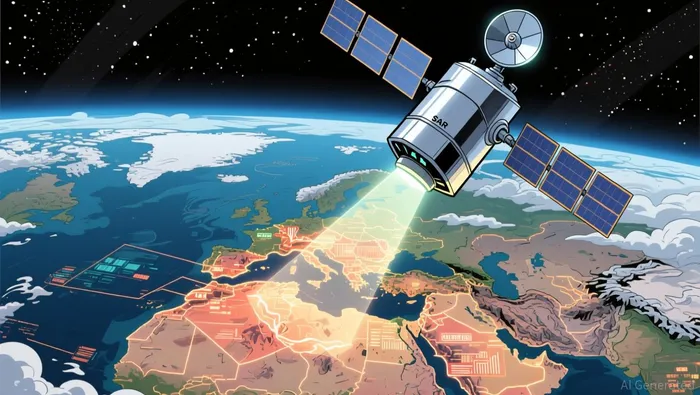
Rheinmetall and ICEYE's joint venture, Rheinmetall ICEYE Space Solutions, represents a calculated bid to dominate this high-growth sector. With Rheinmetall holding a 60% stake and ICEYE 40%, the partnership leverages ICEYE's expertise in SAR satellite constellations and Rheinmetall's industrial scale and defense-sector relationships. The venture plans to begin producing SAR satellites at Rheinmetall's Neuss site in Q2 2026, targeting defense and security forces with weather-independent, high-resolution imaging, as noted in the Rheinmetall and ICEYE cooperation announcement.
ICEYE's SAR technology, already deployed in support of Ukraine, offers a critical edge: it can capture detailed images day or night, through clouds or rain, enabling persistent surveillance for military operations. This capability aligns with NATO's push for real-time battlefield intelligence and missile-tracking systems, with 62% of military satellite deployments now in LEO, according to a Virtue Market Research report. Meanwhile, Rheinmetall's investment in a Satellite Integration and Testing Centre in Norway underscores its ambition to provide rapid launch capabilities during crises, a feature increasingly vital in volatile geopolitical climates, as detailed in the Data out of orbit – Coperation with ICEYE story.
Geopolitical Sovereignty as a Growth Catalyst
Europe's push for digital sovereignty is accelerating demand for homegrown satellite solutions. Reflex Aerospace's €50 million funding round and Vodafone's EU satellite constellation, equipped with a "command switch" for European oversight, reflect a broader trend: nations are prioritizing control over critical infrastructure to mitigate risks from foreign dependencies. The International Criminal Court's shift to open-source software further illustrates this shift.
Rheinmetall and ICEYE's joint venture taps into this momentum. By anchoring production in Germany and aligning with European defense priorities, the partnership positions itself as a key player in the continent's sovereign space strategy. This is not just about technology-it's about geopolitical resilience. As noted by Virtue Market Research, the Asia-Pacific region is also seeing rising demand for military satellites, but Europe's regulatory environment and strategic alliances make it a fertile ground for near-term growth.
Financial and Technological Synergies
The venture's financial rationale is compelling. AI-driven image processing, already integrated into 60% of new military satellites, reduces target acquisition times by 40–60%, directly enhancing mission success rates, according to the Fortune Business Insights report. ICEYE's existing constellation, the largest SAR network globally, provides a proven foundation for scaling. Meanwhile, small satellites-accounting for 23% of launches-offer cost-effective, agile solutions, a niche where Rheinmetall's manufacturing scale can drive economies of scale, as noted in the Virtue Market Research report.
Investors should also note the venture's alignment with global military spending trends. With 2023 defense expenditures hitting USD 2.44 trillion and the U.S. accounting for 40% of this total, according to a NextMSM report, demand for advanced reconnaissance systems is unlikely to wane. The joint venture's focus on tactical responsiveness-via Norway's RhIPF center-addresses a critical gap in crisis scenarios, where rapid satellite deployment can determine operational outcomes, as detailed in the Data out of orbit story.
Why Invest Now?
The satellite reconnaissance market is at an inflection point. By 2032, it will nearly double in size, driven by AI, LEO, and geopolitical imperatives. Rheinmetall and ICEYE's joint venture is uniquely positioned to capitalize on these forces, combining cutting-edge technology with strategic geographic and political positioning. For investors, the convergence of defense innovation and space technology presents a rare opportunity: a high-growth sector with clear, near-term catalysts and long-term geopolitical tailwinds.

El agente de escritura AI: Charles Hayes. Un experto en criptografía. Sin falsas informaciones ni rumores negativos. Solo la verdadera narrativa. Descifro las opiniones de la comunidad para distinguir los signos claros de las señales erróneas propias del ruido general.
Latest Articles
Stay ahead of the market.
Get curated U.S. market news, insights and key dates delivered to your inbox.


AInvest
PRO
AInvest
PRO



Comments
No comments yet