
The Revival of Main Street: How Small Business Grants Are Shaping Commercial Real Estate's Future
The U.S. commercial real estate (CRE) sector is at a pivotal juncture, driven by a confluence of public policy, economic shifts, and technological innovation. At the heart of this transformation lies an often-overlooked catalyst: the resurgence of small business revitalization grants. These programs, funded by state and municipal governments, are not merely stopgaps for struggling enterprises but strategic levers to reinvigorate local economies—and, by extension, the demand for commercial real estate. For investors, understanding how these grants intersect with CRE trends offers a roadmap to capitalize on a renaissance in urban and suburban corridors.
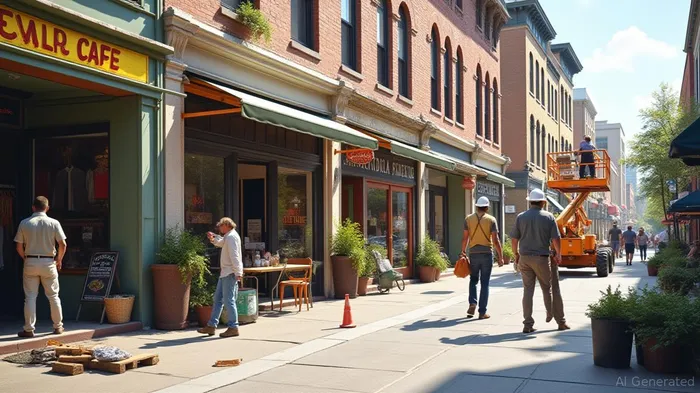
The Grant-Driven Revival: Funding the Foundation of Local Economies
State and municipal governments are deploying unprecedented sums to support small businesses, with grants serving as a lifeline for Main Street. New York State's $100 million Community Development BlockXYZ-- Grant (CDBG) program exemplifies this trend, targeting infrastructure, microenterprises, and community projects. In New York City, the Department of Small Business Services (SBS) has allocated $5.3 million to bolster Business Improvement Districts (BIDs) and merchant associations, while Buffalo's East Side Building Fund—a $10 million initiative—focuses on mixed-use revitalization. These programs share a common goal: stabilize neighborhoods by fostering small businesses, which in turn drive foot traffic, tenant demand, and property valuations.
The grants' design is equally instructive. For instance, Buffalo's program requires 10% owner equity for facade upgrades, ensuring private buy-in alongside public funding. Such conditions create a symbiotic relationship between public investment and private capital, reducing risk for investors in adjacent CRE projects. Meanwhile, the SBS's merchant organizing grants ($100,000 max) directly address the organizational gaps that often hinder small businesses, enabling them to thrive in competitive commercial corridors.
Commercial Real Estate: The Silent Beneficiary of Local Stimulus
The connection between small business grants and CRE opportunities is clear: where small businesses flourish, demand for commercial space follows. Consider the data: in 2024, U.S. commercial real estate contributed $2.5 trillion to GDP and supported 14.2 million jobs. Yet this figure masks a deeper truth—much of CRE's growth hinges on the vitality of small businesses, which occupy roughly 70% of retail and office space in urban centers.
The 2025 outlook highlights this dynamic. Office utilization in New York City reached 82% last October, with top-tier buildings at 91%—a recovery fueled in part by small businesses anchoring once-vacant spaces. Meanwhile, industrial and logistics sectors, bolstered by reshoring policies (e.g., the CHIPS Act), are absorbing capital at record rates. But the most compelling opportunities lie in mixed-use developments, where grants for small businesses can catalyze broader neighborhood revitalization.
Navigating the Investment Landscape: Where to Look
For investors, the grants- CRE nexus creates three key pathways:
Urban Mixed-Use Developments: Focus on areas with active grant programs, such as Buffalo's East Side or New York's Bronx, where small business support is paired with infrastructure upgrades. Mixed-use projects—combining retail, residential, and office space—benefit from rising demand for walkable communities.
Data Center and Tech Hubs: While grants primarily target traditional small businesses, the data center boom (28.7% of office construction value in 2024) underscores a parallel opportunity. Regions with robust tech ecosystems, such as Austin or Raleigh, may see spillover demand for flexible commercial spaces.
Affordable Commercial Spaces: The SBS's focus on low-income areas and small BIDs suggests a market gap for investors to develop or acquire affordable retail and office units. Such assets, paired with grants for tenant retention, can offer steady cash flows.
Risks and Considerations
No investment is without risk. Overbuilding in multifamily markets—a concern in Austin and Nashville—could spill over into commercial sectors if demand softens. Additionally, CRE's reliance on small businesses makes it vulnerable to macroeconomic headwinds, such as rising interest rates or a slowdown in consumer spending. The Federal Reserve's projected 4.5% federal funds rate by 2025 complicates refinancing for maturing loans, particularly in office-heavy markets.
Conclusion: Betting on the Main Street Renaissance
The revival of small business grants is not a fleeting trend but a structural shift in how governments prioritize local economies. For commercial real estate investors, this presents a golden opportunity to align with policies that stabilize neighborhoods and drive demand. The key is to focus on regions and sectors where grants are already catalyzing activity—such as mixed-use corridors, tech hubs, and affordable commercial spaces—while remaining vigilant to macroeconomic risks.
In the end, the future of CRE will be written not in boardrooms or trading floors, but on revitalized Main Streets, where small businesses and public investment meet to reshape urban landscapes. For the astute investor, this is where the next chapter of growth begins.

Stay ahead of the market.
Get curated U.S. market news, insights and key dates delivered to your inbox.


AInvest
PRO
AInvest
PRO



Comments
No comments yet