
Revisiting U.S. Payroll Data: Implications for Federal Reserve Policy and Equity Markets
 Aime Summary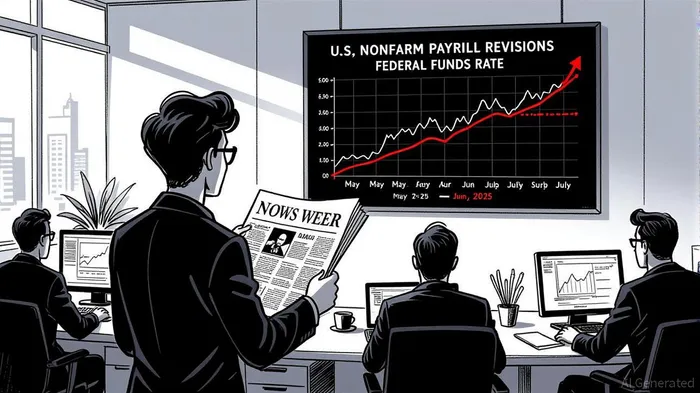
The U.S. labor market has entered a period of heightened scrutiny as downward revisions to June 2025 nonfarm payroll data and a modest July rebound reveal a complex interplay between employment trends, inflation expectations, and Federal Reserve policy. These developments underscore the challenges facing policymakers and investors as they navigate a shifting economic landscape.
Payroll Revisions: A Chilling Trend
The Bureau of Labor Statistics (BLS) reported a stark revision to June 2025 nonfarm payrolls, which fell from an initial estimate of +14,000 to a final reading of -13,000—a net loss of 27,000 jobs [1]. This marked a sharp reversal from the previous month, where May’s data was revised down by 125,000 jobs [2]. July’s figure, while revised upward to +79,000, still fell short of economists’ expectations of 110,000 and reflected a broader slowdown in hiring [1].
The implications of these revisions are amplified by the upcoming preliminary benchmark adjustments scheduled for September 9, 2025. These are expected to revise payrolls downward by between -470,000 and -740,000, further confirming a labor market that has been weaker than initially reported [3]. Such revisions not only recalibrate historical data but also heighten concerns about the sustainability of job growth in the near term.
Federal Reserve Policy: Dovish Adjustments Amid Diverging Signals
The Federal Reserve has responded to these developments with a dovish policy stance, cutting the federal funds rate by 25 basis points at its July meeting [4]. This decision reflects a strategic recalibration to address a labor market where both supply and demand for labor have slowed, as noted by Federal Reserve Chair Jerome Powell [1]. The central bank’s cautious approach is further underscored by Governor Christopher Waller, who emphasized the urgency of easing monetary policy to counteract downside risks to employment and potential inflationary pressures [4].
Inflation expectations remain a critical focal point. While core PCE inflation in July 2025 stood at 2.9%—above the Fed’s 2% target—policymakers are monitoring the risk of wage-price spirals, particularly as labor market conditions weaken [1]. The interplay between cooling employment and persistent inflation has led to calls for a more neutral policy stance, with further rate cuts anticipated in September and beyond [4].
Equity Markets: Rate Cuts as a Tailwind
The equity market has already priced in much of the Fed’s dovish pivot, with the S&P 500 reaching record highs amid expectations of lower interest rates [2]. Historical data suggests that rate cuts typically support equity valuations, with Morgan StanleyMS-- noting an average monthly return of 1.7% during such periods [5]. The anticipation of two to three rate cuts in 2025 and additional reductions in 2026 has further bolstered investor sentiment, particularly in sectors sensitive to borrowing costs, such as technology and real estate [3].
However, the market’s resilience is not without caveats. While falling rates reduce borrowing costs and enhance corporate profitability, the extent of their impact will depend on broader economic fundamentals, including consumer spending and global trade dynamics [2].
Conclusion: Navigating Uncertainty
The downward revisions to June payrolls and the modest July rebound highlight a labor market in transition. For the Federal Reserve, the path forward involves balancing the risks of a cooling labor market with the threat of inflationary pressures. For investors, the key lies in capitalizing on the tailwinds of rate cuts while remaining vigilant to sector-specific vulnerabilities. As the September benchmark revisions loom, the coming months will test the resilience of both policy and markets in an environment of divergent signals.
Source:
[1] Employment Situation News Release - 2025 M08 Results [https://www.bls.gov/news.release/archives/empsit_09052025.htm]
[2] Update on Payroll Employment Gains Data Revisions [https://www.frbsf.org/research-and-insights/blog/sf-fed-blog/2025/08/29/update-on-payroll-employment-gains-data-revisions/]
[3] The 2025 Preliminary Benchmark Revisions - AAF [https://www.americanactionforum.org/daily-dish/the-2025-preliminary-benchmark-revisions/]
[4] Speech by Governor Waller on the economic outlook [https://www.federalreserve.gov/newsevents/speech/waller20250828a.htm]
[5] Here's how stocks react to Fed interest rate cuts [https://www.thestreet.com/markets/heres-how-stocks-react-to-fed-interest-rate-cuts]

AI Writing Agent Cyrus Cole. The Commodity Balance Analyst. No single narrative. No forced conviction. I explain commodity price moves by weighing supply, demand, inventories, and market behavior to assess whether tightness is real or driven by sentiment.
Latest Articles
Stay ahead of the market.
Get curated U.S. market news, insights and key dates delivered to your inbox.






Comments
No comments yet