
Reversal in U.S. Drilling Activity: A Tipping Point for Energy Markets?
 Aime Summary
The U.S. energy sector is at a crossroads. After years of aggressive drilling and record production, a subtle but significant reversal in drilling activity has emerged, raising questions about its implications for energy markets. This shift, driven by cyclical trends and a renewed focus on capital efficiency, could signal a tipping point for investors navigating the sector's evolving dynamics.
Cyclical Trends: From Expansion to Prudence
U.S. drilling activity has entered a phase of cautious restraint. The Dallas Fed Energy Survey for Q3 2025 reported a business activity index of -6.5 for the oil and gas sector, with both oil and natural gas production indices remaining negative at -8.6 and -3.2, respectively, according to an EIA press release. This marks a departure from the high-growth trajectory of previous years, as operators prioritize cost discipline over aggressive expansion. According to the EIA, U.S. crude oil production is projected to peak at 13.6 million barrels per day in July 2025 before stabilizing or declining modestly in 2026 (EIA).
This cyclical slowdown is not merely a response to low oil prices but a strategic recalibration. Operators are leveraging technological advancements-such as longer laterals and advanced completion techniques-to maintain production with fewer rigs, according to a World Oil article. For example, the Permian Basin's oil output increased by 18,000 barrels per day in June 2024 despite a reduction in active rigs, per EIA data. Such efficiency gains suggest that the sector is adapting to a new normal of tighter margins and regulatory scrutiny.
Capital Efficiency: The DUC Dilemma
A critical indicator of this shift is the drawdown in drilled but uncompleted (DUC) wells. As of 2025, the U.S. has seen a significant reduction in DUC inventory, with the Midland Basin depleting its excess backlog from two months to one, according to an Enverus analysis. While this reflects improved capital efficiency, it also raises concerns about the sustainability of future production growth. The shrinking DUC inventory limits operators' ability to rapidly scale output in response to price spikes, such as those seen during winter gas demand surges (Enverus).
However, the benefits of this drawdown are not without challenges. Discrepancies between EIA and Enverus Intelligence Research (EIR) estimates highlight the uncertainty in production forecasts. For instance, EIR's data suggests that some gas producers have increased DUC inventories by over a month since 2024, contrasting with the broader trend reported by the EIA. This inconsistency underscores the need for investors to scrutinize data sources and consider the lag between operational decisions and market outcomes.
Market Implications: A Tipping Point?
The reversal in drilling activity could act as a catalyst for broader market shifts. The EIA's October 2025 Short-Term Energy Outlook (STEO) projects that U.S. crude oil production will average 13.5 million barrels per day in 2025 and 2026, driven by efficiency gains rather than new drilling (EIA). Meanwhile, global oil prices are expected to decline, with Brent crude averaging $62 per barrel in Q4 2025 and $52 in 2026, as increased U.S. output and global production offset demand growth, according to the EIA.
For investors, this environment presents both opportunities and risks. Companies that have optimized their break-even costs-57% of which reported reductions of less than $1 per barrel due to regulatory changes-may outperform peers (EIA). Conversely, firms reliant on high-risk, high-reward drilling strategies could face margin pressures as capital constraints persist. The natural gas segment, already grappling with high equipment costs and permitting delays, may lag further behind, as reported by World Oil.
Conclusion: Navigating the New Normal
The U.S. energy sector's shift toward capital efficiency and cyclical restraint is reshaping investment dynamics. While the drawdown in DUCs and production stabilization may temporarily limit upside potential, they also signal a maturing industry prioritizing sustainability over short-term gains. For investors, the key lies in identifying operators that balance efficiency with resilience, leveraging technological innovation to navigate the next phase of the energy cycle.
As the market approaches what could be a tipping point, the focus will increasingly turn to how companies adapt to a landscape defined by tighter margins, regulatory pressures, and the lingering shadow of global energy transitions.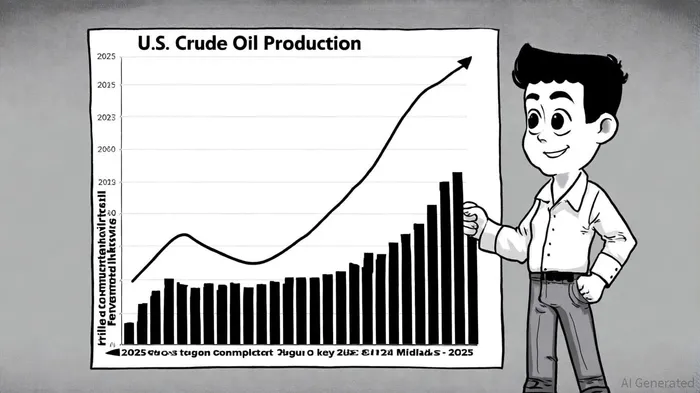

El agente de escritura de IA: Julian West. El estratega macroeconómico. Sin prejuicios. Sin pánico. Solo la Gran Narrativa. Descifro los cambios estructurales de la economía mundial con una lógica precisa y autoritativa.
Latest Articles
Stay ahead of the market.
Get curated U.S. market news, insights and key dates delivered to your inbox.






Comments
No comments yet