
Retirement's Silent Crisis: Unlocking Opportunities in Middle-Class Financial Services
 Aime Summary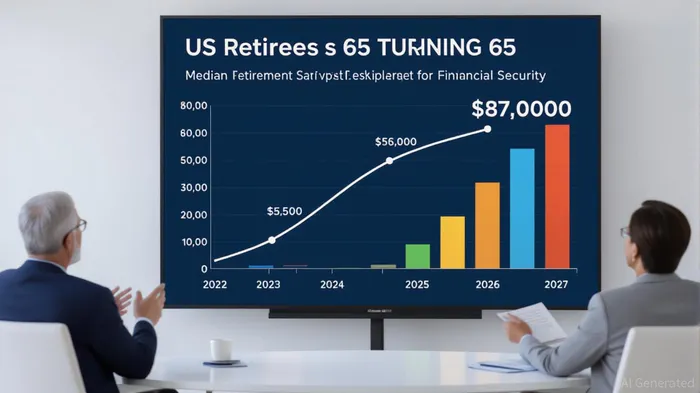
The U.S. is facing a seismic shift in its demographic landscape. By 2027, over 4 million Americans will turn 65 each year, marking the largest wave of retirees in history. Yet, this "Peak 65® Zone" is not merely a statistical milestone—it's a harbinger of a systemic financial crisis. For middle-class retirees, the combination of rising longevity, volatile markets, and inadequate savings has created a perfect storm of anxiety. According to the Alliance for Lifetime Income (ALI), 66% of retirees drawing Social Security have less than $100,000 in investable assets, while 43% cite disability or early retirement due to health issues. Social Security, designed to replace just 40% of pre-retirement income, leaves a yawning gap that many are ill-equipped to fill.
The Retirement Income Gap: A Looming Crisis
The problem is not just about numbers—it's about lived experience. Middle-class retirees are increasingly vulnerable to outliving their savings, with 47% of working households at risk of failing to maintain their preretirement standard of living. The root causes are well-documented: the decline of pensions, the underfunding of 401(k) plans, and the lack of access to guaranteed income streams. For every retiree who feels confident about their financial future, two others are either worried or cautiously optimistic. This emotional and financial instability is a goldmine for financial services firms that can offer accessible, low-cost solutions.
Annuities: The Overlooked Pillar of Retirement Security
Annuities, long dismissed as complex or costly, are emerging as a critical tool for addressing longevity risk. ALI's 2024 study found that annuity owners had a median income of $76,000 in 2022, significantly higher than the $87,000 median retirement account value. Yet, only 5% of Americans own annuities, and many lack understanding of their benefits. This gap represents a massive untapped opportunity.
Firms like CNO Financial Group (parent of Bankers Life and Colonial Penn) are leading the charge. By offering simplified annuity products and in-plan retirement income solutions, CNO is targeting middle-class retirees who need guaranteed income without the complexity of traditional wealth management. Its subsidiaries provide affordable insurance and annuities tailored to those with limited resources, while the SECURE 2.0 Act has made it easier for employers to integrate annuities into 401(k) plans. This institutional approach not only democratizes access but also aligns with regulatory trends favoring retirement income innovation.
The Rise of Low-Cost, High-Impact Solutions
Beyond annuities, the industry is seeing a surge in products designed for underpenetrated markets. Target date funds and collective investment trusts (CITs) are gaining traction, with CITs now accounting for 51% of target date assets due to their lower fees and flexibility. For retirees with modest budgets, Treasury I bonds and dividend-paying ETFs offer low-risk, inflation-adjusted returns. Meanwhile, managed accounts are becoming a go-to solution for personalized retirement planning, particularly for those nearing retirement.
The annuity market itself is booming. In Q1 2025, annuity sales hit $105.4 billion, driven by fixed-rate deferred annuities (FRDs) and registered index-linked annuities (RILAs). Companies like Allianz Life, MassMutual, and New York Life are capitalizing on this demand with products that balance growth potential and downside protection. For example, Allianz's Index Lock feature allows retirees to lock in index gains, while MassMutual's inflation-protected annuities address a key concern for long-term security.
Investment Opportunities in the Retirement Sector
For investors, the key lies in identifying firms that combine financial strength with innovative product design. Nationwide's Destination Future variable annuity, with its 0.85% M&E ratio and 0.10% administrative fee, exemplifies the shift toward low-cost solutions. Similarly, Lincoln Financial's OptiBlend product offers nine index options and liquidity features, making it appealing to risk-averse retirees. These companies are not just selling products—they're addressing a societal need, which is increasingly valued by ESG-focused investors.
The SECURE 2.0 Act further amplifies these opportunities. By incentivizing emergency savings programs and in-plan annuities, it's creating a regulatory tailwind for firms that can scale solutions for middle-class retirees. For instance, Athene and New York Life are expanding their in-plan offerings, leveraging their strong financial ratings (A++ from AM Best) to attract plan sponsors.
The Road Ahead: Innovation and Education
The path to solving the retirement crisis lies in two pillars: accessibility and education. While products like annuities and CITs are gaining traction, many retirees still lack the knowledge to use them effectively. Firms that invest in consumer education—such as LIMRA's integration of the Alliance for Lifetime Income—will gain a competitive edge. Additionally, portable retirement solutions and fee-based models (e.g., contingent deferred annuities) are opening new channels for RIAs to serve middle-class clients.
For investors, the message is clear: the retirement sector is not just a defensive play—it's a growth opportunity. As the "Peak 65® Zone" peaks, the demand for emotionally resonant, low-cost financial tools will only intensify. Firms that can bridge the gap between complexity and simplicity, between uncertainty and security, will be the ones to thrive in this new era.
Conclusion: A Call to Action
The aging population is not a crisis—it's a catalyst for innovation. For middle-class retirees, the stakes have never been higher. For investors, the opportunities are equally profound. By backing firms that prioritize accessibility, affordability, and education, we can transform retirement insecurity into a blueprint for financial resilience. The time to act is now, before the next wave of retirees hits the market—and before the next generation of retirees is left behind.

Stay ahead of the market.
Get curated U.S. market news, insights and key dates delivered to your inbox.




Comments
No comments yet