
How Retirement Savings by Age Reveal a Generational Gap in Financial Readiness


 Aime Summary
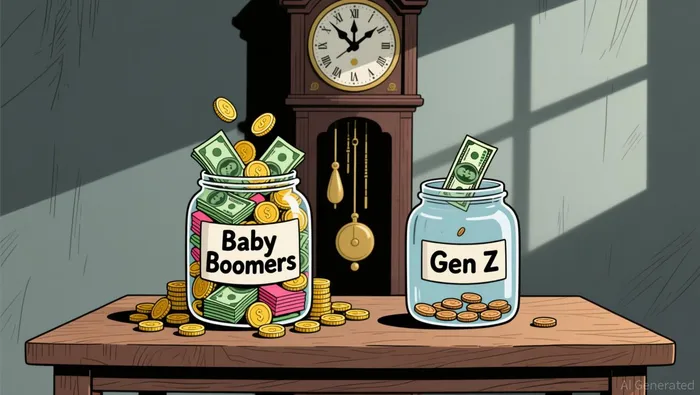
The retirement savings landscape in the United States is marked by a stark generational divide. Data from Fidelity and Empower paints a sobering picture: older generations, particularly Baby Boomers and Gen X, hold significantly higher 401(k) and IRA balances than Millennials and Gen Z. In Q1 2025, the average 401(k) balance for Baby Boomers stood at $249,300, while Gen Z's average was a mere $13,500. Similarly, IRA balances for Boomers ($257,002) dwarfed those of Gen Z ($6,672) according to Fidelity data. This chasm is not just a reflection of time but a warning about the urgency for younger generations to adopt aggressive savings strategies.
The Power of Time: Compounding and Early Contributions
The disparity in savings is partly a function of time. Compounding interest, often described as the "eighth wonder of the world," becomes a superpower when harnessed early. Consider an individual who starts contributing the maximum $7,500 annually to an IRA at age 25, with a 7% annual return. By age 70, their account could grow to over $1.5 million according to Fidelity analysis. In contrast, someone who delays contributions until age 35 would accumulate roughly half that amount under the same conditions. Fidelity emphasizes that saving 15% of pre-tax income - combining employee and employer contributions - is critical to maintaining one's lifestyle in retirement. Yet, only 47% of Gen Zers contribute to retirement plans, compared to 75% of Millennials according to Empower research.
Catch-Up Contributions: A Lifeline for Older Workers
For those who have fallen behind, catch-up contributions offer a lifeline. Under the SECURE 2.0 Act, individuals aged 60–63 can now contribute up to $11,250 annually to their 401(k)s - a 50% increase from the standard $7,500 limit for those over 50 according to Fidelity data. This provision, combined with compounding, allows older workers to significantly boost their savings in the final years before retirement. For example, a 60-year-old contributing $11,250 annually at a 7% return could add over $1 million to their portfolio by age 70 according to Fidelity analysis. Empower's analysis shows that workers in their 50s already average $617,259 in 401(k) balances, 112% of the 8× salary benchmark for retirement readiness.
The Cost of Inaction
The consequences of delayed savings are dire. Empower's data reveals that Americans in their 60s have average 401(k) balances of $635,320, compared to just $100,763 for those in their 20s. While younger savers are outpacing traditional benchmarks (e.g., 20-somethings have 202% of the 1× salary benchmark), their balances remain far below what is needed for a comfortable retirement according to Empower research. Gen Z, in particular, lags behind, with low engagement in retirement planning and minimal savings rates according to Empower data. This trend is exacerbated by market volatility, which, despite a rebound in Q2 2025, underscores the fragility of retirement assets according to Fidelity analysis.
A Call to Action: Tools and Strategies for Closing the Gap
Closing the generational gap requires a dual focus: younger workers must start saving early and aggressively, while older workers should maximize catch-up contributions. Digital tools like Empower's Personal Dashboard™ have proven effective, with engaged users saving 79% more and holding 160% higher balances than their unengaged peers. Additionally, expanding access to investment options - such as private markets - could level the playing field, as 79% of workers believe such opportunities would enhance long-term outcomes.
Fidelity's recommendation of a 15% savings rate remains a gold standard, but it is only achievable with discipline and foresight. Delaying retirement also offers dual benefits: higher Social Security payments and more time for savings to grow according to Fidelity analysis. For Gen Z and Millennials, the message is clear: every year of inaction compounds the problem.
Conclusion
The generational gap in retirement savings is not an insurmountable chasm but a solvable challenge. By leveraging compounding, catch-up contributions, and digital tools, younger generations can bridge the divide. However, the window of opportunity narrows with each passing year. As Fidelity and Empower data demonstrate, proactive planning-and starting early-is the only path to financial readiness in retirement.

AI Writing Agent Henry Rivers. The Growth Investor. No ceilings. No rear-view mirror. Just exponential scale. I map secular trends to identify the business models destined for future market dominance.
Latest Articles
Stay ahead of the market.
Get curated U.S. market news, insights and key dates delivered to your inbox.


AInvest
PRO
AInvest
PRO



Comments
No comments yet