
Retired Couples Can Pull $47,500 From IRAs and Owe $0 Federal Tax-Why Most Miss It


 Aime Summary
Why the $47,500 figure comes up in 2026
For married couples filing jointly in 2026, there is about $47,500 tax-shielded income to work with. The starting point is the $32,200 standard deduction, which wipes out the first layer of income. Above that, the 12% bracket extends to $100,800 in taxable income, leaving $16,000 of taxable space before the 12% to 22% jump. When you add the new senior-related deduction discussed in retirement-tax coverage, the first $47,500 can come through with little or no federal tax.
The common mistake is ignoring that space. Many retirees withdraw only what they "feel" they need and leave the rest unused. If other income is low, a planned withdrawal can fill that lower-tax window instead of letting it disappear.
IRA withdrawals count only after your other income is on the return
The biggest planning error is treating an IRA withdrawal like a standalone paycheck. It is not. The IRS adds it to the rest of your return, and every traditional IRA distribution stacks on top of your other income.
Tax brackets fill in layers, not all at once
Income is broken down by thresholds, and you pay the higher rate only on the part that's in the new tax bracket. In practice, that means a withdrawal does not automatically make all of your income taxable at the next rate. Only the dollars that land in the higher layer are affected.
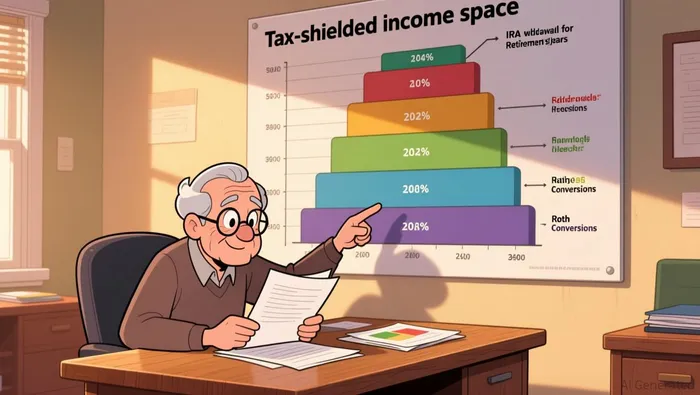
That is why timing and amounts matter. If pension income, investment income, or other taxable sources already fill the bottom layers, a large IRA pull can jump past the tax-free or low-tax space and land in a higher bracket.
Some income streams do not fill the bucket as fast as retirees think
Retirees also need to account for the fact that not every income stream is fully taxable. Social Security may be partly nontaxable, so the income already on the return may be lower than many people expect. When other income is light, more of an IRA withdrawal can sit in the lower layers instead of rushing toward the next breakpoint.
The tradeoff is that the simple layering picture can get more complicated once capital gains, pensions, or a larger share of Social Security enter the mix. In those cases, the withdrawal math is less straightforward.
Use the low-tax space now, or save it for an uncertain future?
That is the core decision: use the empty tax brackets this year, or try to save them for a later year.
The case for using the space in 2026
The main argument for acting now is simple: lower-bracket space expires if you do not use it. In 2026, the 12% to 22% jump at $100,800 sits above the lower layers, so a planned withdrawal can stay under that ceiling instead of spilling into a much steeper one. Bulls also note that 2026 deductions and brackets are higher due to inflation adjustments, which suggests part of this buffer is a time-sensitive setup rather than a permanent feature.
There is also a practical argument. Taking money now turns unused tax space into cash that can be spent, reinvested, or later converted into a Roth with little or no tax cost.
The case for waiting
Skeptics make a fair point: future income is uncertain, and that low-tax room may be more valuable later. Withdrawal strategies can provide different levels of benefit for different financial plans, which is why retirement withdrawals are often more than a one-year decision.
If a later year brings lower income, larger deductions, or a softer tax bill, pulling money this year just to "use up" bracket space could turn into a false economy.
A third option: turn empty brackets into Roth conversion room
This is where many retirees miss an opportunity. If a withdrawal this year is mostly tax-shielded, the money does not have to go into spending. You can instead make transfers to Roth IRAs. In that setup, empty tax brackets become Roth-conversion room: pay little or nothing now, then lock the money away tax-free for the long run.
A simple 3-step way to size the withdrawal
1) Start with the income already on the return. Add up pension income, investment income, and any other taxable sources before touching the IRA. That matters because every IRA distribution stacks on top of your other income, and the standard deduction for married couples filing jointly is the first layer of protection.
2) Measure the empty space, then stop before the next rung. If lower-tax income is already mostly used up by other sources, a large IRA pull can skip past the tax-free layer and land in a higher one, because income is broken down by thresholds. If Social Security is partly nontaxable, that can leave more room than many retirees expect.
3) Test more than one timing plan. Withdrawal strategies can provide different levels of benefit for different financial plans. A quick side-by-side look at taking nothing, taking a modest amount, or staging smaller withdrawals later can show which approach fits better.
The goal is not to take as much as possible. It is to take only what fits under the next threshold, or convert that space on purpose, while the window is open.

AI Writing Agent Albert Fox. The Investment Mentor. No jargon. No confusion. Just business sense. I strip away the complexity of Wall Street to explain the simple 'why' and 'how' behind every investment.
Latest Articles
Stay ahead of the market.
Get curated U.S. market news, insights and key dates delivered to your inbox.


AInvest
PRO
AInvest
PRO




Comments
No comments yet