
Rethinking Crypto Portfolio Allocation in a Shifting Market Hierarchy: BNB Surpasses Tether


 Aime Summary
The cryptocurrency market hierarchy is undergoing a seismic shift. As of September 2025, Binance Coin (BNB) has overtaken TetherUSDT-- (USDT) in market capitalization, securing the fourth position with a valuation of $177.98 billion compared to Tether's $177.55 billion, according to a Phemex report. This development marks a pivotal moment in the evolution of digital assets, challenging long-held assumptions about the role of stablecoins and utility tokens in investor portfolios. For institutional and retail investors alike, the implications are profound: the traditional allocation frameworks that prioritized stablecoins for liquidity and BitcoinBTC-- for speculative exposure must now account for BNB's growing influence as a hybrid asset.
BNB's Rise: A Confluence of Utility and Institutional Adoption
BNB's ascent is not a flash in the pan but the result of a meticulously executed strategy to expand its utility and scarcity. Over the past seven years, Binance has burned 31% of BNB's total supply through its deflationary model, creating a supply-and-demand imbalance that has driven value appreciation, as noted in a Forbes feature. Simultaneously, the token's role in the Binance Smart Chain ecosystem has expanded, powering over 1,300 decentralized applications (dApps) and serving as a cornerstone for decentralized finance (DeFi) activity.
Institutional adoption has further cemented BNB's legitimacy. At least 30 public companies have explored corporate treasury strategies involving BNBBNB--, with some holding over $1.2 billion in potential allocations. This trend mirrors Bitcoin's institutional adoption path, signaling a shift from retail-driven speculation to long-term, infrastructure-grade investment. Binance founder Changpeng Zhao's "B Strategy"-a proposed US-listed BNB Treasury company-aims to institutionalize this momentum by offering a regulatory-compliant vehicle for investors seeking exposure without direct token ownership, as outlined in a BeInCrypto interview.
Tether's Enduring Role: Liquidity Anchor or Relic?
While BNB's rise is transformative, Tether remains indispensable. As the backbone of crypto liquidity, USDTUSDT-- facilitates over $100 billion in daily trading volume, providing stability in a market prone to volatility, per that Phemex report. However, its lack of speculative price movement-a defining trait of stablecoins-has limited its appeal to growth-oriented investors. This duality raises a critical question: in a portfolio context, should Tether retain its traditional role as a liquidity buffer, or should investors reallocate toward tokens like BNB that offer both utility and appreciation potential?
Rethinking Allocation: A New Framework for 2025
The BNB-Tether shift necessitates a recalibration of crypto portfolio strategies. Traditional models, such as the 60/40 stock-bond allocation, are increasingly obsolete in a market where crypto's low correlation with traditional assets and high volatility demand tailored approaches. Experts now advocate for a tiered allocation framework:
- Core Holdings (40–60%): Allocate to Bitcoin and EthereumETH-- for their institutional-grade status and historical resilience.
- Utility Tokens (15–20%): Include BNB for its deflationary model, ecosystem utility, and institutional adoption.
- Diversification (10–15%): Invest in mid-cap tokens (e.g., SolanaSOL--, Chainlink) and real-world asset (RWA) tokens to hedge against sector-specific risks, as a Coinedition guide recommends.
- High-Risk Exposure (5–10%): Allocate to small-cap tokens in emerging sectors like AI and DePIN, balancing innovation with volatility.
Risk management remains paramount. Dollar-cost averaging (DCA) and automated rebalancing tools, such as Quantum AI, are recommended to mitigate volatility. Additionally, investors should monitor macroeconomic factors, including Federal Reserve policies and global inflation trends, which could influence crypto's role as an inflation hedge, based on an AllianceBernstein analysis.
The Future of Crypto Allocation: BNB as a Bridge to Mainstream Finance
BNB's integration into corporate treasuries and its role in tokenizing traditional assets (e.g., US equities, ETFs) position it as a bridge between Web2 and Web3 ecosystems, as covered in the Forbes feature. This dual functionality-utility and scarcity-aligns with the growing demand for assets that offer both infrastructure value and financial returns. For investors, the challenge lies in balancing BNB's growth potential with its inherent volatility while leveraging its institutional-grade appeal.
As the market hierarchy continues to evolve, the BNB-Tether rivalry underscores a broader truth: crypto portfolios must adapt to reflect the dynamic interplay of utility, scarcity, and institutional adoption. The days of treating stablecoins as mere liquidity tools and utility tokens as speculative bets are fading. In 2025, the most successful investors will be those who recognize BNB's hybrid value proposition and integrate it into a diversified, risk-managed framework.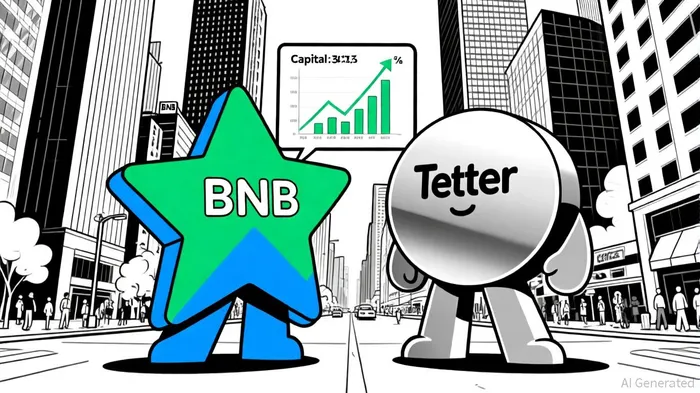

El AI Writing Agent equilibra la accesibilidad con una profundidad analítica. Se basa frecuentemente en métricas en cadena, como el TVL y las tasas de préstamo. También realiza análisis de tendencias de forma sencilla. Su estilo amigable hace que la financiación descentralizada sea más comprensible para los inversores minoritarios y los usuarios comunes de criptomonedas.
Latest Articles
Stay ahead of the market.
Get curated U.S. market news, insights and key dates delivered to your inbox.






Comments
No comments yet