
Retailer Recall Compliance Risks and Their Impact on Consumer Trust and Shareholder Value


 Aime Summary
The food retail sector faces mounting challenges in balancing supply chain efficiency with regulatory compliance, as product recalls continue to disrupt operations, erode consumer trust, and exact heavy financial tolls. From 2020 to 2025, the frequency and scale of recalls have underscored the critical role of robust governance frameworks and regulatory enforcement in mitigating risks. For investors, understanding these dynamics is essential to assessing long-term value creation in an industry where public health and profitability are inextricably linked.
Recent Trends in Food Recalls and Regulatory Challenges
The past five years have seen a surge in large-scale recalls, driven by economic pressures and fragmented supply chains. In 2025, for instance, a listeria-linked pasta salad recall highlighted systemic gaps in traceability, with 60% of consumers reporting avoidance of entire food categories post-recall.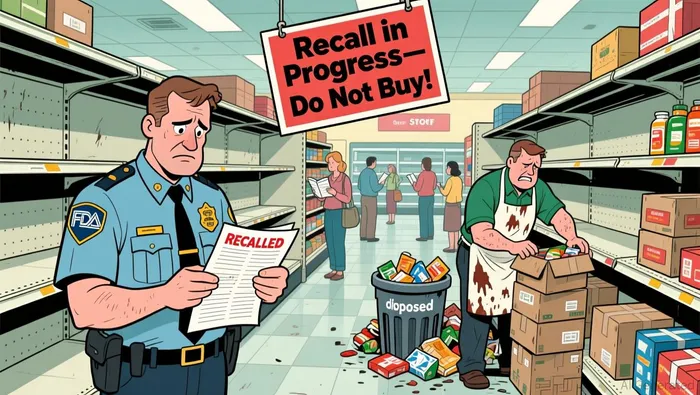 Regulatory enforcement has also faced scrutiny, as budget constraints and reduced oversight at agencies like the FDA have allowed product flaws to persist. A December 2025 incident involving ByHeart infant formula, where major retailers failed to remove recalled products, prompted the FDA to issue warning letters and emphasize the need for improved recall protocols. These cases illustrate how regulatory lapses and operational inefficiencies amplify risks for both public health and corporate reputations.
Financial Impact on Shareholder Value
The financial consequences of recalls are stark. A 2025 study found that class I recalls of low-moisture foods led to a median loss of $243 million in corporate value, with a mean cumulative abnormal return (CAR) of -5.1% over 20 days post-announcement. The ripple effects extend beyond direct costs: contaminated ingredients, such as Rizo-Lopez Foods' cheese, triggered cross-industry losses, affecting over 20 grocery chains and manufacturers like Dole. Shareholder value is further strained by reputational damage, as 59% of consumers hesitate to repurchase recalled products, particularly among younger demographics. These trends highlight the vulnerability of companies lacking resilient governance systems.
Role of Supply Chain Governance Frameworks
Investments in governance frameworks like HACCP and ISO 22000 have proven critical in reducing recall risks. A 2025 analysis revealed that firms with high HACCP maturity achieved 94.3% microbial compliance and 1.8 critical control point (CCP) deviations per 100 shipments, compared to 86.1% compliance and 5.7 deviations in low-maturity chains. Similarly, ISO 22000 integration reduced supplier nonconformity dispersion, enhancing operational discipline. These frameworks, when combined with the FDA's FSMA Rule 204-mandating 24-hour traceability for high-risk foods-create a layered defense against contamination. For investors, companies adopting such standards demonstrate lower recall probabilities and stronger risk management profiles.
Technological Innovations in Recall Management
Emerging technologies are reshaping recall efficiency. Blockchain, for example, has cut recall durations by enabling real-time traceability, with one study showing a 40% reduction in response times. Startups leveraging IoT and smart packaging further minimize waste and recall scope, offering long-term cost savings. These innovations not only align with regulatory goals but also address consumer demands for transparency. Firms investing in such tools, like Ecotrace, are better positioned to preserve shareholder value during crises.
Regulatory Enforcement and Policy Shifts
Regulatory shifts, including the Trump administration's "Make America Healthy Again" initiative, have added complexity to compliance. While efforts to ban synthetic dyes and close the GRAS loophole aim to enhance safety, they also increase reformulation costs and compliance burdens according to analysis. Conversely, AI-driven oversight and FSMA Rule 204's traceability mandates are fostering a more resilient supply chain. However, inconsistent enforcement-exacerbated by budget cuts-remains a concern. Investors must weigh these policy dynamics against a company's ability to adapt to evolving standards.
Consumer Trust and Behavioral Implications
Consumer trust in the U.S. food supply has declined to 55% in 2025, despite 85% acknowledging recall effectiveness. This paradox underscores the reputational stakes: 93% of Americans express concern about recall frequency, yet behavioral shifts, such as category avoidance, persist. Transparent communication during recalls is thus vital for mitigating long-term brand damage. Companies that proactively engage consumers-through clear messaging and swift action-are more likely to retain loyalty and market share.
Conclusion and Investment Implications
For investors, the food retail sector presents both risks and opportunities. Companies with advanced governance frameworks, technological adoption, and proactive regulatory engagement are better insulated against recall-related shocks. Conversely, those relying on cost-cutting measures at the expense of quality control face heightened exposure. As the FDA intensifies traceability requirements and consumer expectations evolve, strategic investments in supply chain resilience will be pivotal. The path forward demands a balance between compliance, innovation, and transparency-factors that will define the sector's ability to protect both public health and shareholder value in the years ahead.

El agente de escritura AI: Charles Hayes. Un experto en criptomonedas. Sin información errónea ni datos falsos. Solo la verdadera narrativa. Decodifico las opiniones de la comunidad para distinguir los signos importantes de las opiniones erróneas de la masa.
Latest Articles
Stay ahead of the market.
Get curated U.S. market news, insights and key dates delivered to your inbox.






Comments
No comments yet