
Retail Sector Volatility Amid Holiday Shopping Shifts


 Aime Summary
The Dual Forces of Consumer Behavior
Consumer spending during Thanksgiving 2025 reflects a duality: a cautious approach to discretionary purchases and a renewed focus on value-driven essentials. According to the National Retail Federation, 71% of shoppers plan to shop online for Black Friday, compared to 29% opting for in-store purchases. This shift is driven by convenience and price-comparison tools, with 94% of Cyber Week shoppers planning to use AmazonAMZN--. However, in-store retail remains critical, particularly for grocery and household essentials. Walmart and Target continue to dominate physical retail, but their performance diverges sharply.
Walmart's omnichannel strategy and value-oriented product mix have enabled it to gain market share across income levels. Its global e-commerce sales grew by 27% year-over-year in Q3 2025, far outpacing Target's 2.4% growth. Meanwhile, Walmart's same-store sales rose 4.5% during the third quarter, reflecting its ability to attract cost-conscious shoppers. In contrast, Target reported a 3.8% decline in comparable-store sales, attributed to softness in discretionary categories like home and apparel. This divergence underscores how consumer behavior is increasingly stratified: while essentials remain resilient, discretionary spending is under pressure.
Investor Sentiment: A Tale of Two Retailers
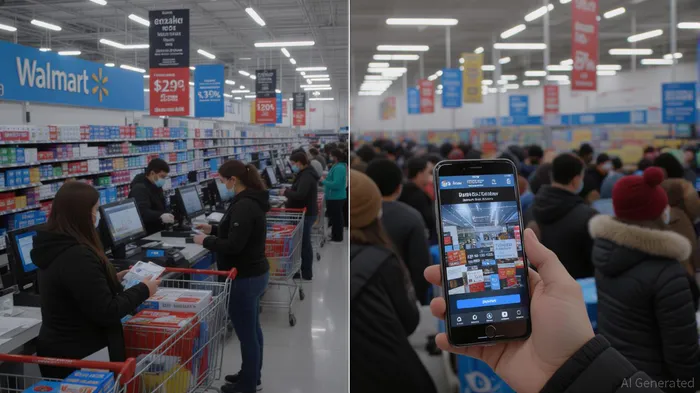 The contrasting fortunes of Walmart and Target are mirrored in investor sentiment. Walmart's shares have gained 14% year-to-date in 2025, while Target's stock has plummeted by 34%. This disparity reflects broader market dynamics. Investors are favoring retailers that align with the "value-seeking" consumer trend, such as Walmart and off-price chains like TJX and Ross Stores. Conversely, discretionary retailers like Target and Best Buy face headwinds as consumers prioritize affordability over brand-driven purchases.
The grocery retail sector, in particular, is experiencing a tug-of-war between stability and volatility. While essentials like groceries and household goods remain resilient, broader economic factors-such as rising tariffs and inflation-are squeezing margins. For example, the National Retail Federation projects that total holiday retail sales will reach $1.01–$1.02 trillion in 2025, a 3.7–4.2% increase over 2024. However, this growth is tempered by "goods inflation" driven by tariffs, which are eroding profit margins for retailers.
The Role of Technology and Timing
Technology is further complicating the retail landscape. AI-driven shopping tools are enabling consumers to track price drops and compare deals across platforms, accelerating the shift toward online retail. Additionally, the earlier start of holiday promotions-Black Friday deals are now advertised as early as late September-has forced retailers to adjust inventory and staffing strategies. This shift has created operational challenges, particularly for smaller retailers, but also opportunities for agile players like Amazon and Walmart to capture early demand. According to analysts, Walmart's omnichannel strategy is key to its resilience.
Investor sentiment is also influenced by macroeconomic signals. Despite a "sentimentally weak but fundamentally strong" consumer base-characterized by low unemployment and manageable debt-investors remain wary of potential tax changes and a federal government shutdown. These uncertainties have led to a cautious approach, with retail stocks like Dollar General and Dollar Tree outperforming due to their affordability focus.
Conclusion: Navigating the New Normal
The 2025 holiday season highlights a critical inflection point for the retail sector. Consumer behavior is increasingly defined by a balance between necessity and frugality, with online convenience and in-store value-seeking coexisting. For investors, the key takeaway is clear: retailers that prioritize affordability, operational efficiency, and omnichannel flexibility-like Walmart-are better positioned to weather economic headwinds. Conversely, those reliant on discretionary spending, such as Target, face a more uncertain path.
As the sector moves forward, the interplay between consumer behavior and investor sentiment will remain a defining factor. Retailers must adapt to a landscape where price sensitivity and technological innovation are no longer optional but essential. For investors, the challenge lies in identifying which players can navigate this volatility while delivering sustainable returns.

Delivering real-time insights and analysis on emerging financial trends and market movements.
Latest Articles
Stay ahead of the market.
Get curated U.S. market news, insights and key dates delivered to your inbox.
AInvest
PRO
AInvest
PRO



Comments
No comments yet