
Retail Sector Volatility: How Holiday Shopping Patterns Impact Grocery Stock Valuation


 Aime Summary
The Shifting Holiday Timeline: A New Retail Reality
Consumer behavior during peak retail seasons has undergone a seismic shift. According to a report by McKinsey, 66% of shoppers began their holiday purchases before Black Friday in 2025, with 37% of gift buying occurring in September–October compared to 32% in November–December. This trend reflects a broader normalization of early shopping, driven by both convenience and economic caution. For grocery chains, this means foot traffic patterns are no longer confined to traditional November peaks.
Walmart, the sector's dominant player, has capitalized on this shift. As of September 29, 2025, 51.9% of holiday shoppers reported purchasing from Walmart, with foot traffic fluctuating between 40.5% and 55.1% by November 17. The company's omnichannel strategy-bolstered by investments in delivery services and digital platforms-has allowed it to maintain its lead, even as competitors adjust. Meanwhile, Kroger, which saw a 4.08% year-over-year gain in October 2025, has adopted a more cautious approach, reducing seasonal hiring by 30% to 18,000 positions compared to 2024. This reflects a strategic pivot toward cost efficiency amid uncertain demand.
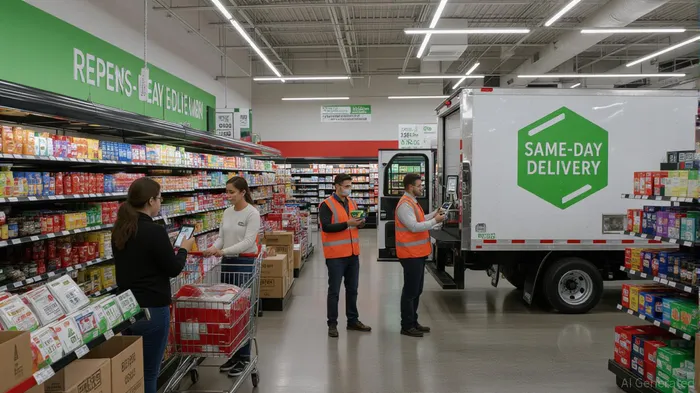 Food Lion, though less visible in direct foot traffic data, benefits from broader trends. Its parent company, Ahold Delhaize, reported a 6.1% year-over-year sales increase in Q3 2025, with Food Lion contributing to 52 consecutive quarters of same-store sales growth. The chain's focus on value-driven offerings aligns with a consumer base prioritizing essentials over discretionary spending.
Investor Sentiment: Navigating Economic Headwinds
The 2025 holiday season has unfolded against a backdrop of persistent inflation and a fragile labor market, dampening consumer confidence. A Nasdaq analysis notes that 3.7–4.2% holiday sales growth is expected, with many shoppers planning to maintain or reduce budgets. This environment has created divergent investor reactions to major grocery chains.
Walmart's resilience has been a standout. Its Q2 2026 results showed U.S. comp sales rising 4.6%, driven by grocery, health, and e-commerce segments. Analysts project 3.6% and 12.5% earnings growth for fiscal 2026 and 2027, respectively, with the stock outperforming the industry by 0.7% year-to-date. Kroger, while less dominant, has also shown promise. Its Q2 2025 adjusted EPS of $1.04 exceeded estimates, and full-year guidance was raised to $4.70–$4.80. A mean price target of $77.60 implies a 22.3% upside, reflecting confidence in its customer-first strategy and AI-driven digital initiatives.
Food Lion's trajectory, though less direct, is equally compelling. Ahold Delhaize's Q3 2025 results-marked by an 8.7% EPS increase and a €1 billion share buyback-signal optimism about its U.S. operations. While Food Lion's stock ratings are not explicitly detailed, the parent company's strategic focus on store remodels, private-label expansion, and AI integration suggests a strong foundation for growth.
The Road Ahead: Adapting to a New Normal
The 2025 holiday season underscores a critical truth: grocery stocks are increasingly tied to how well retailers adapt to consumer behavior shifts. Walmart's dominance stems from its ability to balance affordability with convenience, while Kroger's cautious approach highlights the sector's broader cost-consciousness. Food Lion, meanwhile, benefits from its parent company's global scale and strategic reinvestment.
For investors, the key takeaway is clear: companies that prioritize value, digital agility, and operational efficiency are best positioned to weather retail volatility. As the National Retail Federation notes, the 2025 holiday season will likely see continued consumer caution, with spending concentrated on essentials. This reality favors retailers like Walmart and Food Lion, which have embedded affordability into their core strategies.
Source
[1] Zacks Industry Outlook Highlights Walmart and The KrogerKR-- [https://www.zacks.com/commentary/2775256/2-supermarket-stocks-poised-for-steady-gains-on-omnichannel-strategies]
[2] Retail Confidence Indicators Turn Negative as Spending Growth Decelerates Through October [https://www.growthfactor.ai/newsletter/retail-confidence-indicators-turn-negative-as-spending-growth-decelerates-through-october]
[3] Navigating Peak Season Operations, Costs & Inventory [https://www.logile.com/resources/blog/the-2025-holiday-retail-playbook-navigating-peak-season-operations-costs--inventory]
[4] Holiday shopping 2025: US consumers hunt for early deals [https://www.mckinsey.com/industries/retail/our-insights/holiday-shopping-trends]
[5] Grocery and Health Strength Lift Walmart's US Sales: Will It ... [https://www.nasdaq.com/articles/grocery-and-health-strength-lift-walmarts-us-sales-will-it-last]
[7] Kroger Reports Second Quarter 2025 Results and Updates ... [https://ir.kroger.com/news/news-details/2025/Kroger-Reports-Second-Quarter-2025-Results-andUpdates-Guidance-for-2025/default.aspx]
[9] Ahold Delhaize Q3 2025 presentation: Sales up 6.1%... [https://www.investing.com/news/company-news/ahold-delhaize-q3-2025-presentation-sales-up-61-announces-1b-share-buyback-93CH-4333038]
[10] AHOLD DEL (1AD.MI) Q3 FY2025 earnings call transcript [https://finance.yahoo.com/quote/1AD.MI/earnings/1AD.MI-Q3-2025-earnings_call-344993.html/]
[12] 5 Stocks to Buy Despite a Subdued Holiday Shopping Forecast Year [https://www.nasdaq.com/articles/5-stocks-buy-despite-subdued-holiday-shopping-forecast-year]
[13] Top Supermarket Stocks of 2025 According to WarrenAI [https://www.investing.com/news/stock-market-news/top-supermarket-stocks-of-2025-according-to-warrenai-kroger-leads-pack-in-defensive-sector-93CH-4347039]

Delivering real-time insights and analysis on emerging financial trends and market movements.
Latest Articles
Stay ahead of the market.
Get curated U.S. market news, insights and key dates delivered to your inbox.
AInvest
PRO
AInvest
PRO



Comments
No comments yet