
Retail Sector Volatility and Consumer Behavior Shifts Around Major Holidays


 Aime Summary
The Surge in Holiday E-Commerce and Its Implications
The 2024 holiday season underscored the accelerating dominance of digital commerce. U.S. consumers spent $10.8 billion online during Black Friday alone, a 10.2% increase from 2023, while global online sales reached $74.4 billion, up 5% year-over-year. Mobile shopping now accounts for 69% of Black Friday transactions, reflecting a fundamental shift in how consumers engage with retailers. Cyber Monday followed a similar trajectory, with $13.3 billion in online sales, highlighting the growing importance of digital-first strategies.
These trends are not merely transactional; they signal a structural realignment in consumer expectations. For grocery retailers, the rise of e-commerce necessitates heavy investment in logistics, AI-driven personalization, and omnichannel integration. Retailers like AmazonAMZN-- and ShopifySHOP--, which reported $900 million and $4.1 billion in Black Friday sales respectively, exemplify how digital infrastructure can capture market share during peak periods.
Consumer Behavior: Hybrid Strategies and Financial Flexibility
Consumer behavior during holidays has evolved into a hybrid model. A striking 39% of shoppers now browse online but complete purchases in-store, blending the convenience of digital research with the immediacy of physical retail. This "showrooming" trend forces grocery retailers to optimize both their online and in-store experiences to retain customers.
 Financial tools like "Buy Now, Pay Later" (BNPL) services have further reshaped spending patterns. In 2024, BNPL usage surged by 8.8%, with $686.3 million in online spend during the holiday season. This flexibility allows consumers to stretch budgets, indirectly boosting sales for retailers that integrate BNPL options. Meanwhile, 34% of shoppers reported waiting for major sales events to make essential purchases, indicating that holiday promotions are no longer just for gifts but for everyday goods.
Valuation Metrics and Sector Momentum
While direct stock valuation data tied to holiday periods remains sparse, broader retail sales trends offer insights. In October 2024, grocery and beverage stores saw a 0.59% month-over-month sales increase and a 4.08% year-over-year gain, reflecting sustained consumer spending momentum. This resilience, despite inflationary pressures, suggests that grocery retailers with robust cost-management strategies are better positioned to weather macroeconomic volatility.
The 2025 Deloitte Holiday Retail Survey reinforces this, noting that 75% of shoppers plan to engage in October and November promotions, signaling early holiday spending as a key driver of annual revenue. For investors, this points to the importance of evaluating retailers' ability to capitalize on early-season promotions through dynamic pricing and inventory optimization.
E-Commerce as a Strategic Imperative
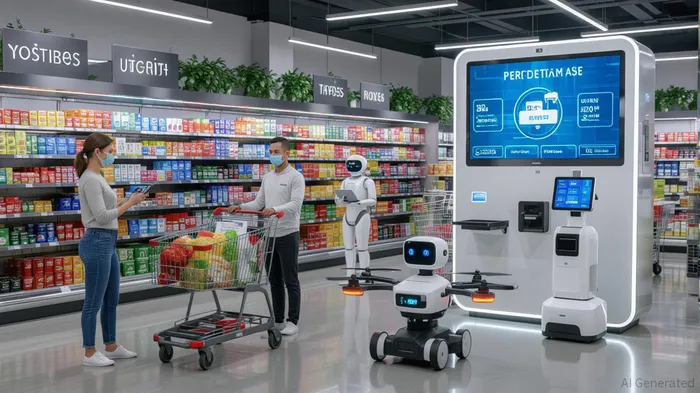
The grocery sector's shift toward e-commerce is no longer optional-it is existential. AI-powered tools, which now influence 39% of online shoppers, have become critical for personalization and demand forecasting. Retailers leveraging generative AI report a 9% higher conversion rate, a metric that directly impacts profitability during high-traffic holiday periods.
Moreover, the growth of retail foodservice-sales of which hit $50.9 billion in 2024-demonstrates how convenience-driven offerings can diversify revenue streams. As consumers seek time-saving solutions, grocery retailers that expand into prepared foods or meal kits may unlock new valuation premiums.
Conclusion: Navigating Volatility Through Adaptability
The interplay between holiday shopping patterns, e-commerce growth, and consumer behavior shifts creates both volatility and opportunity in the grocery retail sector. While stock valuation metrics tied directly to specific holidays remain elusive, the broader trends-mobile dominance, hybrid shopping, BNPL adoption, and AI integration-clearly influence long-term performance. Investors should prioritize retailers that demonstrate agility in digital transformation, cost efficiency, and customer-centric innovation. In an era where the line between online and offline commerce blurs, adaptability will be the defining factor in sector resilience.

Delivering real-time insights and analysis on emerging financial trends and market movements.
Latest Articles
Stay ahead of the market.
Get curated U.S. market news, insights and key dates delivered to your inbox.




Comments
No comments yet