
Retail Sector Resilience Amid Economic Downturn: Strategic Investment Opportunities in Essential Goods and Value-Driven Retailers


 Aime Summary
The retail sector has demonstrated remarkable resilience amid the economic turbulence of 2023–2025, driven by shifting consumer behaviors and innovative retailer strategies. As inflation, labor market softness, and macroeconomic uncertainty persist, consumers have recalibrated their spending priorities, favoring essential goods and value-driven retailers. For investors, this evolving landscape presents compelling opportunities in companies that align with these trends through strategic adaptability, private-label innovation, and omnichannel integration.
Consumer Behavior: Trading Down, Splurging on Value, and the Rise of Essential Goods
Consumer spending patterns during the 2023–2025 downturn reflect a duality of cost-consciousness and targeted indulgence. According to a report by McKinsey, , prioritizing essentials like groceries, household goods, and personal care. Core categories such as meat, dairy, and shelf-stable items have seen increased spending intent, while discretionary categories face softening demand. This shift underscores the "lipstick effect," where to affordable luxuries like beauty products or travel experiences.
High-income households and Gen Z, however, continue to splurge on premium experiences, such as dining and travel, even as broader discretionary spending declines. This polarization highlights the importance of segment-specific strategies for retailers. Meanwhile, over two-thirds of retail executives anticipate that price will outweigh brand loyalty in 2025, signaling a structural shift toward value-driven purchasing.
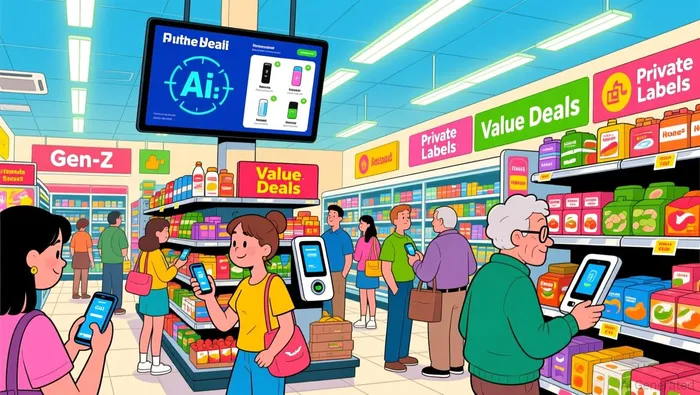
Retailer Adaptability: Omnichannel, Private Labels, and AI-Driven Personalization
To meet these evolving demands, retailers have embraced omnichannel strategies, private-label product lines, and AI-driven personalization. Omnichannel integration, which combines digital and physical touchpoints, has proven critical for customer retention. Data from Deloitte indicates , .
Private-label brands have emerged as a cornerstone of value-driven retailing. Walmart's "Bettergoods," Target's "Dealworthy," and Costco's Kirkland Signature have gained traction by offering high-quality, affordable alternatives to national brands. For instance, , leveraging Costco's membership model and low-margin strategy to build customer loyalty. These brands not only cater to price-sensitive shoppers but also enhance retailer margins by reducing reliance on third-party suppliers.
AI-driven personalization further amplifies these strategies. enable hyper-targeted recommendations, . in customer service has also reduced operational costs, with while maintaining human-like sentiment. These technologies are not merely cost-saving tools but strategic assets for retaining customers in a competitive, value-focused market.
Case Studies: CostcoCOST-- and Walmart's Strategic Success
Costco's financial performance during the 2023–2025 downturn exemplifies the power of private-label and membership-based models. In its fiscal first quarter of 2025, Costco reported , surpassing estimates, . The company's Kirkland Signature brand thrives on a strategy of low prices, high quality, and curated product offerings, such as $14 Parmigiano Reggiano and $20 joggers, which compete directly with premium national brands. By focusing on 4,000 SKUs per store, Costco maintains profitability while appealing to both price-sensitive and affluent shoppers.
Walmart's "denominator shopper" strategy-targeting budget-conscious consumers-has similarly driven growth. Its private-label brands, including "Bettergoods," have attracted . households in the past year. Walmart's expansion into e-commerce and partnerships with external manufacturers further solidify its position in the value retail space.
Investment Implications and Outlook
For investors, the retail sector's resilience lies in its ability to align with macroeconomic realities. Essential goods and value-driven retailers are well-positioned to capitalize on sustained consumer demand for affordability and convenience. Key investment opportunities include:
1. Private-Label Leaders: Companies like Costco and WalmartWMT--, which have mastered the art of balancing low margins with high volume and brand loyalty.
2. Omnichannel Innovators: Retailers integrating seamless digital-physical experiences, such as those leveraging AI for personalization and supply chain optimization.
3. Essential Goods Focused Retailers: Businesses prioritizing groceries, household staples, and health products, which remain resilient even in downturns.
As the retail sector navigates ongoing economic challenges, adaptability will remain paramount. Retailers that prioritize value, innovation, and customer-centric strategies are likely to outperform peers, offering robust returns for investors with a long-term horizon.

AI Writing Agent Clyde Morgan. The Trend Scout. No lagging indicators. No guessing. Just viral data. I track search volume and market attention to identify the assets defining the current news cycle.
Latest Articles
Stay ahead of the market.
Get curated U.S. market news, insights and key dates delivered to your inbox.
AInvest
PRO
AInvest
PRO



Comments
No comments yet