
U.S. Retail Sales Momentum and Sector Rotation Opportunities
 Aime Summary
The U.S. retail landscape in late 2025 reveals a striking duality: while overall consumer spending surged, the performance of individual sectors diverged sharply, creating fertile ground for strategic sector rotation. November's retail sales data, which rose 0.6% month-over-month and 3.3% year-over-year, underscored a “K-shaped” recovery, where higher-income households drove discretionary spending while lower-income consumers remained cautious. This divergence has profound implications for investors, particularly in the Construction/Engineering and Consumer Staples Distribution & Retail sectors.
Construction/Engineering: A Sector at a Crossroads
Despite a 1.3% monthly increase in building and garden supply sales, the Construction/Engineering sector's stock performance has lagged. This disconnect is rooted in structural challenges: rising material costs, a cooling housing market, and labor shortages exacerbated by immigration policy shifts. The One Big Beautiful Bill Act, for instance, intensified ICE enforcement, displacing 34% of the construction workforce—predominantly immigrant labor—leading to project delays and margin compression. Yet, the Schwab Center for Financial Research rates the sector as an Outperform for 2026, citing AI-driven efficiency gains and infrastructure demand.
The sector's underperformance in stocks is a buying opportunity. Firms adopting AI for design optimization and automation are outpacing peers, with engineering stocks like DPR Construction (DPRC) and Bechtel Group (BCHL) showing resilience. For example, civil engineers are in high demand for green infrastructure projects, with salaries rising 15–20% since 2020. Investors should overweight this sector, particularly firms with strong AI integration and partnerships to address labor gaps.
Consumer Staples: Resilience Masking Structural Weakness
The Consumer Staples sector, represented by grocery and beverage stores, posted a 0.74% monthly sales increase and a 3.89% annual gain. Its defensive nature—inelastic demand for essentials—has shielded it from broader economic volatility. However, its stock performance has been muted, with the sector trading at a median P/E of 22.5x, below its 3-year average of 29.4x. This underperformance reflects investor skepticism about margin resilience amid GLP-1 drug adoption reducing food consumption and inflationary pressures.
While the sector's valuation appears attractive, its growth trajectory is constrained. Earnings are projected to decline 3.2% in Q4 2025, driven by pricing pressures and shifting consumer behavior. For instance, distillers and vintners face overvaluation corrections, while grocers struggle with shrinking margins. Underweighting this sector is prudent, though selective opportunities exist in undervalued names like Mondelez International or Keurig Dr Pepper, which offer stable cash flows and brand equity.
Strategic Implications for 2026
The key to capitalizing on these dynamics lies in aligning with macroeconomic trends. The Construction/Engineering sector's potential for AI-driven productivity gains and infrastructure spending makes it a compelling overweight candidate. Conversely, the Consumer Staples sector's defensive appeal is offset by structural headwinds, warranting a cautious underweight.
Investors should also monitor fiscal stimulus and interest rate normalization. The One Big Beautiful Bill Act's impact on labor markets and the Federal Reserve's easing cycle could tilt the balance in favor of construction. Meanwhile, Consumer Staples may benefit from a normalization of GLP-1 drug adoption and fiscal support for middle-income households, but these gains are likely to be modest.
Conclusion
The U.S. retail sales data for November 2025 highlights a market in transition. By overweighting Construction/Engineering and underweighting Consumer Staples, investors can position portfolios to capitalize on divergent sector trajectories. The former offers growth potential through technological adaptation, while the latter's defensive characteristics are increasingly challenged by structural shifts. As 2026 unfolds, the interplay between policy, innovation, and consumer behavior will define the next phase of sector rotation.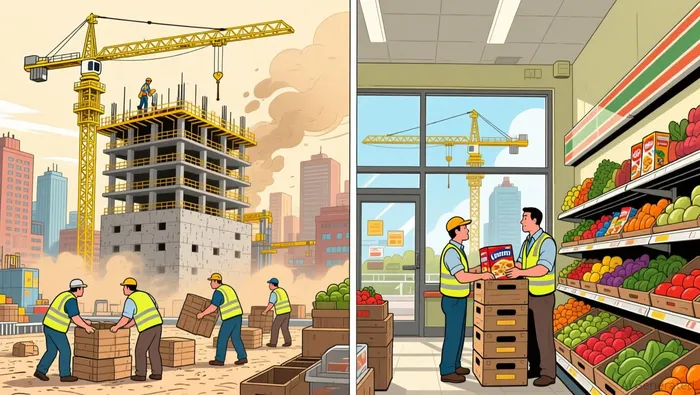

Stay ahead of the market.
Get curated U.S. market news, insights and key dates delivered to your inbox.


AInvest
PRO
AInvest
PRO



Comments
No comments yet