
U.S. Retail Sales Miss Expectations, Highlighting Sector Divergence in Market Reactions
 Aime Summary
The latest U.S. retail sales report for August 2025 has sparked a critical debate among investors: how to navigate the growing divergence between sectors in a fragmented economic landscape. While total retail sales rose 0.6% month-over-month, far exceeding the projected 0.2% gain, the underlying data reveals a stark split. Nonstore retailers (online sales) surged 10.1% year-over-year, driven by back-to-school demand and tariff-avoidance buying, while gasoline stations and department stores contracted. This divergence mirrors broader macroeconomic signals—rising inflation, softening labor markets, and geopolitical tensions—that are reshaping investment strategies.
The Case for Strategic Reallocation
Historical backtesting of sector performance during inflationary periods and tariff-driven disruptions offers a roadmap for reallocation. Consumer Staples, traditionally a defensive haven, has shown resilience in maintaining demand for essentials like food and household goods. However, its vulnerability to margin compression during inflation—exacerbated by input cost spikes and supply chain bottlenecks—has become increasingly evident. For example, during the 2021–2022 inflation spike, companies like MondelezMDLZ-- and Coca-ColaKO-- faced cocoa and sugar price surges, forcing them to absorb costs or risk losing market share.
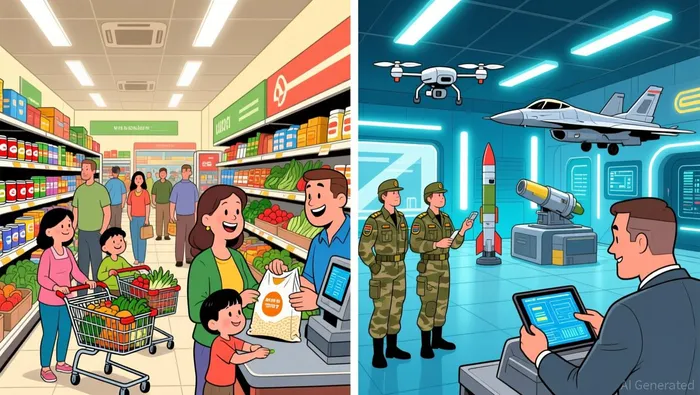
In contrast, the Aerospace & Defense (A&D) sector has demonstrated a unique ability to thrive amid macroeconomic volatility. Geopolitical tensions in Ukraine, the Middle East, and the Indo-Pacific have fueled a global defense spending supercycle. U.S. defense budgets hit $916 billion in 2023, with 9% global growth in 2024, driven by investments in cyber defense, space technologies, and next-gen military systems. Unlike retail, A&D firms operate under long-term government contracts, insulating them from short-term economic shocks. For instance, Lockheed Martin (LMT) and Raytheon Technologies (RTX) reported robust revenue growth in August 2025, even as tariff-related costs pressured margins.
Macro Signals and Sectoral Resilience
The interplay of inflation, tariffs, and geopolitical dynamics has created a K-shaped recovery, where high-income households continue to spend on luxury goods and dining, while lower-income consumers tighten budgets. This bifurcation favors A&D over Consumer Staples. During the 2018–2019 tariff wave, aerospace firms like Boeing and RTX faced supply chain disruptions but offset these with government contracts and capital discipline. Similarly, in 2025, RTX's 9% organic sales growth (despite EPS guidance cuts) highlights the sector's adaptability.
Investment Implications
For investors, the case for reallocation is compelling. Reducing exposure to discretionary retail sectors—such as electronics and furniture, which saw marginal growth in real terms—while increasing allocations to A&D and niche defense subsectors (e.g., cybersecurity, AI-driven logistics) can enhance portfolio resilience. ETFs like XLI and PPA (iShares Global Aerospace & Defense ETF) offer diversified access to this space.
However, caution is warranted. While A&D is less cyclical, it remains sensitive to geopolitical outcomes and regulatory shifts. For example, a potential slowdown in defense budgets under a non-Trump administration could temper growth. Conversely, Consumer Staples' defensive traits make it a hedge against broader economic downturns, particularly if inflation moderates and consumer spending stabilizes.
Conclusion
The August retail sales report underscores a pivotal moment for strategic reallocation. As macroeconomic signals—rising tariffs, inflation, and geopolitical tensions—reshape sector dynamics, investors must prioritize resilience over short-term gains. A&D's long-term contracts and government-driven demand position it as a countercyclical play, while Consumer Staples retains its defensive appeal. The key lies in balancing these allocations based on evolving macro trends, ensuring portfolios remain agile in an increasingly fragmented economic environment.

Stay ahead of the market.
Get curated U.S. market news, insights and key dates delivered to your inbox.
AInvest
PRO
AInvest
PRO



Comments
No comments yet