
U.S. Retail Sales Deteriorate Amid Weak Consumer Demand: Sector Rotation Opportunities in Aerospace & Defense
 Aime Summary
The U.S. retail sector is showing signs of strain as consumer demand weakens, driven by , a , and a . , . Core retail sales—excluding autos, gasoline, , signaling a moderation in discretionary spending. Categories like clothing, electronics, , reflecting a shift toward essentials and a growing divide between high- and low-income consumers.
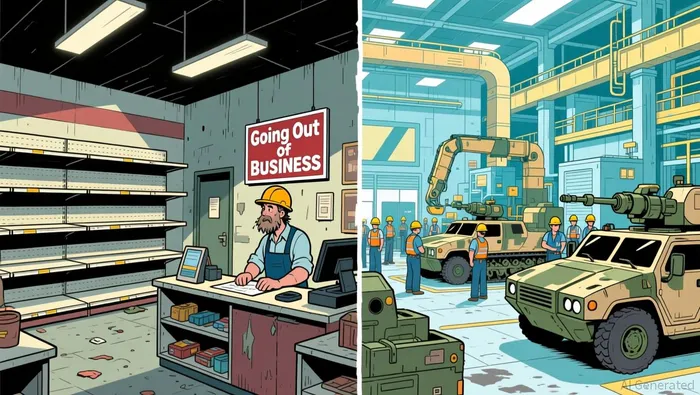
Meanwhile, the Aerospace & Defense (A&D) sector is thriving amid this retail downturn. Defense contractors are capitalizing on geopolitical tensions, modernization programs, and a global defense spending supercycle. The sector's public market performance has outpaced broader indices, with the MSCI ACWI Aerospace & . .
The Retail Sector: A Tale of Two Consumers
The retail slowdown is not uniform. While higher-income households continue to spend on dining, travel, and luxury goods, middle- and lower-income consumers are tightening budgets. on imports, rising energy costs, . The is now a defining feature: discretionary spending in categories like apparel and electronics has contracted, while essentials like gasoline and groceries remain resilient.
This bifurcation creates a fragile foundation for economic growth. , . Analysts warn that a prolonged retail slump could ripple into broader economic activity, particularly if high-income spending—currently a key driver—slows due to stock market volatility or policy shifts.
Aerospace & Defense: A Fortress in a Shifting Landscape
In contrast, the A&D sector is benefiting from a confluence of tailwinds. Geopolitical tensions in Ukraine, the Middle East, and the Indo-Pacific have spurred globally. The U.S. and NATO allies are accelerating modernization programs, . Defense contractors like Lockheed MartinLMT-- (LMT) and Northrop GrummanNOC-- (NOC) are seeing robust demand, .
Technological innovation is another catalyst. , , and are reshaping the sector. Companies like Raytheon Technologies (RTX) and Leidos (LDOS) are leveraging these advancements to secure contracts and boost margins. , , .
The sector's resilience is also tied to its low cyclicality. Unlike retail, defense spending is largely and insulated from consumer sentiment. As governments prioritize national security, A&D firms enjoy long-term visibility and stable cash flows.
Strategic Sector Rotation: From Retail to Defense
For investors, the divergence between these sectors presents a compelling case for rotation. Here's how to position capital:
- Shorten Exposure to Retail Vulnerabilities
- Discretionary Retailers: Reduce holdings in companies reliant on discretionary spending (e.g., apparel, electronics).
ETFs: Consider trimming exposure to like XRT (Consumer Discretionary Select Sector SPDR) as core retail sales weaken.
Increase Allocation to Defense Equities
- Prime Contractors: Overweight stocks like LMTLMT--, NOCNOC--, and RTXRTX--, which benefit from large backlogs and .
- Niche Players: Target high-growth subsectors like (e.g., Leidos) and (e.g., AeroVironment).
ETFs: Add defense-focused ETFs such as XLI (Aerospace & Defense Select Sector SPDR) or PPA (iShares Global Aerospace & Defense ETF).
Hedge Against Geopolitical Volatility
- Energy and Commodity Exposure: Maintain a small position in energy stocks (e.g., oil producers) to offset potential inflationary shocks.
Diversified Portfolios: Balance defense allocations with high-quality, like utilities or healthcare.
Monitor Policy and Geopolitical Catalysts
- Track (e.g., U.S. FY2026 NDAA) and geopolitical developments (e.g., NATO expansion, ).
- Use options strategies (e.g., covered calls on defense stocks) to generate income while hedging against market corrections.
Conclusion: Navigating the Divergence
The U.S. retail sector's decline underscores a broader shift in consumer behavior and economic structure. While discretionary spending falters, defense-related equities are gaining momentum, driven by geopolitical imperatives and technological innovation. For investors, this divergence offers a clear opportunity to reallocate capital from vulnerable retail segments to the resilient A&D sector. By adopting a strategic, to sector rotation, investors can position their portfolios to thrive in an era of divergent economic trajectories.

Stay ahead of the market.
Get curated U.S. market news, insights and key dates delivered to your inbox.
AInvest
PRO
AInvest
PRO



Comments
No comments yet