
Retail Resilience: How Walmart's Thanksgiving Scheduling Decisions Reflect Consumer Behavior and Market Opportunities


 Aime Summary
The holiday season has long been a barometer for the health of the retail sector, offering a glimpse into consumer behavior, competitive dynamics, and macroeconomic trends. This year, Walmart's Thanksgiving scheduling decisions-keeping stores closed on Thanksgiving Day while aggressively reopening for Black Friday-reveal a nuanced strategy that mirrors shifting consumer priorities and underscores new opportunities for investors. By dissecting these moves, we can better understand how the retail sector is adapting to a fragmented economic landscape and what this means for long-term investment.
Walmart's Strategic Alignment with Consumer Priorities
Walmart's decision to remain closed on Thanksgiving Day, , , reflects a calculated effort to balance employee welfare with customer expectations. While some competitors have experimented with limited-hour operations on the holiday, Walmart's choice to prioritize family time for its workforce aligns with a broader trend of consumers valuing experiential spending over material purchases.
According to a report by , this policy allows the company to "reinforce its brand as a socially responsible employer" while redirecting shoppers to its Black Friday openings.
The retailer's reopening at 6 a.m. on Black Friday, coupled with a multi-phase promotional schedule, highlights its focus on capturing early holiday demand. Online-only deals from November 25 to 27, followed by combined in-store and online promotions from November 28 to 30, demonstrate a deliberate omnichannel approach. This strategy not only caters to convenience-driven shoppers but also leverages Walmart's extensive physical footprint to fulfill e-commerce orders,
in its digital business.
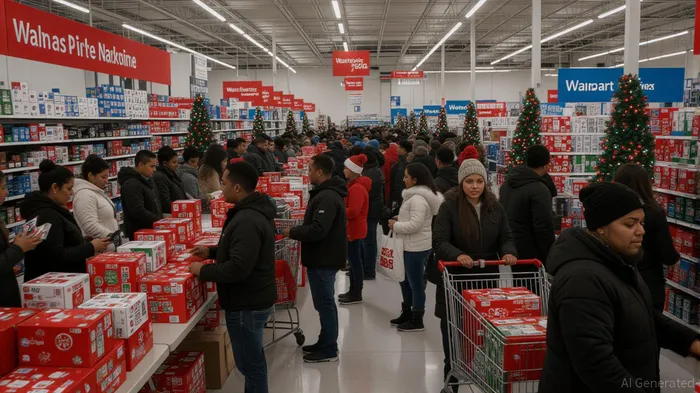
Navigating a Divided Consumer Market
Walmart's sales performance-marked by a 4.5% increase in same-store sales-underscores its ability to navigate a polarized consumer landscape. Upper- and middle-income shoppers continue to spend, but lower-income customers,
constrained by inflation and wage stagnation, are prioritizing essentials over discretionary items. To bridge this gap, WalmartWMT-- has doubled down on aggressive pricing and expanded its private-label brands, which offer cost-conscious consumers high-quality alternatives at lower margins.
This approach is paying off. By bolstering its omnichannel capabilities-such as same-day delivery and curbside pickup-the retailer is effectively serving budget-conscious shoppers without sacrificing profitability. For investors, this signals a strategic pivot toward high-volume, low-margin growth, a model that could stabilize earnings in an era of economic uncertainty.
Competitive Dynamics and Early Black Friday Promotions
Walmart is not alone in its push for early holiday engagement. Competitors like Target and Amazon are similarly rolling out pre-Black Friday deals,
reflecting a broader industry shift toward extended shopping windows. However, Walmart's emphasis on its Walmart+ membership program-a service offering free delivery, fuel discounts, and exclusive deals-provides a unique value proposition. This subscription model not only enhances customer retention but also generates recurring revenue, a critical differentiator in a sector historically reliant on one-time transactions.
Amazon, meanwhile, is leveraging its vast product catalog to dominate electronics, home goods, and fashion categories. Yet, Walmart's localized inventory and price-matching guarantees give it an edge in categories like groceries and household essentials,
where price sensitivity remains acute. For investors, the key takeaway is clear: the holiday season is no longer a single-event sprint but a multi-week marathon, and retailers that can balance early engagement with operational efficiency will outperform.
Investment Implications and Long-Term Outlook
The retail sector's resilience hinges on its ability to adapt to evolving consumer behavior. Walmart's Thanksgiving scheduling decisions-coupled with its omnichannel innovations and pricing strategies-position it as a bellwether for this transformation. For investors,
for the fiscal year, despite a slowing economy, suggests a durable business model.
However, challenges remain. The aggressive discounting required to attract price-sensitive shoppers risks compressing profit margins, a risk shared across the sector. Investors must weigh this against Walmart's long-term investments in automation, supply chain optimization, and private-label brands, which could mitigate these pressures. Additionally, the rise of early Black Friday promotions may force competitors to further extend their holiday calendars, potentially diluting the impact of traditional shopping benchmarks.
In conclusion, Walmart's Thanksgiving strategy is more than a scheduling decision-it is a microcosm of the retail sector's broader evolution. By aligning with consumer priorities, embracing omnichannel innovation, and navigating economic divides, the company is not only securing its own growth but also reshaping the competitive landscape. For investors, the lesson is clear: the future of retail lies in agility, affordability, and the ability to turn holidays into year-round opportunities.

Stay ahead of the market.
Get curated U.S. market news, insights and key dates delivered to your inbox.
AInvest
PRO
AInvest
PRO



Comments
No comments yet