
The Retail Resilience Play: Leveraging Holiday Shopping Trends in Regional Grocery Chains


 Aime Summary
Holiday Shopping Trends: A Return to In-Store, But Digital Stays Relevant
The National Retail Federation reported a 5.9% year-on-year increase in foot traffic at shopping centers on Black Friday 2024, with 81.7 million consumers visiting stores. Albertsons and Fred Meyer, often anchoring these centers, likely benefited from this resurgence. Meanwhile, online spending surged, particularly on Cyber Monday, where 64.4 million shoppers spent $13.3 billion-a 7.3% increase from 2023. Mobile shopping accounted for 57% of Cyber Monday sales, highlighting the growing importance of seamless digital platforms. For grocery chains, this duality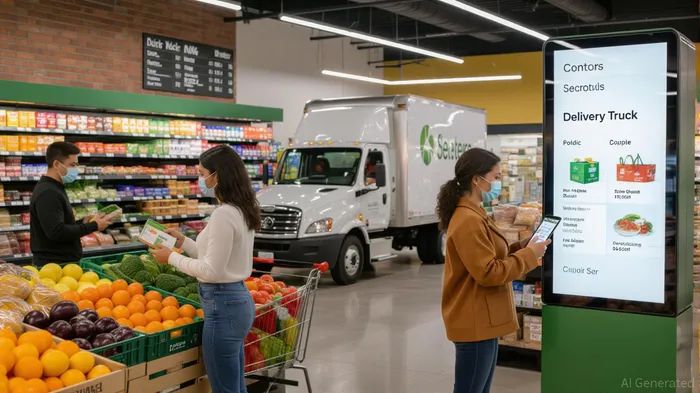 -strong in-store traffic and rising online engagement-demands a balanced approach to fulfillment and inventory management.
Albertsons: Digital Growth and AI-Driven Inventory
Albertsons' Q3 2024 results revealed a 2.0% increase in identical sales and a 23% surge in digital sales, driven by pharmacy operations and loyalty program expansion according to company results. The company's 15% growth in loyalty members (reaching 44.3 million) underscores its success in retaining customers through personalized offers as reported by company data. However, Albertsons faced a 1.4% decline in visits year-over-year, though this was offset by a 10.8% increase in visits compared to 2019 levels according to Grips Intelligence. To counter rising grocery prices and discount competition, Albertsons deployed AI-based inventory solutions like Afresh Fresh Replenishment, which optimizes stock levels in fresh departments (e.g., bakery, deli) and reduces waste. These innovations, coupled with enhanced mobile app features (e.g., AI-powered search and meal planning), position Albertsons to maintain regional relevance.
Kroger and Fred Meyer: Store-Based Fulfillment and Regional Flexibility
Kroger's Fred Meyer banners saw a 16% year-over-year increase in e-commerce sales, driven by BOPIS (buy-online-pickup-in-store) and curbside pickup services. This strategy fueled a surge in short visits to stores, reflecting consumer demand for speed and convenience. Kroger's regional adaptability is further evident in localized inventory strategies, such as tailoring product assortments to Western U.S. markets where Fred Meyer operates. Despite a 0–5% decline in Fred Meyer's online sales for Q3 2024 according to Grips Intelligence, its in-store performance remained robust, with 52.4% of Kroger's total foot traffic attributed to smaller banners like Fred Meyer between January and May 2024.
Operational Innovations: The Key to Regional Resilience
Both chains have prioritized localized inventory and store formats to meet regional demand. Albertsons' AI-driven replenishment system, for instance, ensures precise stock levels for perishable goods, while Kroger's store-based fulfillment model reduces delivery costs and improves customer convenience as detailed in Oregon Live reporting. Additionally, partnerships with third-party delivery services and flexible payment options (e.g., "Buy Now, Pay Later") have enhanced customer retention. In Portland, where Fred Meyer and Albertsons historically competed fiercely, the proposed $24.6 billion Kroger-Albertsons merger has sparked concerns about reduced competition and higher prices. However, the sale of 579 stores to C&S Wholesale Grocers aims to mitigate antitrust risks, though critics question C&S's retail experience.
Investment Implications: Resilience Through Adaptability
For investors, the resilience of regional grocery chains lies in their ability to balance digital and in-store experiences while adapting to local market dynamics. Albertsons' focus on AI-driven inventory and loyalty programs, combined with Kroger's store-based fulfillment strategies, highlights a forward-looking approach to consumer needs. However, the proposed Kroger-Albertsons merger introduces regulatory and competitive uncertainties, particularly in markets like Oregon where both chains have long vied for dominance.
In conclusion, the 2023–2024 holiday season reaffirmed the importance of operational agility in the grocery sector. As consumer behavior continues to evolve, regional chains that prioritize localized inventory, omnichannel convenience, and technological innovation will likely outperform peers in an increasingly fragmented retail landscape.

Delivering real-time insights and analysis on emerging financial trends and market movements.
Latest Articles
Stay ahead of the market.
Get curated U.S. market news, insights and key dates delivered to your inbox.
AInvest
PRO
AInvest
PRO



Comments
No comments yet