
Retail Resilience: How Holiday Shopping Trends Signal Consumer Confidence and Retail Sector Opportunities


 Aime Summary
Consumer Behavior: A Tale of Two Consumers
The 2025 holiday season highlights a stark bifurcation in consumer spending. While overall holiday spending is projected to decline by 5% year-over-year, e-commerce growth of 7–9% suggests a shift toward budget-conscious, deal-driven shopping according to data. This duality is evident in generational spending patterns: Baby boomers and Gen Z are increasing their gift budgets, while millennials and Gen X are tightening their belts according to the holiday spending update. Meanwhile, gift card spending-a low-risk, high-liquidity option-has surged to $29.1 billion, with consumers purchasing an average of three to four cards according to NRF data.
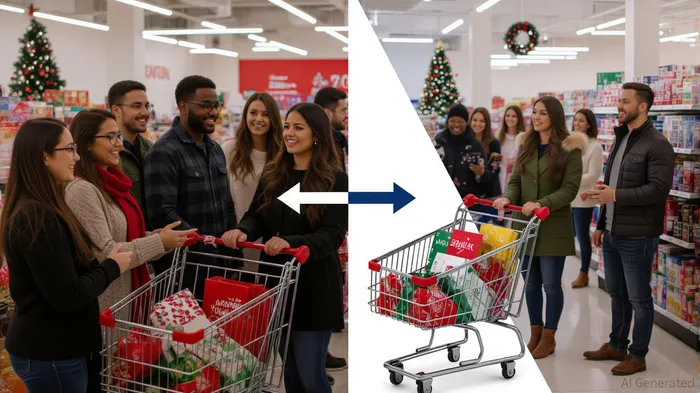
Regional and sectoral trends further illustrate this divide. Luxury department stores and upscale restaurants saw a 3.8% year-over-year increase in visits, reflecting affluent consumers' willingness to splurge on premium experiences according to Commercial Observer. Conversely, off-price retailers and dollar stores also gained traction, catering to budget-conscious shoppers seeking value according to the same report. This duality is not merely a seasonal anomaly but a structural shift in consumer behavior, driven by inflation and income inequality.
Retail Stock Valuation: Winners and Losers in the Holiday Season
The divergence in consumer behavior is mirrored in retail stock performance. WalmartWMT--, for instance, has defied broader spending slowdowns by leveraging its dominance in essentials and groceries. The company raised its full-year sales guidance to 4.8–5.1% growth, with Q4 sales projected to rise 3.75–4.75% at constant currency. This resilience stems from a strategic shift in customer demographics: higher-income shoppers trading down to Walmart for value-oriented purchases, coupled with a 28% surge in online sales.
In contrast, TargetTGT-- faces headwinds. Its third-quarter comparable sales fell 2.7%, and the company slashed its full-year earnings forecast, anticipating low single-digit sales declines in Q4. The disconnect reflects Target's struggle to retain middle- and upper-income shoppers, who are increasingly prioritizing essentials over discretionary items according to Wall Street Horizon analysis. This trend is evident in the S&P Retail Select Industry Index, which remains flat for the year, with stocks like Bath & Body Works and Target underperforming according to Yahoo Finance data.
Regional grocery retailers, meanwhile, present a mixed picture. Kroger's disciplined cost control and strong sales performance have earned it a "Buy" rating, with a 10.6% 1-year return and a 11.3% fair value upside according to Investing.com. AlbertsonsACI--, though, has seen a -5.2% 1-year return, despite raising its profit forecast and launching a $750 million share-repurchase program to signal confidence in its undervalued stock. These divergent trajectories highlight the importance of operational efficiency and pricing strategy in a high-inflation environment.
E-Commerce Integration: The Gen Z-Driven Shift
The 2025 holiday season also underscores the accelerating digitization of retail, particularly among Gen Z. This cohort, which accounts for 55% of digital holiday sales via mobile devices, is reshaping the retail landscape by demanding seamless omnichannel experiences. For instance, Gen Z's share of clothing sales grew by 1.5% in Q4 2024 compared to Q4 2023, outpacing other age groups according to JPMorgan data. Retailers that prioritize mobile-first strategies-such as early bird deals and integrated online-offline platforms-are better positioned to capture this demographic.
Walmart's e-commerce growth exemplifies this trend. Its 28% year-over-year online sales increase reflects a successful pivot to digital, while Target's struggles highlight the risks of lagging in this space. For investors, the ability to adapt to Gen Z's preferences-through AI-driven inventory management, social media integration, and flexible delivery options-will be critical in 2026.
Investment Implications: Where to Focus
The 2025 holiday season signals a clear investment thesis: prioritize retailers that balance value-driven offerings with technological agility. Walmart's robust Q4 guidance and e-commerce momentum make it a standout, while Kroger's cost discipline and defensive positioning in the grocery sector offer long-term appeal. Regional grocers like Albertsons, despite near-term challenges, warrant attention due to their aggressive share-buyback programs and potential for margin stabilization.
Conversely, retailers like Target-struggling to retain discretionary spenders-pose higher risks. The broader sector's flat performance underscores the need for selective investing, focusing on companies that align with the dual forces of economic caution and digital transformation.
As the holiday season concludes, the retail sector's resilience lies not in broad consumer optimism but in its ability to cater to a fragmented, value-conscious market. For investors, the key is to identify those retailers that have mastered this duality-and to act swiftly before the next wave of consumer trends emerges.

Delivering real-time insights and analysis on emerging financial trends and market movements.
Latest Articles
Stay ahead of the market.
Get curated U.S. market news, insights and key dates delivered to your inbox.
AInvest
PRO
AInvest
PRO



Comments
No comments yet