
Retail Resilience: How Holiday Shopping Patterns Shape Consumer Stock Opportunities


 Aime Summary
The Shifting Consumer Landscape: Spending Habits and Timing
The 2024 holiday season was defined by a duality in consumer behavior: frugality and indulgence coexisted. According to a Deloitte survey, 40% of shoppers planned to spend less than in previous years, while another 40% aimed to splurge on premium items. This bifurcation was driven by income inequality, with high-income households reducing spending by 18% compared to 12% for lower-income families. Meanwhile, the holiday shopping window expanded dramatically, with 33% of consumers starting their purchases before October. This early surge forced retailers to rethink traditional timelines, extending promotions into summer and overlapping Black Friday with Cyber Monday events.
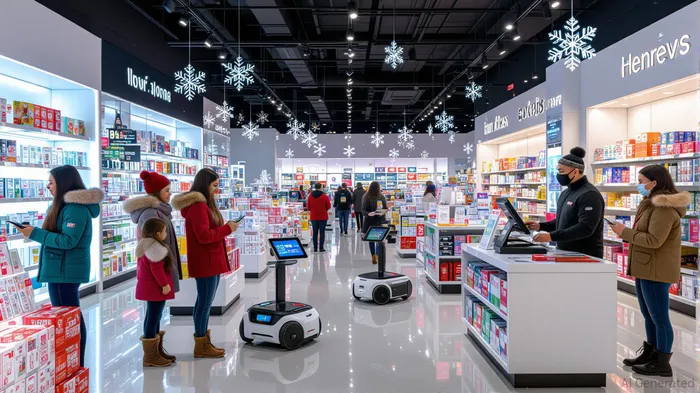
The physical retail experience remained critical, despite the rise of e-commerce. Over 80% of consumers planned to shop in stores, with those spending more than 90 minutes in-store generating significantly higher revenue. Extended store hours-such as Macy'sM-- 6 a.m. to 11 p.m. Black Friday schedule and Kohl'sKSS-- 5 a.m. openings-were designed to accommodate this trend. However, the real winner was the omnichannel model: 55% of Gen Z shoppers completed their purchases through a blend of online and in-store interactions.
Operational Efficiency: The New Retail Imperative
Retailers that thrived in 2024 did so by prioritizing operational efficiency. Walmart and Amazon leveraged AI-driven inventory optimization and logistics networks to deliver 27% faster package delivery times compared to 2023. Walmart's same-store sales growth of 4.0% in Q4 2024 underscored the effectiveness of its omnichannel strategy, which included expanded same-day delivery coverage in 140+ metro areas. Similarly, Amazon's AWS segment grew by 19%, fueling its dominance in cloud infrastructure and enabling scalable retail operations.
Ulta Beauty, while facing a 1.9% decline in Q4 net sales due to calendar shifts, demonstrated the power of personalized engagement. Its loyalty program drove 1.5% comparable sales growth, and its AI-powered tools, such as virtual beauty consultations, enhanced customer retention. Meanwhile, TikTok Shop's 223% year-over-year sales surge highlighted the importance of social media integration in modern retail.
Investment Opportunities: Stocks to Watch
For investors, the 2024 holiday season pointed to three key subsectors: omnichannel retailers, AI-integrated logistics players, and value-focused brands.
Walmart (WMT): With $173.4 billion in Q4 revenue and a 5.7% year-over-year sales growth, Walmart's ability to balance in-store foot traffic with e-commerce global e-commerce sales surpassed $100 billion makes it a cornerstone of the consumer sector. Its strategic investments in AI-driven pricing and delivery infrastructure position it to outperform in 2025.
Amazon (AMZN): Amazon's Q4 revenue of $187.8 billion and 61% year-over-year operating income growth highlight its dominance in both retail and cloud computing. The company's AI innovations, including the Trainium2 chip and AI-powered tools like Rufus, are set to drive long-term margins.
Ulta Beauty (ULTA): Despite a cautious 2025 outlook, Ulta's Q4 EPS of $8.46 (exceeding expectations) and strong loyalty program performance indicate resilience. Its focus on AI-driven personalization and strategic inventory management could unlock value as consumer spending normalizes.
Dollar General (DG): As shoppers prioritize affordability, Dollar General's 5% year-over-year sales growth in 2024 underscores its appeal. Its low-cost model and expansion into omnichannel services make it a compelling play in a cost-conscious environment.
The Road Ahead: Balancing Risks and Rewards
While the 2024 holiday season was a success, challenges loom. Tariffs, supply chain bottlenecks, and the 2024 U.S. presidential election could disrupt spending patterns in 2025. However, retailers that double down on AI, omnichannel integration, and customer-centric strategies are likely to weather these headwinds. For instance, AI-powered chatbots drove a 1,300% surge in web traffic during the 2024 holiday season, signaling the growing importance of digital engagement.
Investors should also monitor sustainability trends, as 64% of global consumers prioritize ethical retail practices. Companies like WalmartWMT-- and AmazonAMZN--, which have made strides in reducing carbon footprints and offering eco-friendly packaging, are well-positioned to capture this demand.
Conclusion
The 2024 holiday season proved that retail resilience is not about resisting change but embracing it. By aligning operational efficiencies with evolving consumer preferences, retailers like Walmart, Amazon, and Ulta Beauty have set the stage for sustained growth. For investors, the key is to identify stocks that not only adapt to the present but also anticipate the future-where AI, omnichannel agility, and value-driven innovation converge.

Delivering real-time insights and analysis on emerging financial trends and market movements.
Latest Articles
Stay ahead of the market.
Get curated U.S. market news, insights and key dates delivered to your inbox.
AInvest
PRO
AInvest
PRO



Comments
No comments yet