
Retail Holiday Operations and Consumer Spending Patterns: How Holiday Store Hours Impact Short-Term Retail Stock Volatility


 Aime Summary
Store Hours and Consumer Behavior: A Delicate Balance
Retailers' holiday store hour adjustments reflect a strategic response to evolving consumer priorities. For instance, Walmart extended Christmas Eve hours to 6 p.m., while TargetTGT-- operated until 8 p.m., aiming to capture last-minute shoppers. Conversely, major chains like Costco and Kroger closed entirely on Christmas Day, signaling a focus on employee rest and inventory management. These decisions directly impact consumer spending patterns: extended hours can boost foot traffic and sales, while closures may drive demand toward online channels or alternative retailers.
The shift toward omnichannel shopping further complicates this dynamic. According to a report by Forrester, 26% of total holiday retail spending in 2023 occurred online, a 10.1% year-over-year increase. Retailers with robust digital infrastructures, such as AmazonAMZN-- and WalmartWMT--, leveraged early promotions and flexible fulfillment options (e.g., Buy Online, Pick Up In-Store) to mitigate the impact of in-store closures. This duality-physical store adjustments paired with digital acceleration-has created a fragmented yet resilient retail landscape.
Stock Volatility: Operational Decisions and Investor Reactions
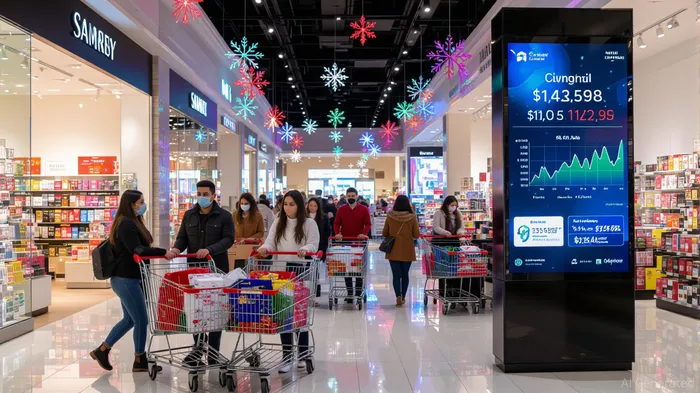 The immediate impact of store hour announcements on stock prices underscores the sensitivity of retail equities to operational signals. For example, Walmart's cautious holiday forecast-despite strong fourth-quarter earnings-led to a 3.89% stock price drop, reflecting investor concerns about future demand. Similarly, Target's flat sales guidance and price-cutting strategies resulted in a 1.25% decline, as analysts questioned its ability to maintain margins. In contrast, off-price retailers like TJX and Ross Stores, which aligned their operations with value-driven consumer behavior, saw improved stock performance, benefiting from a 9% year-over-year growth in online and non-store retail sales.
The volatility is amplified by reduced trading volumes during the holiday period. As noted by Autochartist, compressed trading activity-driven by fewer market participants-leads to sharper price swings when earnings or operational updates are released. This was evident in 2023, when Best Buy's optimistic Black Friday projections briefly lifted its stock, only for subsequent weak December sales to trigger a reversal.
Broader Economic and Demographic Trends
Underlying these operational and stock market dynamics are broader economic and demographic shifts. Consumer confidence, already tempered by inflation, has led to a prioritization of essentials over discretionary purchases. For example, Gen Z's shopping behavior-characterized by early purchases, omnichannel integration, and a 23% reduction in discretionary holiday spending-has forced retailers to adapt their hour strategies to align with this cohort's preferences. Meanwhile, the rise of AI-driven shopping tools and mobile commerce projected to account for 56.1% of online sales in 2025 has further decentralized the impact of physical store hours.
Case Studies: Direct Impacts on Retailers
- Walmart: Despite a 5% year-over-year increase in October retail sales, Walmart's stock fell 3.89% following its cautious holiday forecast. This reaction highlights investor skepticism about the sustainability of its value-driven model amid rising costs.
- Target: A 1.25% stock decline followed Target's announcement of reduced Christmas Day hours and price cuts on 2,000 items, signaling margin pressures and weaker consumer demand for non-essential goods.
- Costco: While its Christmas Day closures aligned with industry norms, Costco's stock remained relatively stable, buoyed by its bulk-buy model and strong online growth.
Conclusion: Strategic Implications for Investors
The 2023–2024 holiday season illustrates that retail stock volatility is not solely a function of macroeconomic trends but is deeply intertwined with operational decisions like store hours. Investors must monitor how retailers balance in-store adjustments with digital innovation, as well as their ability to navigate consumer shifts toward value and convenience. For companies that successfully align their operations with these trends-such as Walmart's IoT-driven inventory management or Amazon's AI-powered promotions-the rewards are clear. However, those lagging in adapting to the new normal risk eroding both market share and investor confidence.
As the retail sector enters the 2025 holiday season, the interplay between operational agility and consumer behavior will remain a critical determinant of stock performance.

Delivering real-time insights and analysis on emerging financial trends and market movements.
Latest Articles
Stay ahead of the market.
Get curated U.S. market news, insights and key dates delivered to your inbox.
AInvest
PRO
AInvest
PRO



Comments
No comments yet