
The Resurgence of Space IPOs: Firefly Aerospace and the New Frontier of Capital
 Aime Summary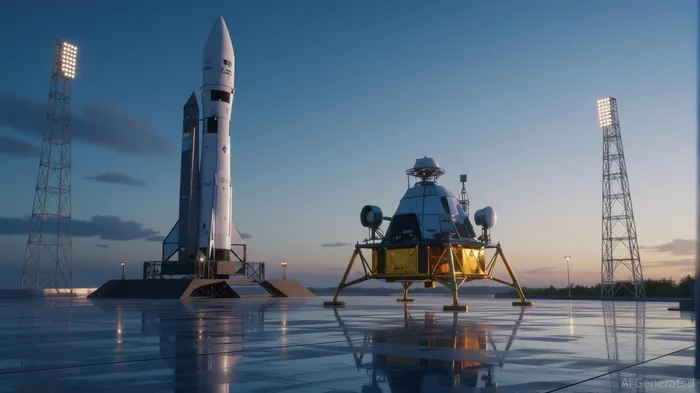
The space industry is no longer a niche curiosity but a burgeoning economic frontier. In 2025, the sector has witnessed a seismic shift: after years of regulatory uncertainty and financial caution, private capital is flooding into space startups, driven by technological breakthroughs, geopolitical urgency, and a reimagined regulatory landscape. Firefly AerospaceFLY--, which went public on August 7, 2025, epitomizes this transformation. Its $868 million IPO, which valued the company at $8.5 billion, marked not just a milestone for FireflyFLY-- but a broader signal that investors are beginning to view space as a viable long-term asset class.
The Firefly Thesis: A Dual-Track Strategy
Firefly's appeal lies in its dual focus on mid-lift launch systems and lunar logistics. The company's Alpha rocket, a medium-lift vehicle capable of carrying 1.5–2.5 metric tons to orbit, targets a segment of the market that remains underserved. While SpaceX's Falcon 9 dominates heavy-lift launches and Rocket Lab's Electron excels in small-satellite deployments, Firefly's niche—dedicated one-ton launches for national security, commercial, and scientific payloads—positions it to capture a growing share of demand.
The company's lunar ambitions further differentiate it. In March 2025, Firefly's Blue Ghost lander became the first private spacecraft to achieve an upright landing on the Moon, a $102 million NASA-funded mission. This success, coupled with a $177 million NASA contract for future lunar deliveries, has cemented Firefly's role in the Artemis program. The company's roadmap includes a 2026 mission to land on the far side of the Moon—a feat currently reserved for China's Chang'e program—underscoring its technical ambition.
Financials: Growth, Losses, and a $1.1 Billion Backlog
Firefly's financials tell a story of rapid scaling. In its most recent quarter, revenue surged sixfold to $55.9 million, driven by contract wins with NASA, Northrop GrummanNOC--, and defense contractors like Lockheed MartinLMT--. However, the company reported a net loss of $60.1 million, a widening from $52.8 million in the prior year. While losses persist, Firefly's $1.1 billion contract backlog and $175 million Series D funding (valuing it at $2 billion pre-IPO) suggest a path to profitability.
The IPO proceeds—$868 million in gross proceeds—will be allocated to repay debt, fund production of the Alpha rocket, and develop the Eclipse rocket (a mid-size vehicle co-developed with Northrop Grumman) and Elytra, a space tug for in-orbit satellite servicing. These investments aim to diversify Firefly's revenue streams beyond launch services, tapping into the $12.4 billion satellite manufacturing market projected to grow at 16% annually through 2030.
Industry Tailwinds: Tech, Regulation, and Capital
Firefly's success is inextricably tied to broader industry trends. Technological progress has made space more accessible: reusable rockets, modular designs, and digital twins are reducing costs and increasing launch cadence. Firefly's vertically integrated production model—manufacturing carbon composites and propulsion systems in-house—mirrors this trend, enhancing cost control in a sector historically plagued by supply chain bottlenecks.
Regulatory shifts are equally critical. The U.S. government's streamlining of FAA and FCC approval processes, coupled with the formation of the Part 450 SpARC committee, is accelerating commercial space activity. Firefly's partnerships with defense firms and its alignment with the Trump administration's “Golden Dome” missile defense initiative further insulate it from regulatory volatility.
Private-sector investment has reached a tipping point. From 2020 to 2023, $50 billion flowed into space startups, with 500 new companies emerging globally. Firefly's $2 billion valuation places it among the most valuable private space firms, though it remains dwarfed by SpaceX ($180 billion) and Rocket LabRKLB-- ($12.4 billion). Yet its strategic focus on mid-lift and lunar logistics—segments with limited competition—gives it a unique edge.
Risks and Realities
Despite its momentum, Firefly faces headwinds. The mid-lift market is becoming increasingly crowded, with competitors like Relativity Space and ABL Space Systems entering the fray. Technical challenges—such as scaling Alpha production to meet demand—remain unproven. And while Firefly's $1.1 billion backlog is a strength, converting it into cash flow will require consistent execution.
Moreover, the space sector's capital intensity means Firefly must continue to secure funding. Its IPO raised $868 million, but sustaining growth will likely require additional rounds or strategic partnerships. The company's reliance on government contracts also exposes it to budgetary shifts and geopolitical tensions.
Investment Implications
For investors, Firefly represents a high-conviction bet on the commercialization of space. Its dual-track strategy—launch systems and lunar logistics—positions it to benefit from both the $17.5 billion mid-lift market and the $1 trillion cislunar economy expected by 2030. The company's technical milestones, institutional backing (AE Industrial Partners owns 41%), and alignment with U.S. defense priorities add layers of credibility.
However, Firefly is not for the faint of heart. The stock's 34% IPO surge reflects optimism, but its path to profitability is uncertain. Investors should monitor key metrics: gross margin trends, production scalability, and the pace of contract execution. Those with a long-term horizon and a tolerance for volatility may find Firefly's vision compelling, particularly as the sector matures.
Conclusion: A New Era of Space Capitalism
Firefly Aerospace's IPO is more than a company milestone—it's a harbinger of a new era in space capitalism. As regulatory barriers fall, private capital surges, and technology advances, the sector is transitioning from government-led exploration to commercial-driven innovation. Firefly's success will depend on its ability to execute on its ambitious roadmap, but its current trajectory suggests it is well-positioned to thrive in this evolving landscape. For investors, the question is no longer if space will become a viable asset class, but how to allocate capital in a sector where the risks are high, but the rewards could be historic.

Delivering real-time insights and analysis on emerging financial trends and market movements.
Latest Articles
Stay ahead of the market.
Get curated U.S. market news, insights and key dates delivered to your inbox.




Comments
No comments yet