
The Resurgence of Space Commerce and Its Implications for Investors


 Aime Summary
The global space industry is undergoing a seismic shift, driven by technological breakthroughs, geopolitical realignments, and a surge in private-sector investment. As SpaceX continues to redefine the economics of space access through reusable rocketry and rapid launch cadence, the commercialization of space is no longer a speculative vision but a tangible reality. For investors, this marks a pivotal moment to strategically position capital in infrastructure and launch-capable tech firms poised to benefit from this renaissance.
SpaceX's Milestones: A Catalyst for Cost Reduction and Scalability
SpaceX's achievements in 2025 underscore its role as the linchpin of the new space economy. The company's
500th mission using a reusable rocket, including the recent launch of the Sentinel-6B satellite for climate monitoring, highlights its mastery of cost-effective, high-frequency operations. By recovering and reusing Falcon 9 first stages-such as the 23rd landing of the droneship Just Read the Instructions-
SpaceX has slashed launch costs by over 80% compared to traditional expendable systems. This efficiency not only democratizes access to orbit but also accelerates the deployment of satellite constellations, Earth observation networks, and deep-space missions, creating a virtuous cycle of demand for downstream services.
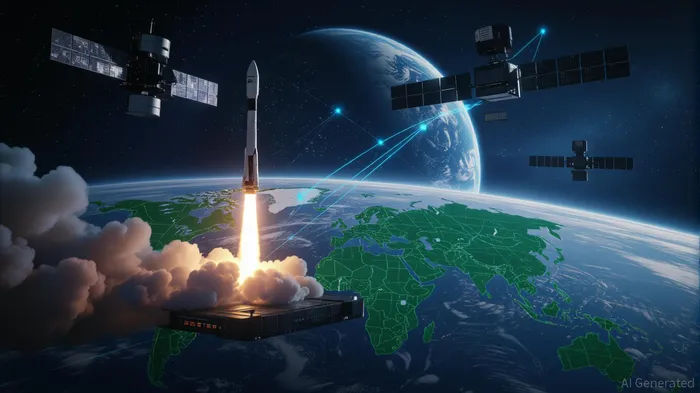 The 100th mission of 2025, which delivered 29 Starlink satellites to orbit, further illustrates SpaceX's operational dominance. With
11 launches in November alone, the company has set a new benchmark for launch frequency, a critical enabler for industries ranging from broadband connectivity to national security. Such milestones reinforce the long-term viability of space commerce, as reduced costs and increased reliability lower barriers for startups, governments, and corporations seeking to leverage orbital infrastructure.
Geopolitical Alliances and the Democratization of Space
Parallel to SpaceX's technical advancements, international collaboration is reshaping the geopolitical landscape of space.
The recent India-Canada agreement to deepen cooperation in space technology exemplifies this trend. By pooling resources in satellite manufacturing, , and supply chain diversification, nations are accelerating their capabilities while mitigating risks associated with over-reliance on single partners. This aligns with broader efforts under frameworks like the Australia-Canada-India Technology and Innovation (ACITI) Partnership, which
in critical technologies.
Such alliances are not merely diplomatic gestures; they signal a strategic reallocation of capital toward space infrastructure. For instance, India's growing emphasis on commercial satellite launches and Canada's investments in Earth observation systems are creating new markets for launch providers and component manufacturers. Investors should note that these partnerships often translate into long-term contracts for firms supplying satellite components, propulsion systems, and ground infrastructure.
Investment Trends: Defense-Driven Growth and Supply-Chain Resilience
The Q3 2025 Space Investment Quarterly report , a five-quarter high, driven largely by defense and dual-use technologies. U.S. satellite manufacturers, such as Apex (which secured $200 million in funding), are aligning with Pentagon initiatives like the Golden Dome program, which
aims to harden national-security space systems. Similarly, , reflecting Beijing's aggressive industrial mobilization in launch services
as reported in the Q3 report.
The Pentagon's Defense Innovation Unit (DIU) is also reshaping the investment landscape by targeting firms capable of rapid, high-volume production of satellite components.
A recent solicitation emphasized the need for companies producing , , and -critical for both commercial and defense applications. These components are essential for proliferated satellite architectures, where constellations of small, low-cost spacecraft require agile supply chains. The DIU's focus on U.S.- or allied-based suppliers further underscores the strategic imperative to localize production,
reducing vulnerabilities in global supply chains.
Supply-Chain Beneficiaries: From Logistics to Advanced Manufacturing
While SpaceX and satellite manufacturers dominate headlines, the real growth lies in the underappreciated layers of the supply chain. For example, RG Group-a manufacturer of motion control and fluid handling systems-has
partnered with logistics firm Nexterus to optimize its aerospace operations. This collaboration highlights the importance of robust logistics networks in scaling space infrastructure, particularly as demand for satellite components and launch services intensifies.
Closer to the production end, firms specializing in radiation-hardened electronics and thrusters are emerging as key beneficiaries. Though specific names remain undisclosed in recent reports,
the Pentagon's has prioritized investments in and spacecraft manufacturing, signaling a focus on firms capable of scaling production within three months of contract awards. Investors should also monitor companies like Apex,
to expand its satellite production capabilities, and California-based startups leveraging AI-enabled tools for adaptive manufacturing
as highlighted in Pentagon reports.
Strategic Entry Points for Investors
For those seeking to capitalize on this transformation, the following sectors offer compelling opportunities:
1. Reusable Launch Providers: SpaceX's dominance is well-established, but secondary players in reusable rocketry and launchpad infrastructure (e.g., companies supporting Cape Canaveral's operations) could benefit from increased demand.
2. Satellite Component Manufacturers: Firms producing radiation-hardened electronics, , and thrusters-aligned with -are positioned for outsized growth.
3. Supply-Chain Resilience Firms: Logistics providers like Nexterus and manufacturers optimizing for high-volume production (e.g., ) are critical to sustaining the pace of space commerce.
4. AI-Driven Infrastructure Funds:
, while not space-specific, highlights the broader trend of capital flowing into that enhance space manufacturing and logistics.
Conclusion: A New Era of Space Commerce
The convergence of technological innovation, geopolitical collaboration, and defense-driven investment is creating a fertile ground for space commerce. SpaceX's milestones have proven that is not a niche experiment but a foundational pillar of the industry. Meanwhile, international partnerships and Pentagon initiatives are accelerating the development of and scalable infrastructure. For investors, the key lies in identifying firms that are not only aligned with these trends but are also positioned to dominate their respective niches-whether in launch services, satellite components, or logistics.
As the cost of accessing space continues to decline and the applications of orbital infrastructure expand, the next decade promises returns that rival the most transformative tech revolutions of the past. The time to act is now.

Stay ahead of the market.
Get curated U.S. market news, insights and key dates delivered to your inbox.






Comments
No comments yet