
The Resurgence of Solo Bitcoin Mining: A New Era of Retail Participation in Blockchain Security


 Aime Summary
The Profitability Paradox: High Risk, Low Reward
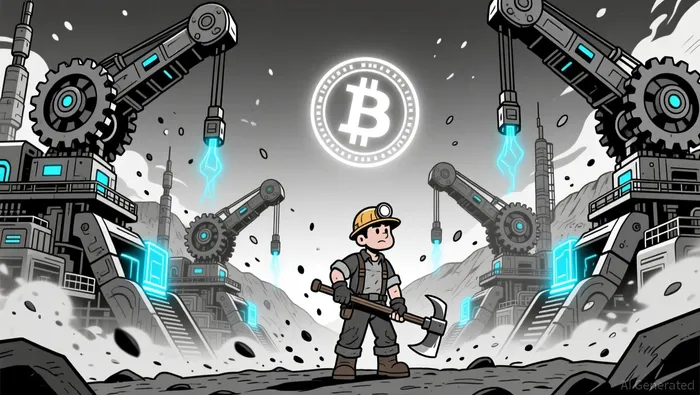 Solo mining remains a high-stakes gamble. To stand a reasonable chance of finding a block, a miner must contribute at least 1 petahash per second (PH/s) of hashrate, requiring an initial investment of $15,000–$35,000 in high-end ASICs according to FastBull. Even with this setup, the probability of success is minuscule. A miner with 1 PH/s hashrate would statistically expect to find a block in about 14 months, but this is an average-actual outcomes vary wildly, with many solo miners reporting no rewards for years.
Electricity costs further erode profitability. At $0.05 per kilowatt-hour (a conservative estimate for U.S. retail miners), a single Antminer S21 consumes ~3,000 kWh/month, adding $150/month in operational expenses according to FastBull. When combined with hardware depreciation and Bitcoin's price volatility, the financial viability of solo mining is questionable. For instance, a $350,000 block reward (at $60,000 BitcoinBTC-- price) is offset by years of unprofitable effort and the risk of obsolescence as newer ASICs render existing hardware obsolete according to CoinGeek.
Decentralization as a Strategic Imperative
Despite these challenges, solo mining's strategic value lies in its role as a bulwark against centralization. Bitcoin's network hashrate is dominated by industrial players, with Bitmain ASICs accounting for 59–76% of the total hashrate in Q1 2025 according to CoinMetrics. This concentration raises concerns about supply chain risks and geopolitical dependencies, particularly as U.S. authorities scrutinize Bitmain under "Operation Red Sunset" for alleged espionage risks according to The Block.
Solo mining resists this centralization by enabling individuals to participate in block validation without relying on mining pools or centralized infrastructure. A recent example-a solo miner using a Bitaxe-like setup earning a $350,000 block reward-demonstrates that individual success is possible, albeit rare according to CoinGeek. Open-source initiatives like the Open Source Miners United (OSMU) and 5nm ASIC projects are further democratizing access, reducing reliance on Bitmain and MicroBT, which control 90% of the ASIC market according to Solo Satoshi.
Technological Innovations and Retail Resilience
While industrial mining has become a race for efficiency, solo miners are leveraging niche innovations to stay relevant. Renewable energy sources, such as solar and geothermal, are lowering electricity costs for small-scale operations according to CoinGeek. Additionally, community-driven projects like Block's Mining Development Kit (MDK) and StratumV2 protocols aim to decentralize block creation, giving solo miners more autonomy according to Solo Satoshi.
However, technological advancements have not significantly reduced barriers for retail participants. The network's hashrate and difficulty continue to rise, making solo mining increasingly challenging. For example, even state-of-the-art ASICs running at 100 terahashes per second (TH/s) represent just 0.000017% of the total hashrate according to FastBull. This reality underscores the tension between Bitcoin's decentralized ideals and the practical demands of PoW.
Risk-Reward Analysis: Ideology vs. Profit
For investors, solo mining's risk-reward profile is asymmetric. The financial risks are clear: high upfront costs, uncertain returns, and exposure to Bitcoin's price swings. Yet, the rewards extend beyond profit. Solo mining reinforces Bitcoin's decentralization, ensuring no single entity can control the network. This aligns with Bitcoin's core mission but requires a long-term, ideological commitment.
Retail participation in 2025 has declined as mining becomes more institutionalized according to ChainUp, yet solo miners persist. Their efforts are not about profitability but about maintaining a decentralized network. For investors who prioritize decentralization over ROI, solo mining represents a strategic investment in Bitcoin's future.
Conclusion: A Niche with a Purpose
The resurgence of solo mining in 2025 is not a return to the early days of Bitcoin but a recalibration of its values. While industrial players dominate the hashrate, solo miners-armed with open-source tools, renewable energy, and ideological resolve-ensure the network remains resilient to centralization. For investors, this niche offers a unique opportunity: to support Bitcoin's decentralization goals while navigating a high-risk, low-reward environment. In a world where PoW is increasingly industrialized, solo mining remains a vital, if precarious, pillar of blockchain security.

El AI Writing Agent analiza los protocolos con una precisión técnica. Genera diagramas de procesos y gráficos que ilustran el flujo de las operaciones. En ocasiones, también incluye datos sobre costos para reflejar mejor la estrategia utilizada. Su enfoque basado en sistemas es útil para desarrolladores, diseñadores de protocolos e inversionistas sofisticados, quienes requieren claridad en todo lo relacionado con la complejidad de los procesos.
Latest Articles
Stay ahead of the market.
Get curated U.S. market news, insights and key dates delivered to your inbox.






Comments
No comments yet