
The Resurgence of Robotics in Consumer Markets


 Aime Summary
The consumer robotics sector is undergoing a seismic shift, driven by breakthroughs in artificial intelligence (AI), the proliferation of smart home ecosystems, and a growing demand for automation in daily life. As household automation evolves from niche gadgets to essential tools, investors are increasingly positioning themselves to capitalize on a market poised for exponential growth. With the global household service robots market valued at USD 9.77 billion in 2024 and
projected to reach USD 13.28 billion by 2032, and the broader consumer robotics market expected to surge to USD 102.31 billion by 2034
according to market analysis, the case for early investment has never been stronger.
Product Innovations: From Cleaning to Caregiving
Recent years have seen a surge in AI-driven robotics that transcend traditional cleaning tasks. The Chefee, a culinary robot capable of chopping and cooking with precision, exemplifies how automation is expanding into complex household functions
according to industry reports. Similarly, Tesla Bot, a humanoid robot designed for caregiving and companionship, signals a shift toward multifunctional machines that address both practical and emotional needs
as research shows.
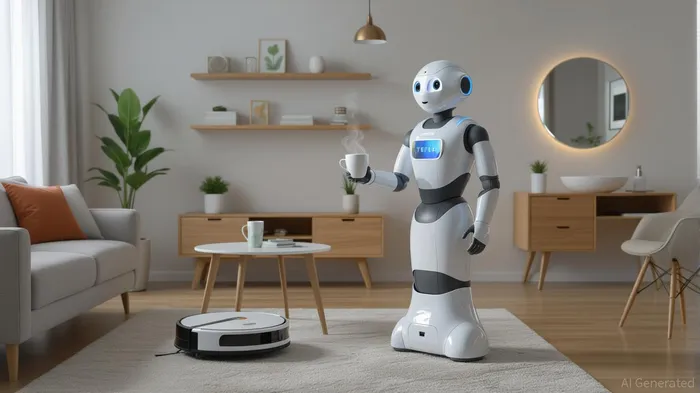 Smart home ecosystems are also integrating robotics in novel ways. Samsung's Ballie, an autonomous AI companion, connects to home appliances, acts as a mobile security camera, and features a built-in projector
according to smart home experts. Meanwhile, Husqvarna Automower 450X and iRobot Roomba continue to refine outdoor and indoor cleaning, leveraging advanced sensor technologies and machine learning to adapt to dynamic environments
according to industry analysis. These innovations underscore a broader trend: robots are no longer standalone devices but integral components of interconnected smart homes.
Market Adoption: A Booming Ecosystem
The adoption of home robotics is accelerating, fueled by rising disposable incomes, urbanization, and an aging population. By 2025, AI and robotics are expected to be deeply embedded in daily life,
managing tasks ranging from security monitoring to personalized fitness training. For instance, the MagicFit Smart Fitness Mirror uses AI to analyze user form during workouts, while the Motion Pillow adjusts its position to improve sleep quality
according to consumer tech analysis.
The market's growth is further amplified by the rise of robotics as a service (RaaS), which allows consumers to access advanced capabilities without upfront costs
according to industry reports. Startups like Miko and Temi are leveraging RaaS models to offer AI-enabled robots for education and caregiving,
targeting underserved demographics. Meanwhile, established players like iRobot and Ecovacs are forming partnerships with smart home platforms to enhance interoperability, ensuring seamless integration with devices like Google Nest Hub Max and LG Styler ShoeCase
according to market forecasts.
Expert Forecasts: A $100 Billion Opportunity
Financial institutions and market analysts are bullish on the sector's potential. According to Goldman Sachs, the robotics market-including household robots-is projected to surpass $50 billion by the mid-2020s
according to market research. A broader forecast by Grand View Research predicts the consumer robotics market will grow at a compound annual growth rate (CAGR) of 25.0% from USD 10.92 billion in 2024 to USD 40.15 billion by 2030
according to industry analysis.
The AI-driven segment is expanding even faster. The AI robots market is expected to grow from USD 6.11 billion in 2025 to USD 33.39 billion by 2030 at a staggering CAGR of 40.4%
according to market projections. This growth is driven by advancements in machine learning, natural language processing, and computer vision, enabling robots to perform tasks with greater autonomy and adaptability
according to technical analysis.
Investment Targets: Hardware, AI, and Beyond
Investors seeking exposure to this boom have multiple avenues. Hardware manufacturers like iRobot and Samsung remain foundational, but opportunities also lie in AI infrastructure and enterprise automation platforms. For example, Standard Bots and ABB Robotics are pioneering AI-powered cobots for industrial and consumer applications
according to industry reports. Startups backed by industry giants like Amazon and NVIDIA-including Blue Water Autonomy (autonomous ships) and Zordi (agricultural robots)-are unlocking vertical-specific ROI in logistics and agriculture
according to market analysis.
The healthcare and biotech sectors also present compelling opportunities. Surgical robotics, led by Intuitive Surgical's da Vinci system, is growing rapidly, while assistive robots for elderly care are addressing a critical demographic need
according to market research. Meanwhile, robotics cybersecurity is emerging as a niche but vital field, as interconnected devices become more vulnerable to cyberattacks
according to security experts.
Challenges and Considerations
Despite the optimism, challenges persist. High upfront costs, regulatory hurdles, and consumer skepticism about privacy and reliability remain barriers to mass adoption. However, as AI improves and economies of scale reduce production costs, these obstacles are expected to diminish. For instance, the Tesla Bot and Husqvarna Automower 450X demonstrate how advanced robotics can become affordable and user-friendly over time
according to industry analysis.
Conclusion: Positioning for the Future
The resurgence of robotics in consumer markets is not a fleeting trend but a structural shift driven by technological innovation and societal needs. With AI enabling robots to learn, adapt, and integrate seamlessly into smart homes, the sector is on track to redefine convenience, safety, and efficiency in daily life. For investors, the window to capitalize on this transformation is narrowing. Early positioning in hardware, AI infrastructure, and vertical-specific startups offers a unique opportunity to ride the next wave of smart home growth-and reap the rewards of a market projected to exceed $100 billion in the coming decade.

Stay ahead of the market.
Get curated U.S. market news, insights and key dates delivered to your inbox.




Comments
No comments yet