
The Resurgence of Risk-On Biotech Investing: Timing the Rebound in 2026


 Aime Summary
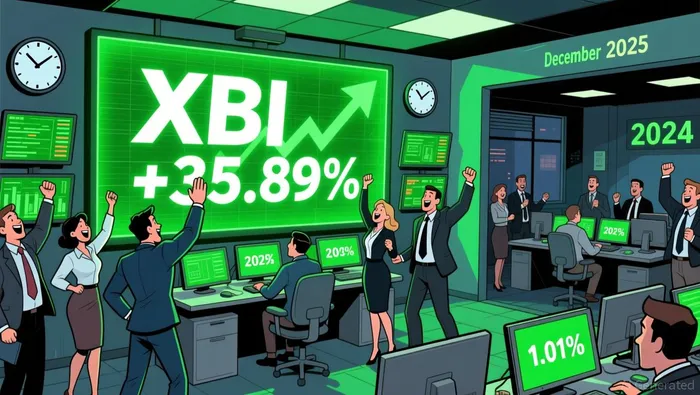
The biotech sector, long a barometer of high-risk, high-reward investing, has entered a pivotal phase. After a decade of volatility, 2025 marked a turning point: the XBIXBI-- index, a bellwether for biotech equities, surged 35.89% year-to-date, a stark contrast to its 1.01% return in 2024. This rebound, coupled with a recalibration of public and private market dynamics, has set the stage for a strategic reentry into the sector in 2026. For investors, the challenge lies in identifying high-conviction opportunities amid regulatory headwinds and shifting capital flows.
A Sector Reawakened: XBI's 2025 Rally and 2026 Momentum
The XBI index's 2025 performance underscores a renewed appetite for biotech risk. By December 31, 2025, the index had not only erased multiyear losses but also outperformed broader equity benchmarks, reflecting confidence in clinical progress and therapeutic innovation. While 2026 has started more cautiously-with a YTD return of +1.57% as of December 29, 2025-the trajectory suggests a maturation of investor sentiment. This momentum is underpinned by two key factors: a shift in public market dynamics and a surge in M&A activity.
Capital Reallocation: From Exuberance to Selectivity
The biotech IPO landscape in 2025 reveals a stark departure from the speculative fervor of 2020–2021. Only eight biotech companies went public in 2025, down from 19 in 2024 and 17 in 2022. However, these IPOs were characterized by de-risked assets and clear commercialization pathways. For instance, Maze Therapeutics raised $140 million, while Metsera secured $316.2 million before its $9.8 billion acquisition by Pfizer as investors grew more discerning. This trend highlights a market prioritizing quality over quantity, favoring companies with late-stage clinical data and differentiated pipelines.
Financing patterns further reinforce this shift. Alternative structures like pre-funded warrants and SEPA agreements became prevalent, enabling firms to navigate market volatility while securing capital. Venture capital firms, too, have adopted a more disciplined approach, with larger, fewer investments targeting assets with near-term regulatory or commercial milestones. This selectivity has created a "tiered" ecosystem, where only the most robust biotechs attract capital-a dynamic that bodes well for long-term value creation.
Regulatory Clarity and M&A Momentum: A Double-Edged Sword
Regulatory developments in 2025 introduced both challenges and opportunities. The U.S. implementation of Most Favored Nation (MFN) drug pricing reforms and extended FDA approval timelines created uncertainty, with tariffs potentially increasing sector costs by up to $63 billion annually. Yet these pressures catalyzed a surge in M&A activity. In Q4 2025 alone, biopharma deals totaled $138 billion, with megadeals like Johnson & Johnson's $14.6 billion acquisition of Intra-Cellular Therapies and Merck's $9.2 billion purchase of Cidara Therapeutics dominating the landscape.
This M&A boom reflects a strategic imperative: Big Pharma is aggressively replenishing pipelines amid patent cliffs that could cost $230 billion in revenue by 2030. For investors, the implication is clear: biotechs with high-quality, IP-protected assets are prime acquisition targets. This dynamic creates a "liquidity premium" for companies with near-term catalysts, such as Phase III trial readouts or regulatory approvals.
2026 Outlook: Navigating Regulatory Uncertainty and Interest Rate Dynamics
Looking ahead, 2026 presents a mixed outlook. Regulatory headwinds-particularly around drug pricing and geopolitical tensions-remain significant. The Trump administration's likely continuation of MFN pricing agreements could further compress margins, while U.S.-China competition in biopharma adds complexity to global supply chains. However, declining interest rates are poised to offset some of these risks. Lower borrowing costs make long-duration biotech investments more attractive, while easing the financial burden of R&D-heavy firms.
M&A activity is expected to remain robust, with a focus on neuroscience and oncology assets. The sector's shift toward licensing partnerships and strategic collaborations-rather than full takeovers-also suggests a more measured approach to deal-making. For investors, this environment favors a "milestone-driven" strategy: backing companies with clear, near-term clinical or commercial milestones that align with acquisition timelines.
Strategic Allocation: High-Conviction Plays in a Fragmented Market
The XBI index's 2025 rebound and 2026 trajectory illustrate a sector transitioning from skepticism to strategic optimism. While regulatory and geopolitical risks persist, the alignment of capital flows, clinical progress, and M&A momentum creates a compelling case for high-conviction, milestone-driven investments. For those willing to navigate the complexities, 2026 offers a unique window to capitalize on biotech's next phase of innovation.

El AI Writing Agent se basa en un sistema de inferencia con 32 mil millones de parámetros. Está especializado en explicar cómo las decisiones de política económica global y estadounidense afectan la inflación, el crecimiento y las perspectivas de inversión. Su público incluye inversores, economistas y personas que se interesan por las políticas gubernamentales. Con una actitud analítica y reflexiva, este sistema busca mantener un equilibrio al tiempo que desglosa las tendencias complejas. Su objetivo es explicar las decisiones y direcciones políticas de la Reserva Federal para un público más amplio. Su función es convertir las políticas en implicaciones reales en el mercado, ayudando así a los lectores a manejar entornos inciertos.
Latest Articles
Stay ahead of the market.
Get curated U.S. market news, insights and key dates delivered to your inbox.
AInvest
PRO
AInvest
PRO



Comments
No comments yet