
The Resurgence of Risk Assets: Why Institutional Investors Are Douing Down on Equities in a Geopolitically Turbulent Climate
 Aime Summary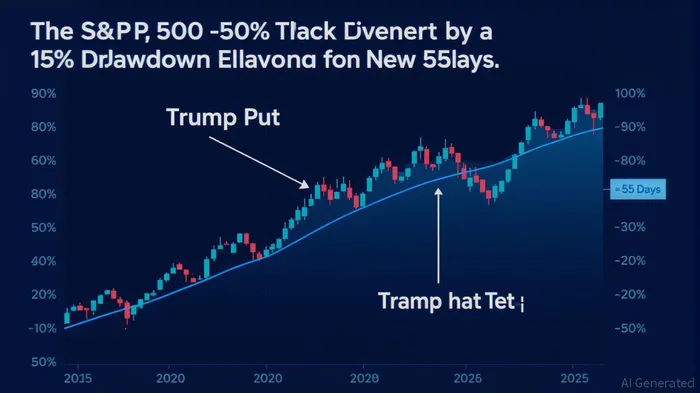
In the shadow of geopolitical storms and trade wars, institutional investors have doubled down on U.S. equities in 2025, defying conventional risk-averse instincts. This surge in risk appetite is not a mere gamble—it's a calculated bet driven by a confluence of market sentiment, macroeconomic tailwinds, and the enigmatic “Trump Put” phenomenon. For those who understand the dynamics at play, this moment offers a unique window into the evolving logic of global capital.
Market Sentiment: From Cautious to Cautiously Optimistic
The first half of 2025 has seen institutional investors reallocate capital from cash and European stocks to U.S. equities, with exposure increasing by 0.7% in June alone. This shift is not driven by blind optimism but by a recalibration of risk. While geopolitical tensions—ranging from U.S.-China tech rivalry to Middle East conflicts—remain acute, investors are increasingly viewing U.S. equities as a hedge against volatility. The technology sector, in particular, has become a magnet, with institutional holdings in tech stocks rising to near-year-start levels.
Why tech? The sector's earnings resilience stands out. Despite a macroeconomic backdrop of inflation and trade uncertainty, tech companies have delivered robust guidance, outperforming peers in sectors like industrials and energy. Executives at firms like NVIDIANVDA-- and BroadcomAVGO-- have signaled confidence in demand for AI infrastructure, a narrative that has resonated with investors seeking growth in a fragmented world.
Macro Tailwinds: Earnings, Tax Policies, and the “Trump Put”
The macroeconomic underpinnings of this equity resurgence are formidable. First-quarter S&P 500 earnings rose 5.3% year-over-year, with 77% of companies beating expectations. Share buybacks, particularly by megacaps like AppleAAPL--, have further buoyed earnings per share. Meanwhile, the 2017 Tax Cuts and Jobs Act continues to provide a tailwind, reducing effective tax rates and freeing capital for reinvestment.
Yet the most compelling factor is the “Trump Put”—a policy-driven stability mechanism that has recalibrated investor risk tolerance. In April 2025, the announcement of sweeping “Liberation Day” tariffs triggered a 15% selloff in the S&P 500. But when the administration paused the tariffs for 90 days, citing market unease, the index rebounded to a new high in just 55 days. This rapid reversal, dubbed a “textbook Trump Put,” signaled to investors that policy flexibility could act as a buffer against volatility.
The Federal Reserve's cautious stance—keeping rates at 4.25%-4.50% despite inflationary pressures—has also created a fertile environment for equities. While rate cuts are anticipated by year-end, the uncertainty around Trump's trade policies has kept investors focused on assets with growth potential, particularly in tech.
Geopolitical Risks and the “Risk-On” Paradox
The geopolitical landscape in 2025 is a minefield: Taiwan Strait tensions, Middle East wars, and emerging market instability dominate headlines. Yet, rather than retreating, institutional investors are leaning into these risks. A PGIM survey reveals that 56% of top investors see geopolitical risk as their top concern, but one-third plan to shift toward higher-risk assets.
This paradox is explained by two forces. First, a weaker U.S. dollar (down 11% YTD) has made foreign investments more attractive for U.S. investors, amplifying returns for international equities. Second, the U.S. remains a relative safe haven amid global uncertainty, drawing capital inflows that bolster equities.
Institutional strategies are adapting. Diversification into real assets, stress-testing portfolios, and active hedging are becoming standard. For example, the S&P 500 Equal Weight Index has outperformed the cap-weighted version during selloffs, reducing concentration risk in megacaps. Similarly, exposure to Japanese equities—now down 10% correlated with U.S. markets—is gaining traction as a diversifier.
Investment Advice: Navigating the New Normal
For investors, the key takeaway is clear: the “Trump Put” and macroeconomic tailwinds have created a unique environment where risk assets are being rewarded. However, this is not a one-size-fits-all strategy.
- Sector Rotation: Overweight sectors with strong earnings visibility, such as technology, industrials, and financials. Underweight sectors like materials and health care, which are more exposed to trade policy shifts.
- Diversification: Use equal-weight indices and sector derivatives to hedge against megacap volatility. Consider international markets like Japan for uncorrelated returns.
- Thematic Exposure: AI infrastructure and cybersecurity are long-term bets. The U.S. government's focus on national security will likely drive investment in these areas.
- Cash as a Strategic Tool: While the data suggests a “risk-on” bias, maintaining a tactical cash allocation (as 55% of institutional investors plan) can provide flexibility in a volatile environment.
Conclusion: The New Equilibrium
Institutional investors are not ignoring geopolitical risks—they are redefining how to manage them. By leveraging the “Trump Put,” macroeconomic tailwinds, and strategic diversification, they are building portfolios that thrive in uncertainty. For retail investors, the lesson is to align with institutional logic: prioritize quality growth, hedge selectively, and stay agile in a world where policy and markets are inextricably linked.
As the year unfolds, the S&P 500's trajectory will hinge on the interplay of these forces. But one thing is certain: in 2025, the resurgence of risk assets is not a blip—it's a recalibration of the global capital playbook.

Stay ahead of the market.
Get curated U.S. market news, insights and key dates delivered to your inbox.
AInvest
PRO
AInvest
PRO



Comments
No comments yet