
The Resurgence of Momentum ETFs: Is Momentum (MMT) the Next Big Play?


 Aime Summary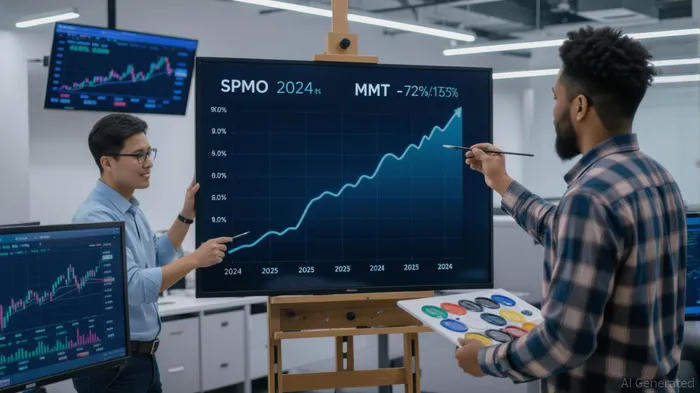
Market Structure Shifts: The Rise of Diversified, Low-Fee Strategies
The 2025 market has seen a structural shift toward value and defensive stocks, driven by macroeconomic uncertainty and a reevaluation of speculative growth bets. This trend has been amplified by the expansion of robo-advisors and tax-advantaged savings plans in Europe and Asia, which prioritize diversified, low-fee portfolios. These platforms, increasingly favored by retail investors, have redirected capital away from concentrated tech-heavy strategies like MMT and toward broader market exposure. For instance, SPMO's success-tracking the S&P 500 Momentum Index, which outperformed the S&P 500 by 30% in the 12 months ending June 2025-highlights the appeal of diversified momentum strategies in a risk-averse environment.
Retail Investor Behavior: From Speculation to Systematic Allocation
Retail investor behavior has also evolved, with a growing preference for options-based income strategies and automated investment platforms. This shift reflects a broader skepticism toward high-valuation tech stocks and a demand for more systematic, rules-based approaches. While MMT's concentrated exposure to AI-driven equities once aligned with retail enthusiasm for innovation, its recent underperformance has exposed the risks of overreliance on a narrow sector. In contrast, robo-advisors have capitalized on this trend by offering tailored, low-cost solutions that balance growth and risk management.
The Partnership Angle: A Strategic Pivot for MMT?
Despite the lack of an explicit 2025 partnership announcement between MMT and a major robo-advisor, the fund's challenges underscore the importance of such collaborations. Institutional investors, however, have shown renewed interest in MMT, with 1607 Capital Partners LLC increasing its stake by 84.7% in Q4 2024. This suggests that while retail capital is drifting away, institutional players see potential in MMT's strategy if it can adapt. A partnership with a robo-advisor could provide the necessary infrastructure to repackage MMT's momentum approach into a more diversified, fee-competitive product, aligning it with the preferences of modern retail investors.
The Road Ahead: Can MMT Reclaim Its Momentum?
The key to MMT's resurgence lies in its ability to navigate the structural shifts reshaping the ETF landscape. While SPMO's success demonstrates that momentum strategies remain viable, MMT's concentrated tech focus and recent underperformance pose significant hurdles. Retail inflows into crypto ETFs-such as XRPXRP-- and SolanaSOL-- products-further highlight the appetite for alternative, high-growth assets, a space MMT does not occupy. For MMT to thrive, it must either pivot toward a more diversified momentum framework or leverage a robo-advisor partnership to enhance accessibility and fee efficiency.
Conclusion
The momentum ETF space is far from obsolete, but its future belongs to strategies that align with the evolving priorities of both retail and institutional investors. While MMT's 2024 AI-driven rally was impressive, its 2025 struggles reflect the fragility of concentrated, high-valuation bets. The absence of a clear robo-advisor partnership announcement raises questions about its ability to adapt, yet the broader momentum ETF category-led by SPMO-remains robust. For MMT to become the next big play, it must either innovate its strategy or secure a strategic alliance that bridges the gap between its current structure and the demands of a post-quant easing landscape. Until then, investors may find safer harbor in diversified momentum alternatives.

Mezclando la sabiduría tradicional en el comercio con las perspectivas más avanzadas sobre criptomonedas.
Latest Articles
Stay ahead of the market.
Get curated U.S. market news, insights and key dates delivered to your inbox.
AInvest
PRO
AInvest
PRO



Comments
No comments yet