
The Resurgence of Meme Stocks: Are Retail-Driven Volatility and AI-Influenced Sentiment the New Norm?
 Aime Summary
In the summer of 2025, the stock market witnessed a surreal spectacle: Kohl's CorporationKSS-- (KSS) and OpendoorOPEN-- Technologies (OPEN) surged by 37.7% and 500%, respectively, in mere days. These price explosions, devoid of fundamental catalysts, underscored a new era in financial markets—one where retail investors, armed with social media and AI tools, have reshaped market dynamics. This article examines the interplay of behavioral finance, algorithmic sentiment, and institutional complacency in the 2025 meme stock frenzy, asking whether this trend signals speculative chaos or a democratized financial revolution.
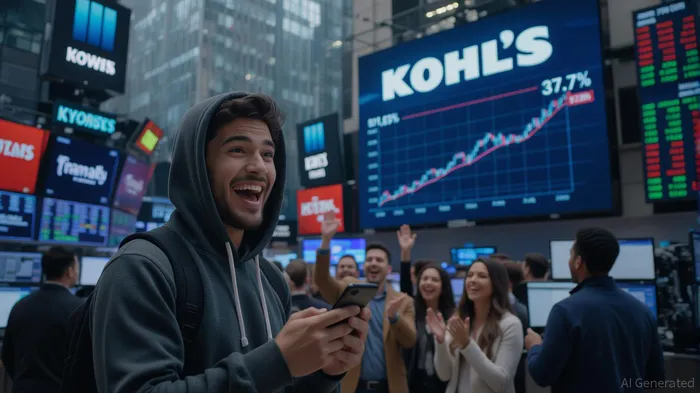
The Meme Stock 2.0 Surge: KSSKSS-- and OPEN as Case Studies
Kohl's and Opendoor's 2025 rallies were not driven by earnings reports or product launches but by retail-driven speculation. KSS, with a 49% short interest and a Goldman SachsGS-- price target hike (despite a “sell” rating), became a rallying point for WallStreetBets users seeking to trigger a short squeeze. Opendoor, burdened by a $85 million net loss and a 4.08 debt-to-equity ratio, saw its shares multiply by five as traders weaponized its narrative as a “real estate play.”
The metrics tell a story of artificiality: KSS's trading volume spiked to 207 million shares in one day (25x its 25-day average), while OPEN's hit 1.9 billion shares (1,700% of its three-month average). These numbers reflect not organic demand but a coordinated, meme-fueled stampede. As one analyst noted, “The fundamentals are a red herring; the market is now trading on sentiment, not sense.”
The AI-Social Media Nexus: Sentiment as a Tradable Asset
The 2025 meme stock cycle diverges sharply from the 2021 GameStopGME-- saga. Retail investors now wield AI-driven sentiment analysis tools to identify targets and time their moves. For instance, Krispy KremeDNUT-- (DNUT) shifted from bearish to “extremely bullish” sentiment within 24 hours, as AI algorithms detected a surge in Stocktwits and RedditRDDT-- posts. These tools, coupled with algorithmic trading bots, enable retail traders to act with unprecedented precision.
The result is a feedback loop: AI amplifies social media narratives, which drive buying pressure, which forces short sellers to cover, which further inflates prices. This dynamic has transformed meme stocks into a form of speculative warfare, where sentiment is both weapon and target. As Ihor Dusaniwsky of S3 Partners observed, “It's a tactical war zone where retail investors clash with short sellers in a high-stakes battle over stock price direction.”
Institutional Underestimation: The “Retail Is Dumb” Fallacy
Institutional investors have historically dismissed retail sentiment as irrational noise. Short sellers like Goldman Sachs and Jane Street bet heavily against KSS and DNUTDNUT--, assuming their fundamentals would drag prices down. Yet, the 2025 surges forced these institutions into a defensive posture, scrambling to revise price targets and cover positions.
This underestimation stems from a flawed belief in market efficiency—a theory that assumes prices reflect all available information. But in an AI-augmented retail era, information is no longer just financial data; it's sentiment, memes, and algorithmic narratives. Institutions that fail to account for this shift risk being blindsided by retail-driven volatility.
Speculative Froth or Democratic Innovation?
The debate hinges on whether this trend represents a bubble or a paradigm shift. On one hand, KSS and OPEN's surges lack fundamental justification. Kohl'sKSS-- Q1 2025 revenue fell 4.1% year-over-year, while Opendoor's operating cash flow remains negative. Their valuations are anchored to speculative narratives—such as “unlocking real estate value”—rather than earnings. This mirrors the dot-com bubble, where stories trumped substance.
On the other hand, the 2025 cycle reflects a democratization of finance. AI and social media have empowered retail investors to challenge institutional dominance, creating a more participatory market. This shift aligns with broader trends in decentralization, from crypto to decentralized finance (DeFi). As one WallStreetBets user quipped, “The streets are buying, and the suits are sweating.”
Investment Implications: Navigating the New Normal
For investors, the key is to balance participation with caution. Short-term traders may exploit meme stock volatility, but the risks are immense. KSS's gains have already reversed, while OPEN's 10.3% decline in late July 2025 underscores the fragility of these rallies.
Long-term investors should focus on fundamentals. The meme stock phenomenon is a symptom of a broader market shift, not a sustainable strategy. However, it also highlights the growing importance of sentiment in asset pricing. Even blue-chip stocks are not immune to AI-driven narratives, as seen in Tesla's (TSLA) social media-driven volatility.
Conclusion: The Future Is a Meme
The 2025 meme stock cycle is not an anomaly but a harbinger of change. Behavioral finance and AI-driven sentiment analysis have merged to create a new market structure, where narratives and algorithms dictate price movements as much as earnings reports. While this democratizes finance, it also introduces unprecedented volatility.
For investors, the challenge lies in adapting to this duality: recognizing the power of retail sentiment while anchoring decisions in fundamentals. The future of markets may be a meme, but the best strategies will blend the wisdom of crowds with the rigor of analysis. As the line between speculation and strategy blurs, one truth remains: in the AI and social media era, the crowd is no longer a force to be ignored—it is the market.

Stay ahead of the market.
Get curated U.S. market news, insights and key dates delivered to your inbox.
AInvest
PRO
AInvest
PRO



Comments
No comments yet