
The Resurgence of Local Retail: How Small Business Saturday is Driving Consumer Spending and Economic Recovery


 Aime Summary
A Generational Shift in Consumer Behavior
The 2025 American Express Shop Small Impact Study reveals . households plan to shop at small businesses during the holiday season, . This trend is most pronounced among Millennials and Gen Z, with . For investors, this signals a long-term realignment of retail demand. Regional retailers specializing in niche products-such as artisanal goods, locally sourced food, and bespoke services-are particularly well-positioned to capitalize on this shift.
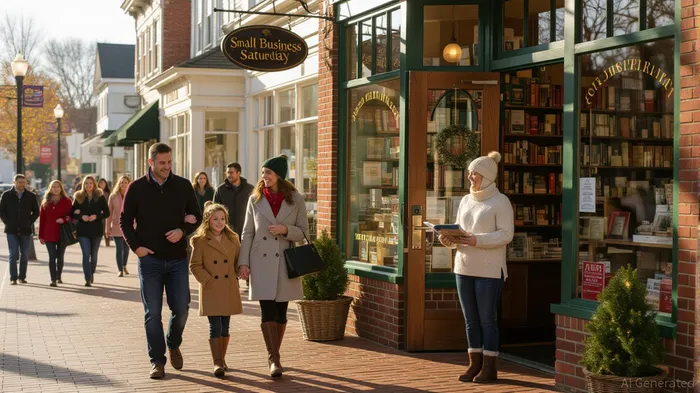
Case studies underscore this potential. For example, Backlot Flying Squirrel Coffee, a regional coffee roastery, leveraged e-commerce and social media to expand its customer base beyond its home state of North Carolina, . Similarly, Laurel & Ash, a New York-based food gift company, after optimizing its TikTok and Instagram presence. These examples highlight how digital integration is transforming small businesses into scalable regional brands.
Small Business Banking: A Catalyst for Growth
The financial infrastructure supporting small businesses is equally compelling. The Consumer Bankers Association's "Small Business Spotlight 2025" campaign illustrates how regional banks are adapting to this new retail landscape. By promoting SBA 7(a) loans and other tailored financial products, banks are not only facilitating business expansion but also creating a pipeline of high-growth opportunities for investors. For instance, , driven by demand for inventory financing and digital payment upgrades.
Moreover, fintech solutions are emerging as critical enablers. The 2025 Bank of America Business Owner Report notes , a trend that benefits fintech firms offering point-of-sale systems, AI-driven marketing tools, and cloud-based accounting platforms. Investors in companies like Square or PayPal may find indirect exposure to this growth, but niche fintechs focused on small business needs-such as Klarna's Buy Now, Pay Later (BNPL) solutions-present more targeted opportunities.
Measuring the Economic Ripple Effect
The economic impact of Small Business Saturday extends beyond immediate sales. According to the U.S. Small Business Administration, 67 cents of every dollar spent at a small business stays within the local community, . This multiplier effect is particularly significant in rural areas, where . For example, , which directly funded the hiring of two local employees and indirectly supported suppliers like a nearby dairy farm.
Investors can capitalize on this by targeting regional retail chains with strong community ties. . These companies often operate with leaner margins but offer higher customer loyalty, making them attractive for impact-focused investors.
Challenges and Mitigation Strategies
Despite the optimism, challenges persist. Rising costs and supply chain disruptions remain top concerns for small businesses, . However, , suggesting resilience through innovation. For investors, this underscores the importance of backing businesses that prioritize cost optimization and digital agility.
Conclusion: A Strategic Investment Horizon
Small Business Saturday 2025 has proven to be more than a shopping event-it is a barometer of economic resilience and a gateway for investors seeking exposure to high-growth, community-driven sectors. From regional retailers leveraging e-commerce to banks offering tailored financial products, the opportunities are both diverse and measurable. As consumer spending continues to shift toward local businesses, the time to act is now.

Delivering real-time insights and analysis on emerging financial trends and market movements.
Latest Articles
Stay ahead of the market.
Get curated U.S. market news, insights and key dates delivered to your inbox.
AInvest
PRO
AInvest
PRO



Comments
No comments yet