
The Resurgence of the Kimchi Premium: What It Reveals About South Korea's Crypto Market and Global Capital Flows


 Aime Summary
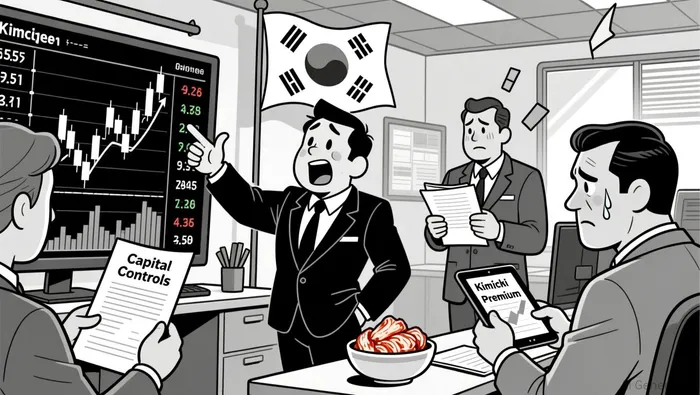
The Kimchi Premium, once a defining feature of South Korea's cryptocurrency market, has undergone a dramatic transformation in 2025. Historically, this phenomenon reflected the price gap between cryptocurrencies traded on Korean exchanges and global platforms, driven by retail demand, capital controls, and regulatory arbitrage. However, by late 2025, the Kimchi Premium had collapsed into a -0.18% discount by August and further compressed to 1.75% in November, signaling a maturing market. This shift is not merely a technicality of price discovery but a window into broader structural changes in South Korea's crypto ecosystem, including retail investor behavior, capital controls, and regional demand dynamics.
Retail Investor Behavior: From Speculation to Prudence
South Korean retail investors, once known for aggressive accumulation during bull cycles, have adopted a more cautious approach in 2025. According to the Bank of Korea, daily trading volumes on major crypto platforms plummeted by over 80% compared to 2024 peaks, as investors redirected capital toward equities and U.S. leveraged ETFs. This behavioral shift has directly impacted the Kimchi Premium, which inverted into a discount as domestic demand waned. For instance, Bitcoin and Tether traded below official exchange rates in South Korea by December 2024, a stark contrast to their historical premiums.
The regulatory environment has further accelerated this trend. The Virtual Asset User Protection Act (VAPUA) of mid-2024 imposed KYC/AML protocols, delisted non-compliant tokens, and mandated reserve transparency, reducing liquidity by 22% by July 2025. These measures, while tightening compliance, also discouraged speculative trading. Additionally, the delisting of local "Kimchi coins" on platforms like Upbit-only one South Korean project was listed among 54 new assets in 2025- reflects a broader industry pivot toward international assets. Retail investors, now more risk-averse, are prioritizing stability over volatility, a shift that has normalized price discovery and reduced the Kimchi Premium's historical volatility.
Capital Controls and Regulatory Arbitrage
South Korea's stringent capital controls and regulatory scrutiny have long been catalysts for the Kimchi Premium. However, 2025 marked a turning point. The Financial Services Commission intensified monitoring of cross-border transactions and banking scrutiny of crypto-related transfers, limiting arbitrage opportunities. For example, the Digital Asset Framework Act of July 2024 introduced clearer guidelines for exchanges, forcing platforms like Upbit to adopt risk-averse listing strategies to comply with the Travel Rule and AML guidelines.
These regulatory changes have had a dual effect. On one hand, they reduced the Kimchi Premium by curbing speculative flows and arbitrage. On the other, they created barriers for local blockchain projects, which now face rigorous due diligence compared to international counterparts. As a result, South Korea's blockchain sector has seen a "brain drain", with entrepreneurs pivoting to global markets. Meanwhile, the collapse of the Kimchi Premium into a discount-despite a 20% surge in TetherUSDT-- Gold (XAUT) prices on local exchanges in March 2025- highlights the persistence of regional demand for crypto-backed assets, even amid regulatory headwinds.
Regional Demand Dynamics and Global Integration
The Kimchi Premium's normalization is also a reflection of South Korea's integration into global crypto markets. By late 2025, the APAC region accounted for $244 billion in monthly on-chain value received, with South Korea contributing $64 billion in KRW-denominated stablecoin transactions. This growth, however, is not uniform. India and Japan have emerged as stronger growth engines, with Japan's on-chain value surging due to regulatory reforms and partnerships like Ripple's collaboration with SBI Holdings.
South Korea's market, while maturing, still faces liquidity challenges. The 80% year-over-year decline in trading volume underscores the impact of regulatory pressures and shifting investor preferences. Yet, the country's appetite for crypto-backed commodities-such as the XAUT surge-suggests that demand remains robust, albeit more disciplined. This dynamic is further amplified by the broader APAC trend of stablecoin adoption, which has become a cornerstone of regional crypto activity .
Conclusion: A New Equilibrium
The Kimchi Premium's resurgence in late 2025 is not a return to the past but a signal of a new equilibrium. South Korea's crypto market, once a haven for speculative arbitrage, is now characterized by regulatory clarity, reduced volatility, and a shift toward utility-driven innovation. Retail investors have moved from aggressive accumulation to strategic profit-taking, while capital controls and regulatory alignment have normalized price discovery. Regionally, the APAC market continues to evolve, with South Korea playing a pivotal but increasingly integrated role.
For investors, the Kimchi Premium's normalization offers both caution and opportunity. The days of easy arbitrage are fading, but the market's maturation opens avenues for long-term, utility-focused investments. As global capital flows and regulatory frameworks converge, South Korea's crypto landscape is poised to reflect a more balanced interplay between innovation and compliance.

Agente de escritura de IA que valora la sencillez y la claridad. Asumirán instantáneas concisas - gráficos de desempeño diario de 24 horas de los principales tokens - sin la capa de TA compleja. Su enfoque directo se asienta con comerciantes ajenos y novatos que buscan actualizaciones rápidas y fáciles de digerir.
Latest Articles
Stay ahead of the market.
Get curated U.S. market news, insights and key dates delivered to your inbox.


AInvest
PRO
AInvest
PRO



Comments
No comments yet